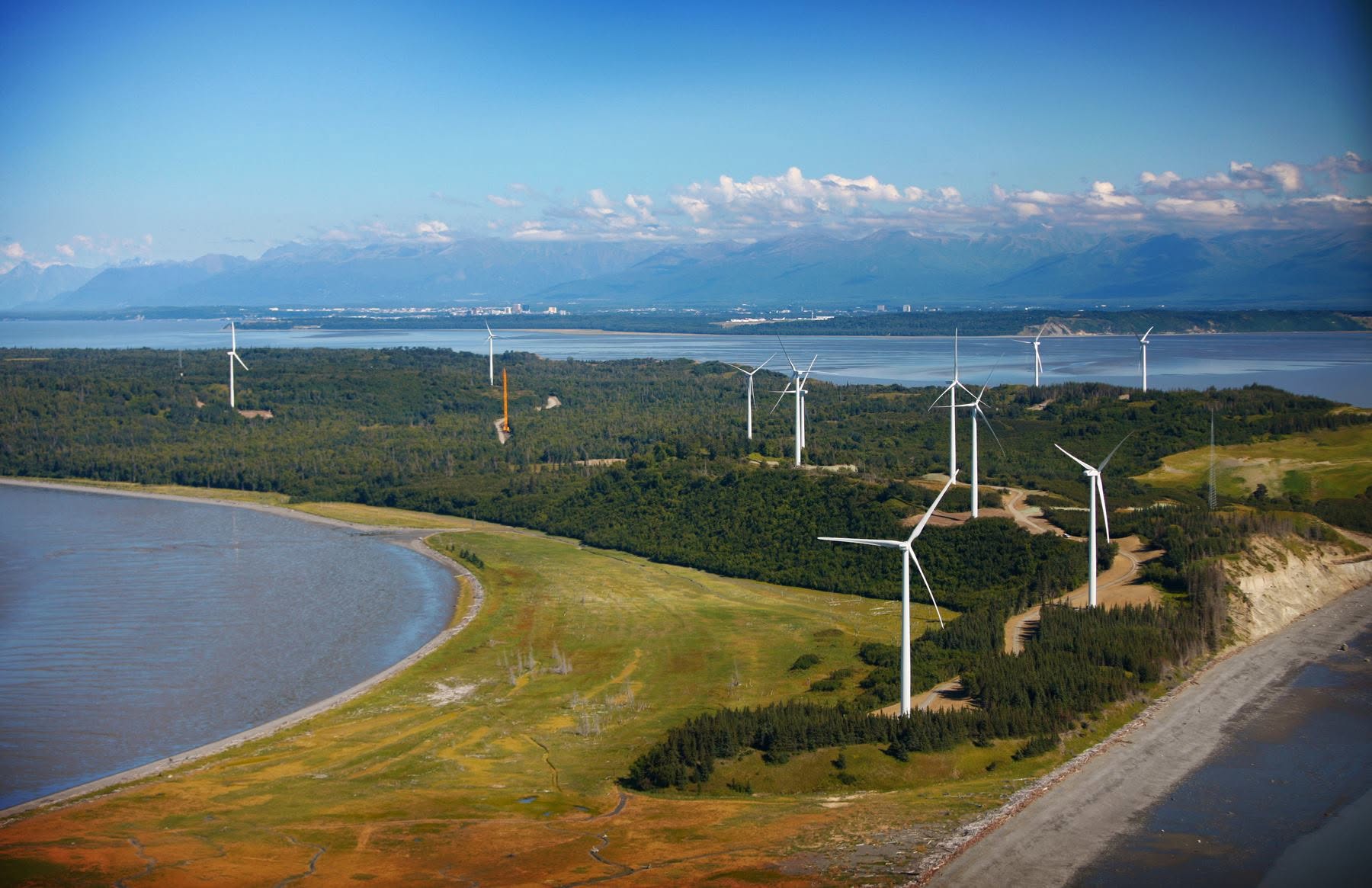
Suzanne Settle spent more than a decade getting eleven wind turbines onto an island off Anchorage, and she has never been shy about what the effort meant to the company that made it possible. Settle, who led the work and later became vice president of Cook Inlet Region, Inc (CIRI), called Fire Island Wind “the first project CIRI developed and constructed on its own.”
CIRI is one of 12 land-based Alaska Native regional corporations formed under the Alaska Native Claims Settlement Act. Incorporated in 1972 and owned by Alaska Native shareholders, CIRI has paid out more than $1.3 billion in cumulative distributions to date. It owns most of Fire Island, which CIRI places three and a half miles off Anchorage’s west coast. Building and running a power plant was new ground, as Southcentral Alaska’s first utility-scale wind farm.
Getting there took more than a decade of planning, including the removal and rebuilding of a navigational aid serving Ted Stevens Anchorage International Airport. The Federal Aviation Administration had cleared only a reduced version of the project in 2008, concerned that the turbines would interfere with a radio beacon on the island, so CIRI paid to build a replacement beacon elsewhere and won full approval.
Finding someone to buy the power took nearly as long. CIRI had planned as many as 33 turbines, and the project was scaled back to 11 as it worked to secure utilities’ commitments. Finally, Chugach Electric Association, which serves Anchorage, signed a 25-year contract with CIRI at 9.7 cents per kilowatt-hour, and the Regulatory Commission of Alaska approved it in October 2011. Production started the following September.
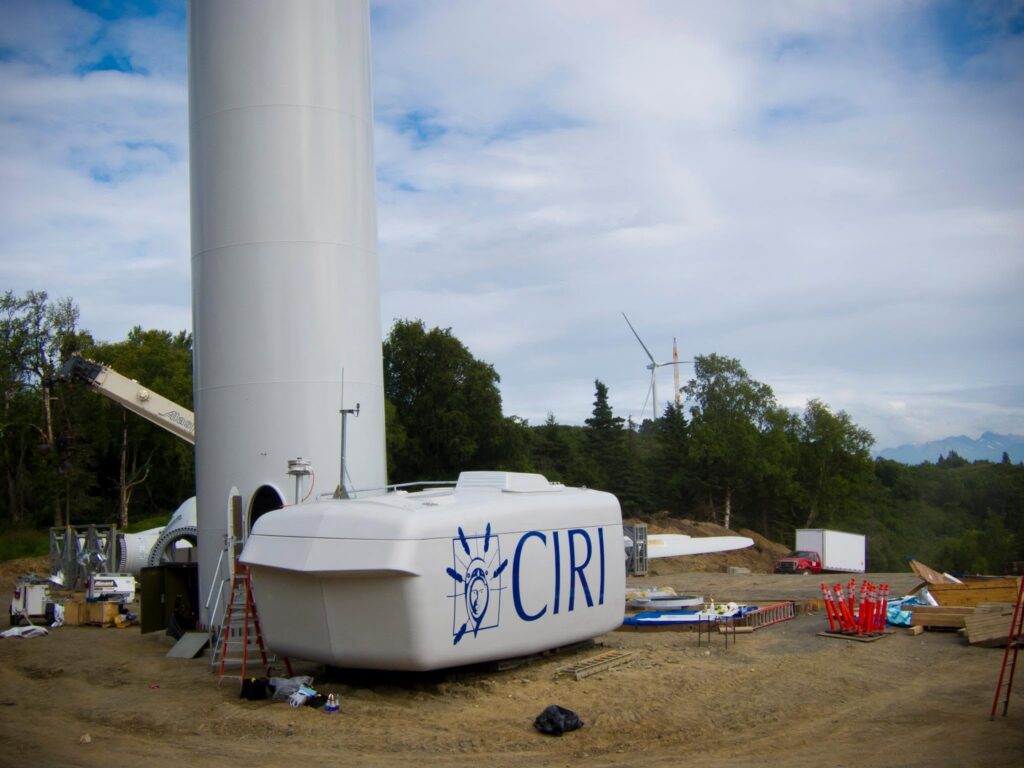
Photo Courtesy Fire Island Wind
The project has run continuously ever since, Chugach reports, at an annual capacity factor of about 32%. The 11 General Electric XLE turbines produce roughly 49,000 megawatt-hours a year. “For reference, the average Chugach residential member uses approximately 6.3 MWh per year, so the project’s annual energy production is equivalent to more than 7,500 households,” Chugach explained.
The machines have been remarkably steady. In a November 2020 presentation to the Department of Energy, CIRI estimated total lifetime generation through that October above 400,000 megawatt-hours, natural gas burn avoided above 3,346,747 thousand cubic feet (Mcf), 183,629 metric tons of carbon avoided, and turbine availability at 99.76%. That performance settled any doubts about the ability of wind power on a barren island that were raised in the early stages of the project, which the Anchorage Daily News notes were widespread.

Photo Courtesy Fire Island Wind
Construction cost roughly $65 million, and most of the line connecting the island to the road-system grid was funded with a $25 million grant appropriated by the State Legislature in 2008. Chugach’s power averaged about 6 cents per kilowatt-hour when the turbines came online, Alaska Public Media reported, putting the wind roughly 3.7 cents higher upfront than traditional energy sources, which sparked some criticism. At the time, Chris Rose from the Renewable Energy Alaska Project explained, “Wind power is a very mature resource around the world. And for us to finally be getting it in the Anchorage area is a boon, because I think people understand now that it is something that is happening other places, it’s not something that is going to happen in the future.”
Fourteen years later, that cost gap has inverted. John Sims, president of Enstar Natural Gas Co., the region’s main gas utility, explained the volatility to the Alaska Beacon in July 2026 and expressed concern about not only the supply of gas, but at a reasonable cost. Chugach has warned that liquefied natural gas imports could start in 2028, when its own supply contract runs out, which officials estimate could add about 10% to customers’ bills.
On the other hand, the Fire Island’s price for wind power does not move. Although it is still slightly more expensive than other sources of power in the utility’s portfolio, Chugach describes the contract on its own website as “hedge against future increases in the price of natural gas” that “helps stabilize the cost of electric service to members.” In total, it saves the utility company $2.4 million against the roughly $4.8 million it spends on power each year. Moreover, Julie Hasquet, a spokeswoman for Chugach Electric, told the Anchorage Daily News that the extra cost to individual households is well below $1 on the average bill. Plus, the company sells the resulting Renewable Energy Certificates from the project to offset cost.
The benefit, the utility says, is that the project has “increased our capability to integrate new renewable energy resources and diversify our generation portfolio while maintaining safe, reliable, and affordable electric service to Chugach members.”
CIRI has been ready to build more for a long time. The island was laid out for 33 turbines in three strings of 11, and the company has called a second string “shovel ready” because the transmission capacity, roads, switchgear, and maintenance building are already in place. When utilities passed on that second phase in 2015, Suzanne Gibson, then CIRI’s senior director of energy development, said the company was not walking away. “We’re not giving up on the utilities,” Gibson told the Anchorage Daily News.
The eleven that are there get tended. Operations manager Christopher Jimenez compared the upkeep to keeping a car running. The towers themselves, he said, could carry new blades and bigger turbines as the technology improves. “They’ll be here forever,” Jimenez said.
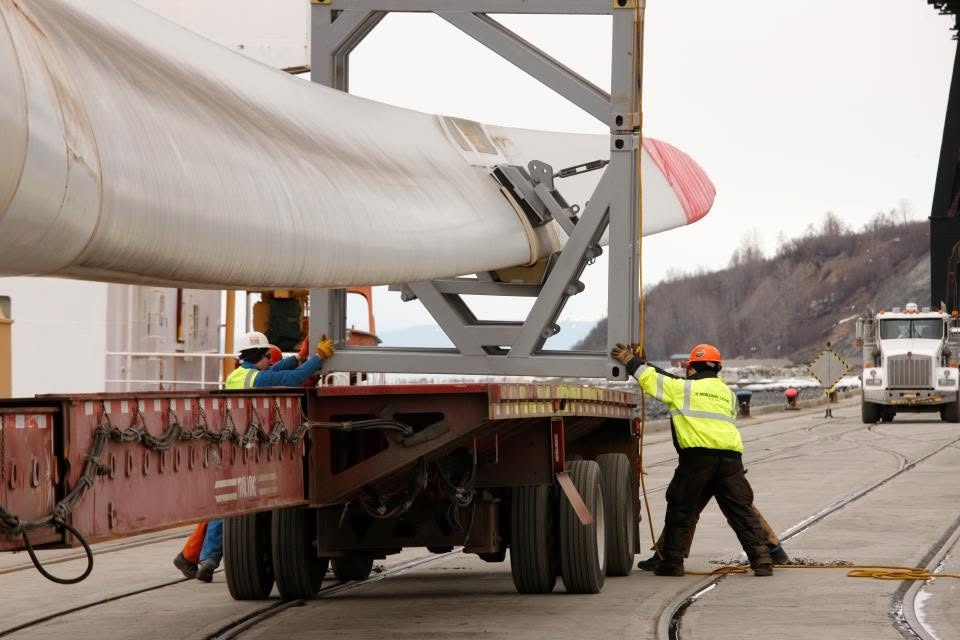
Photo Courtesy Fire Island Wind