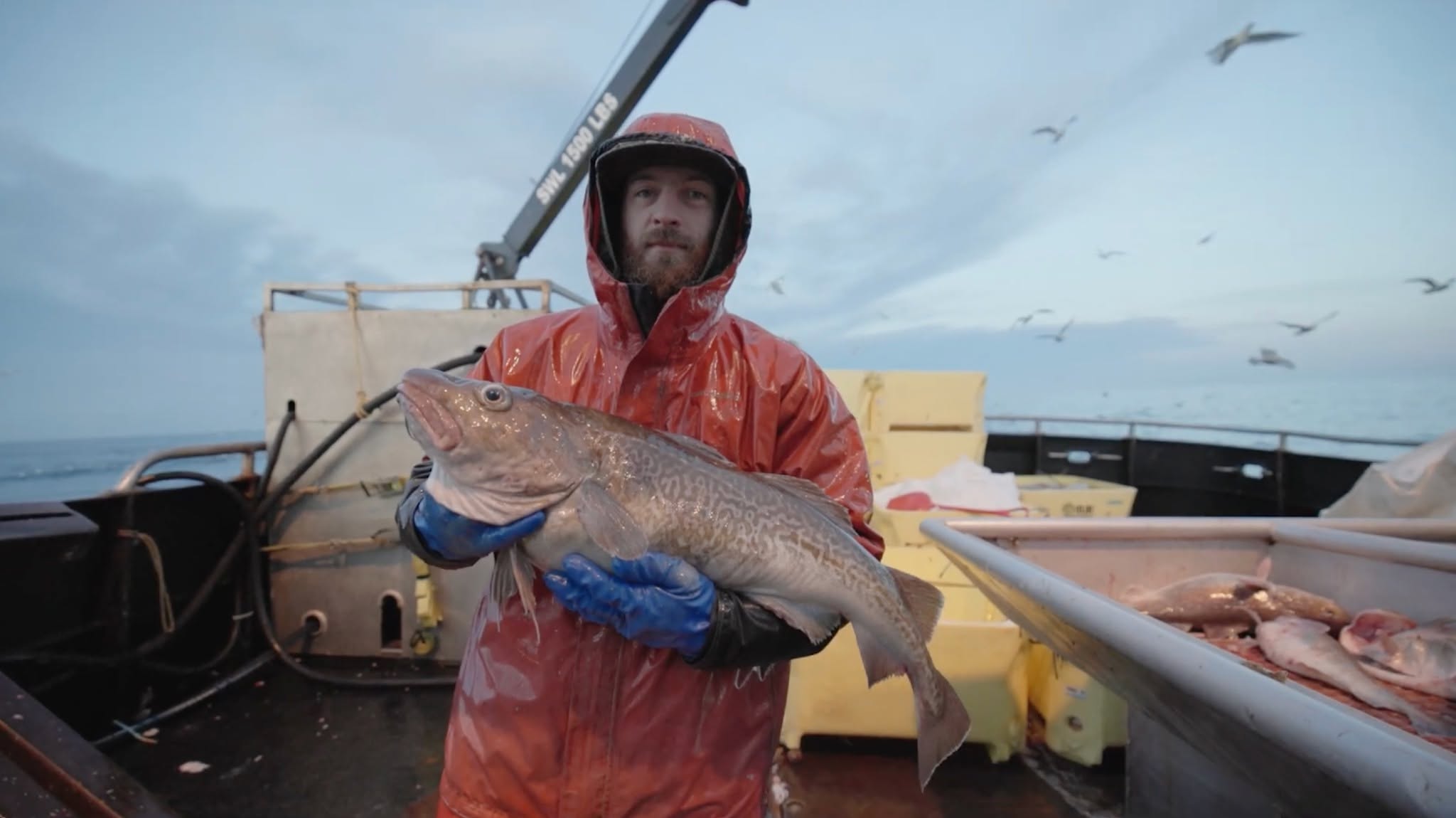
Erik Velsko started fishing as a child with his father, John, in Homer, Alaska; by age 17, he worked on an opilio crab boat in the Bering Sea, and he’s made his living on the water ever since. Pacific cod prices fell to $0.25 a pound when the 2024 season opened, a figure Velsko described in National Fisherman as “the lowest I’d seen since I was a teenager.” At the same time, he noted, fuel ran in the high $4-per-gallon range, and bait cost more than $1 per pound. “Costs of goods and services were so high, and the price of fish so low, that no amount of fish could make up for the difference,” Velsko wrote.
He was not alone. Alaska’s seafood harvest was worth $1.3 billion at the dock in 2024, down 19% from the year before, and Pacific cod dropped the lowest by 36%, the State of Alaska reported. The market has improved since then. In May 2025, seafood supplier Tradex Foods reported that buyers competed for a tight supply, driving up prices for Alaska cod.
Erik and his wife, Lacey, who also comes from a Homer fishing family, run Kaia Fisheries LLC and sell their catch under the Kaia Seafoods brand. The couple bought the F/V Kaia in the fall of 2019. Erik wrote in National Fisherman that in late August 2024, Kaia Fisheries “made the decision to get off the hamster wheel.” Rather than chase more pounds, the family set out to get more from each fish. “It is not about catching more fish. It is about making each fish worth more,” Erik told KAPP, the company that supplied the boat’s new chilling system.
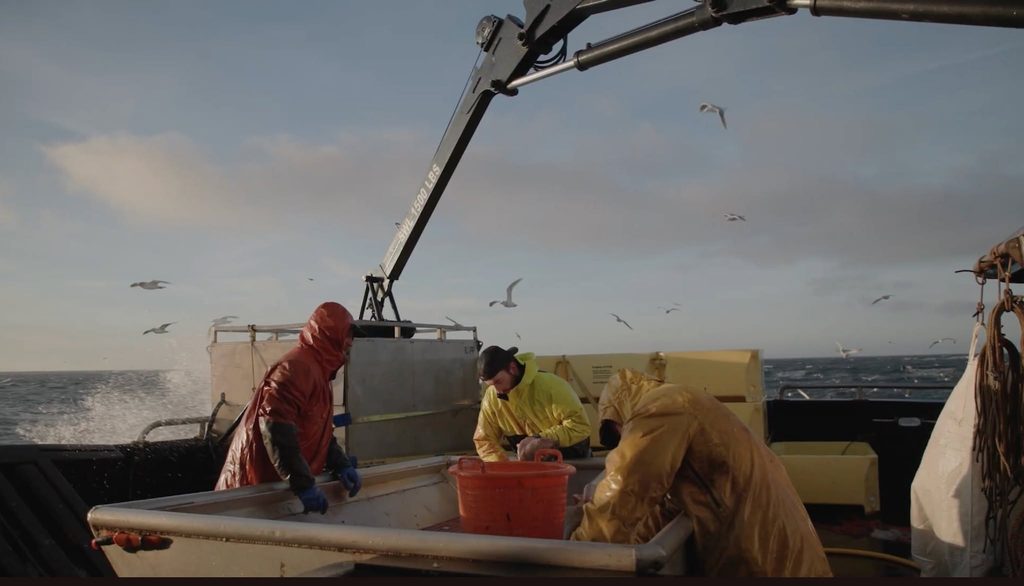
Photo Courtesy Sæplast
The model came from Iceland. Erik told National Fisherman that cod paid Alaska fishermen 40 cents a pound when he entered the Alaskan fishery, and that a visit to Iceland showed him boats there were paid $1.67 a pound. “Harvesters in Alaska were getting nearly 10 times less than their Icelandic counterparts,” he remembered. “In Alaska, we still tend to measure our success in pounds. In Iceland, they measure it in value,” Erik explained after a 2025 trip there, in The Quality Line, a newsletter he contributes to.
Under its old routine, the Kaia’s crew stored ungutted cod in a refrigerated seawater (RSW) tank, the Icelandic research institute Matís reported in a study of the boat’s catch. Under the new routine, the crew bleeds and guts each fish as soon as it comes aboard, then places it in insulated plastic tubs from Sæplast packed with slurry ice from an onboard KAPP system. By the time the liquid drains out of a tub, Erik noted in a video of the operation, the fish “should be down to 31°.” As Lacey told KAPP, “Alaska cod is already an exceptional product. Our job is to protect that quality from the moment it comes on board.”
To measure the difference, Kaia worked with Matís on a side-by-side test funded through a U.S. Department of Agriculture Value-Added Producer planning grant. Fish from the same haul out of Dutch Harbor in January 2025 went into either the old tank or the new tubs, then to a Seattle lab whose experts scored samples without knowing which group they came from. Five hours after catch, the tank fish measured 33.9°F at the core, while the slurry-ice fish measured 30.0°F; at landing, the temperatures had reached 31.9°F and 29.8°F, respectively, indicating a more rapid cooling process for the slurry ice group. The tank fish fell below the panel’s freshness threshold around the eighth or ninth day after catch, while the slurry-ice fish stayed above it through day 14. Matís concluded the new method kept the cod fresh about six days longer and extended its shelf life by at least five days. Because the comparison used carefully handled tank fish, the researchers noted that “in real-world conditions, the difference between these methods may be even more pronounced.” Erik told KAPP, “What stood out immediately was how fast and consistent the cooling is. You are not guessing anymore. You know the fish is being treated the same way every time.”
The tubs also remove a step. Alaska boats often pump fish out of RSW holds, sometimes twice before the catch reaches a processor, a practice the Matís report says damages fish and warms them. The researchers also credit two features of the new routine: gutting right away removes a leading source of spoilage bacteria, and separate tubs of about 300 kilograms (roughly 660 pounds) keep fresh fish from mixing with older catch in one large tank. Work on the deck changed, too.
Better handling also means more of each fish can be used. Erik remembered that at times “nearly 80 percent of the cod Kaia catches ends up in low-value markets, fish meal, or outright waste,” but that Icelandic processors recover close to twice as much fillet from each fish. “We should be looking to maximize every pound of fish or protein that’s coming out of Alaska instead of just trying to move big volumes,” he said to Sæplast.
Video Courtesy Sæplast
“When the fish comes out of the water, that’s when the clock starts. Everything you do after that either protects the quality or reduces it,” Erik told KAPP. “There is less manual work involved. You are not shoveling ice or trying to manage it throughout the trip. The system does the work for you. It simplifies things. It makes the whole operation more efficient.”
That efficiency translates into reliability. “On deck, the system has to work. The tubs, the ice, and the handling all have to fit the rhythm of the boat,” the Kaia’s captain, Murray Gamrath, said. When the first tubs reached the dock in January 2025, Erik wrote that the family was “looking at improved prices, reduced fuel costs, and a list of other positive shifts.”
The payoff shows up in price. “We are getting three times the dock price,” Erik told National Fisherman. “We are catching less fish, but we are providing premium-quality fish.” Ultimately, he concluded, “When you deliver a better product, the market responds.”
Photo Courtesy Sæplast
The company’s cod is certified by the Marine Stewardship Council and labeled Product of USA, and home cooks can order portions through Whidbey Island Seafoods, which says each one can be traced back to the F/V Kaia and the specific spot where it was caught.
The industry has taken notice. In 2025, National Fisherman named Erik one of its Highliners, an honor its editors have awarded every year since 1975. Erik called the first delivery under the new system “a dream-turned opportunity. For my family, our crew, our fishery, and for Alaska.”
For Erik, the change comes down to how a fisherman treats the catch. “When you’re harvesting someone’s food, it deserves your full respect,” he said. Ultimately, he summarized, “We don’t want an industry that is just going through the motions to get the job done. We want an industry always striving for excellence. That is an industry that breeds innovation and change and brings new people who are excited and energized by the work.”