Brandon Small spent 11 years on a swing shift running a dragline at the coal mine in Colstrip, Montana, before leaving to find work tied to the land. “I got tired of robbing from the land,” he told Drovers.
He turned to the land he knew. Small is an enrolled member of the Northern Cheyenne Tribe, whose reservation in southeastern Montana has kept a buffalo herd since the 1970s. Early on, Nebraska buffalo producer T.R. Hughes donated 14 animals and later 10 more, and by 2014 the herd had grown to about 160 animals on a pasture with fencing along only part of its boundary. That spring, poachers killed an estimated nine of the animals.
When COVID-19 hit, Small started going out to the herd on his own, mending fences and bringing feed while he lobbied the tribal council to adopt a management plan. “I spent a lot of time out there on my own, out of my own pocket,” he told The Daily Yonder.
The animals needed help. “Seeing them go unmanaged and treated poorly, malnourished, no water; they were traveling 10, 15 miles a day for water,” Small told KPAX in 2023. “I decided I couldn’t just stand by and watch our buffalo be neglected and decided that somebody needed to do it,” he added. He submitted a multi-year plan to the tribal council in January 2023, and the tribe hired him that March as its first buffalo manager in years. Small also coauthored the U.S. Department of the Interior’s Bison Shared Stewardship Strategy, a national framework for bison restoration released in October 2024.
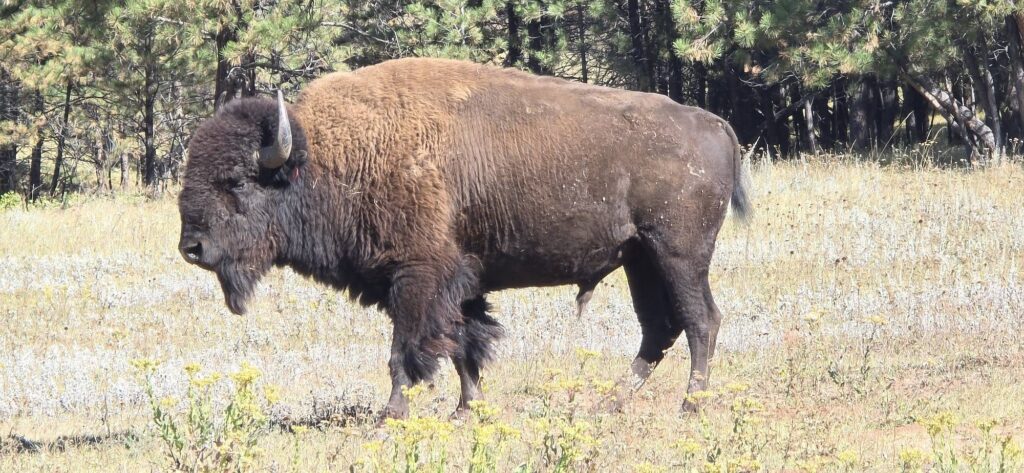
Photo Courtesy Brandon Small
Left on its own, the herd wandered across roughly 20 square miles of tribal and neighboring land, wearing on the range and on goodwill with nearby landowners. “They were tearing up fence lines and water tanks from Highway 212 all the way 20 miles south of here,” Small told Drovers. The animals, which descend from Yellowstone stock, needed a home of their own.
That home now covers 15,244 acres near Lame Deer, according to the U.S. Department of Agriculture’s Natural Resources Conservation Service (NRCS). Working with the agency, the tribe built fencing to buffalo specifications, which differ from those for cattle, plus new watering facilities and a livestock pipeline, so the herd and neighboring ranchers could share the land. “The first project of the buffalo ranch was 22 miles of fence, 7′ tall, seven strand fence,” NRCS Tribal Conservationist Kathy Knobloch told Drovers.
The land has responded. “We have so much more grass out there for them now, so much more water for them,” Small said, adding that other wildlife has started coming back. The herd keeps moving, so the grass is not being overgrazed. “I am totally, 100% convinced that bison are the natural regenerators of the soil and land,” he told KPAX.
Electricity was harder. No transmission lines cross the pasture, so any power there has to be made off the grid. For years, that meant diesel generators.
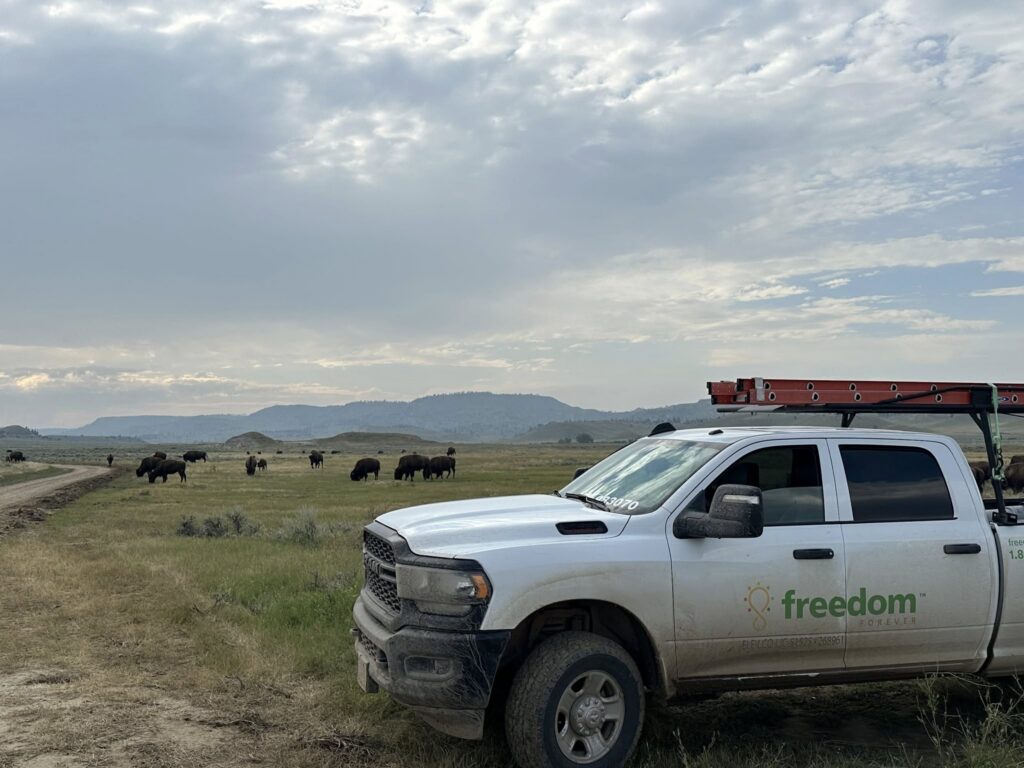
Photo Courtesy Brandon Small
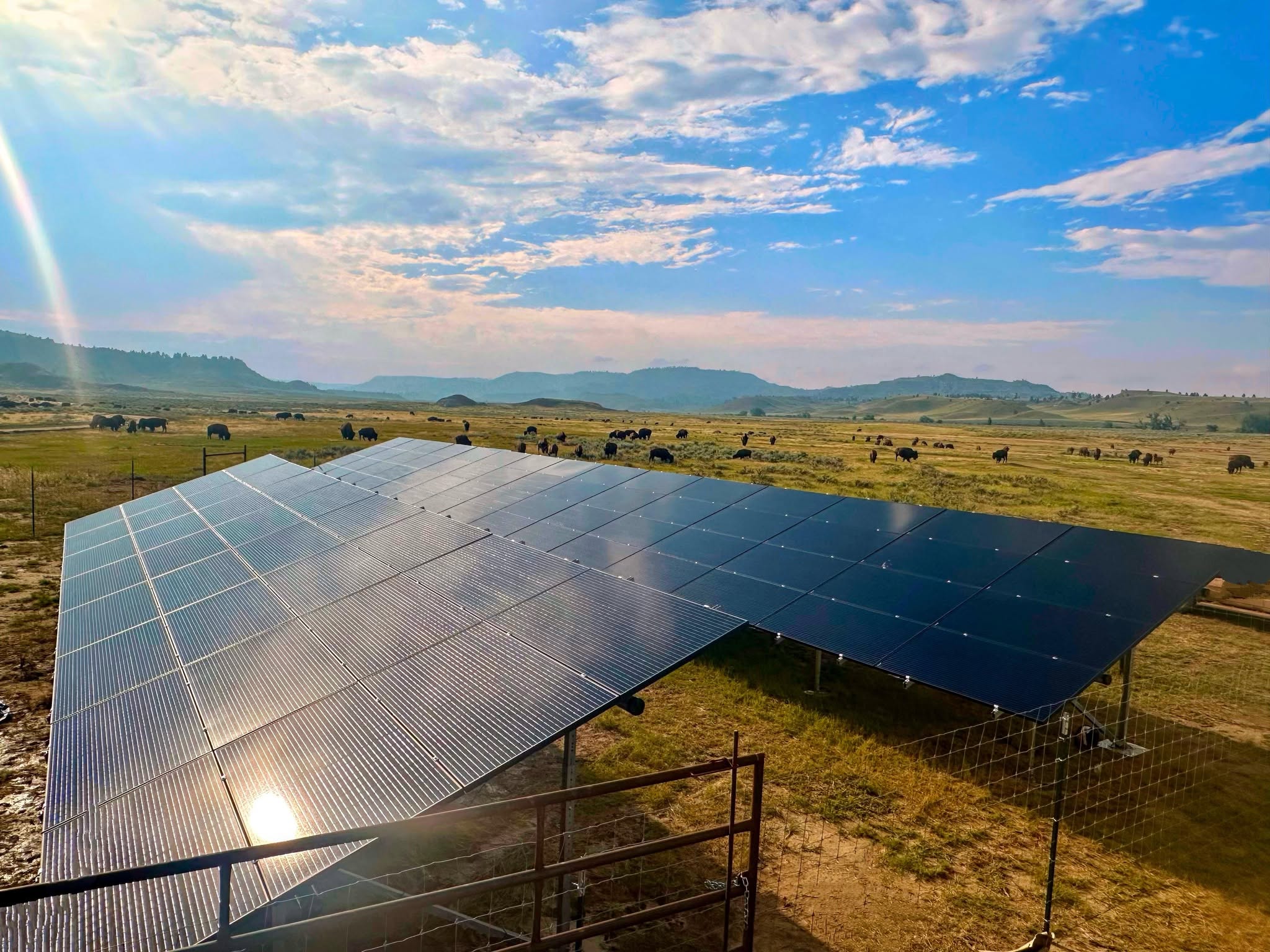
In 2025, a 36-kilowatt off-grid solar array paired with 58 kilowatt-hours of battery storage replaced those generators, after nearly two years of work, according to Indigenized Energy, the Native-led nonprofit that developed the project with installer Freedom Forever and major funding from the Honnold Foundation and Empowered by Light. The system cost about $250,000, all of it raised from private donors. An on-site operations building houses some of its critical components and gives tribal members a place to stay.
“There were no utility lines that went anywhere in the area or where their buffalo roamed,” Cody Two Bears, founder and CEO of Indigenized Energy, told Solar Builder. Getting the equipment in took work. The long dirt road to the pasture turned to mud when it rained, so Small’s crew graded it to let the delivery through.
The setup has three working parts: the panels produce electricity, the batteries hold it, and the inverters send it out to the ranch’s equipment. The battery carries the ranch through the night. It stores solar energy for use after sunset and during cloudy stretches, and its 58 kilowatt-hours could run an average U.S. home for about 48 hours. That matters on a ranch where a freezer full of meat and an electric fence need power around the clock, not only while the sun is up.
That stored power runs the bunkhouse’s mini-split air conditioner, a Starlink connection, a freezer stocked with processed buffalo meat, and electric fences and gates that guard against intruders, especially poachers. The system also powers a hydraulic buffalo chute and a shed that gives the crew a place to escape the heat and cold, so the four-wheelers used for herding no longer have to be hauled out daily. Solar Builder named the project one of its 2025 Projects of the Year, in the under-100-kilowatt category.
Swapping diesel for stored solar ended the ranch’s dependence on diesel fuel and generator maintenance, along with the recurring costs that came with them. It also spared the tribe the cost of a new grid connection. The equipment has to handle both ends of Montana weather. “In the summertime, it gets extremely hot out there, but then in the wintertime, it gets extremely cold,” Freedom Forever senior electrical applications engineer Craig Ells told Solar Builder.
“By running the buffalo facility off-grid, we’re proving that our Nation can meet modern needs while honoring the ways of our ancestors,” Small said in an Indigenized Energy announcement.
The model is spreading. The Honnold Foundation, which partnered with Indigenized Energy in 2023 to commission the ranch’s microgrid, has announced a multi-year partnership with the group to build similar solar installations across five Native Nations.
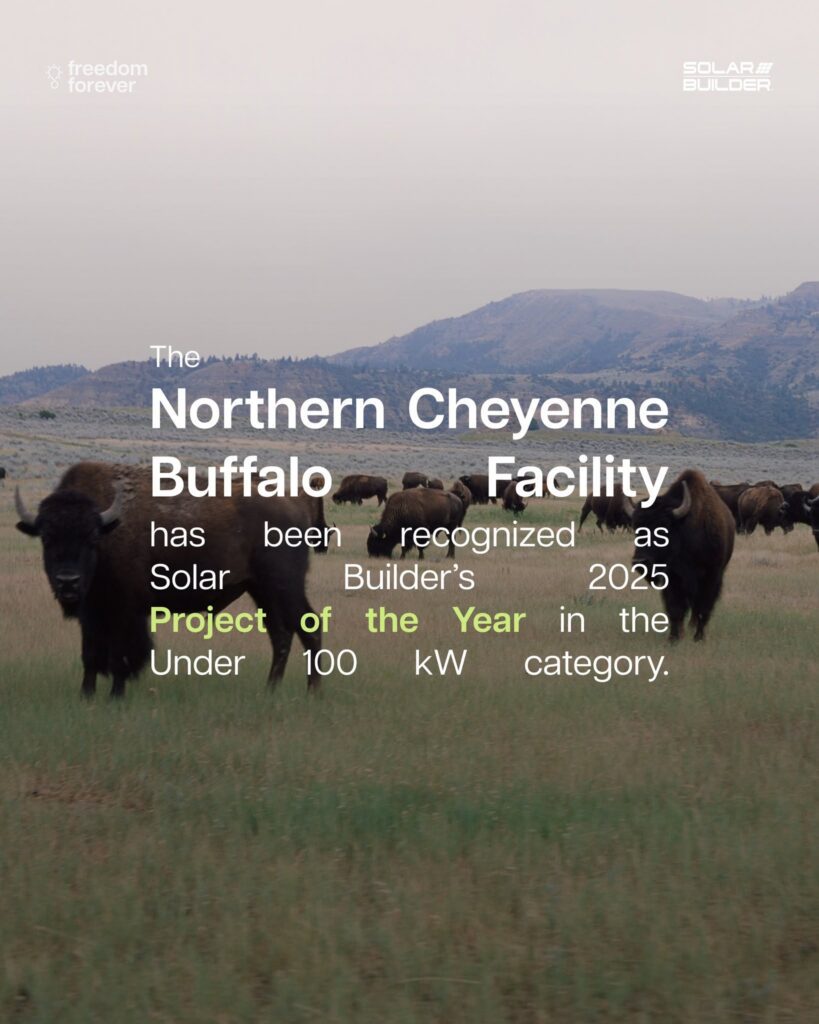
Photo Courtesy Freedom Forever
More than a dozen workers and trainees worked on the installation, with training built into the job. “It took a lot of hands and a lot of heart to make this happen,” Small said. Some of the hands that built it came from the reservation. Northern Cheyenne members who helped install the system now work full-time on Freedom Forever’s traveling crews, hired on the strength of training from earlier Department of Energy projects on the reservation. Those projects include the tribe’s White River Community Solar effort, which drew $3.26 million in Department of Energy funding to put solar on homes and tribal buildings.
“Our people have struggled. Renewable energy is a source of hope for a new economy, and a better future for all,” Otto Braided Hair, a Northern Cheyenne member who chairs Indigenized Energy’s board, said in remarks published by the Honnold Foundation.
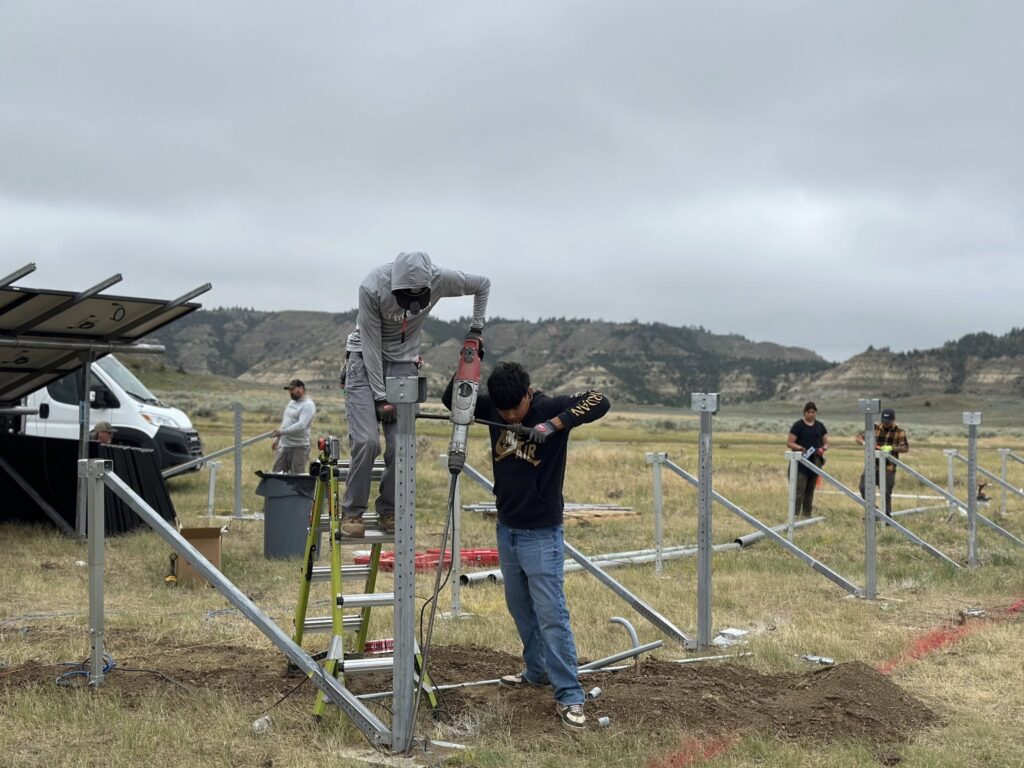
Photo Courtesy Brandon Small
The buffalo feed the community. In November 2025, the program gave away 5,414 pounds of meat; in its first year, it also sold 103 animals to a South Dakota rancher for about $126,000.
Small called the solar system “a game-changer for our program” in a September 2025 statement from Indigenized Energy. “It is helping us protect the herd and will allow us to grow and better serve our people,” he said.
“We’re close to 400,” Small told Solar Builder in 2025, “so if we doubled, it’s going to be right around 800, which is kind of our ideal size.” The program harvested and donated 55 animals that year; after expanding, it hopes to harvest and donate about 100 a year.
The system was sized for another building the program plans to add, and Small eventually wants a small on-site processing facility. In 2026, First Nations Development Institute awarded the tribe $100,000 to sustain the buffalo program.
The work is not cheap. During a September 2025 visit, Small told The Daily Yonder the program was spending $32,000 that year on hay alone; his goal is a program that needs no money from the tribe or federal government, and he said it is on track. “My kids are getting older, and I just wanted to leave this reservation, this land better than when I had it,” Small told the NRCS.
“Power to manage your land, feed your community, and decide your own future. That’s what energy sovereignty looks like,” added Cody Two Bears, CEO of Indigenized Energy.
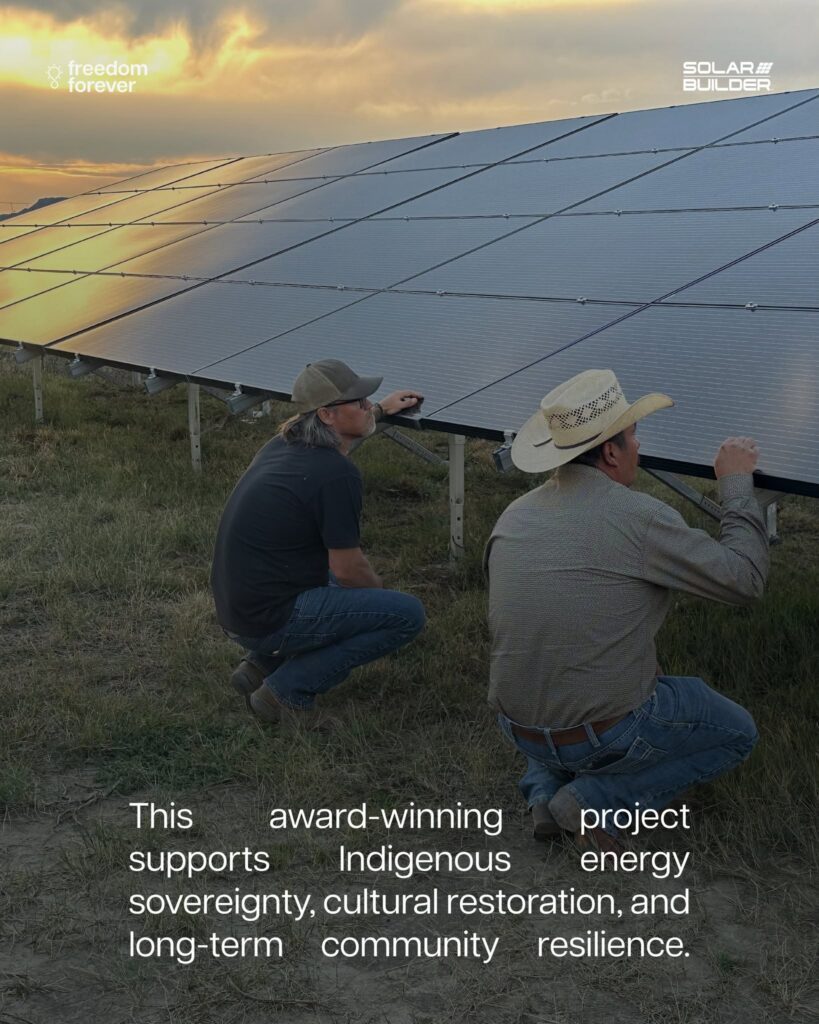
Photo Courtesy Freedom Forever