On a Wednesday night in October 2024, Hurricane Milton hit about 25 miles from Cortez, Florida, with winds gusting to 120 miles per hour. Marshall Gobuty, founder of the homebuilder Pearl Homes, lives in the old fishing village on the Gulf Coast and saw the storm come ashore.
Around 9 p.m., the grid went down at Hunters Point, the waterfront neighborhood Pearl Homes has been building in Cortez, and each home switched over to its own battery. Geoff Ferrell, a vice president at sonnen, the company that makes those batteries, told Fast Company that the handoff takes about a third of a second. “From the customer’s experience, they might see the lights flicker. Generally speaking, you don’t have to go reset the clock on your oven. It’s that fast.”
Across the rest of the county, the outage dragged on. By midday on Saturday, Oct. 12, 2024, the Florida Public Service Commission reported that 48% of Florida Power & Light (FPL) customers in Manatee County, home to Cortez, were still without power, with restoration estimated at more than five days. Gobuty later told the Bradenton Herald, “In Milton, power around us was out for eight days. We had power during the storm, and every single day after.”
The storm was the test Gobuty built for. Gobuty wanted to show that a home could take a hurricane and keep running, and he told the Florida Phoenix that the proving ground “had to be in a [federal] flood zone.”
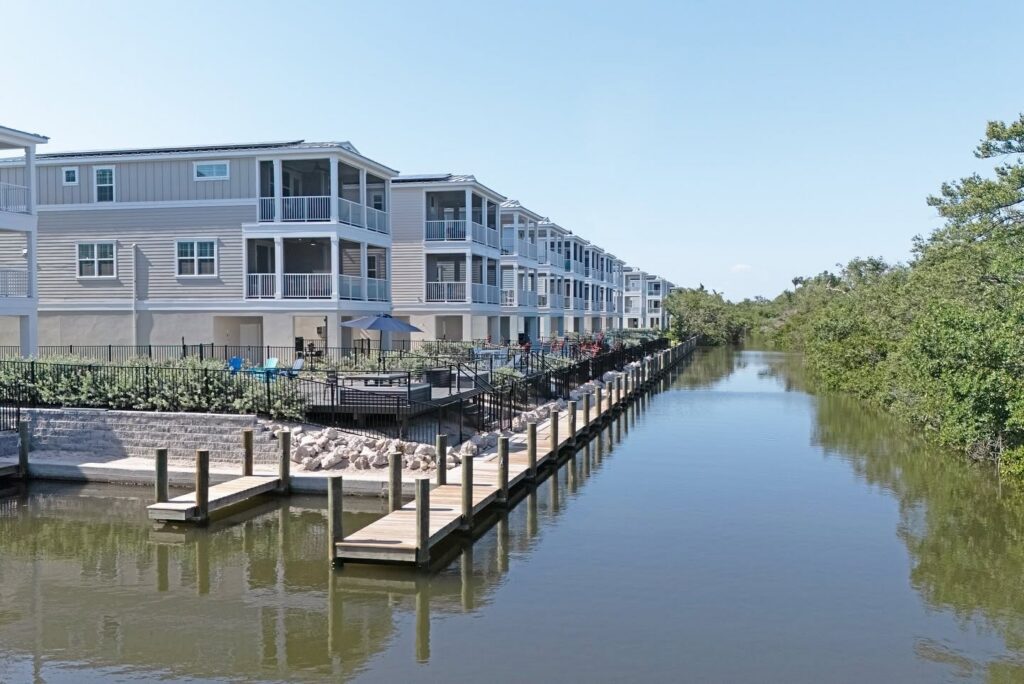
Photo Courtesy Hunters Point Resort & Marina
The idea began with a challenge. After Pearl Homes’ Mirabella community in Bradenton earned Leadership in Energy and Environmental Design (LEED) Platinum status from the U.S. Green Building Council (USGBC), the council’s then-president, Mahesh Ramanujam, pushed Gobuty to build a home that produces more power than it uses. Researchers at the Florida Solar Energy Center at the University of Central Florida helped design the system, and Pearl Homes tested a prototype inside a Palmetto warehouse for 18 months. In 2019, USGBC certified that model as the world’s first LEED Zero single-family home.
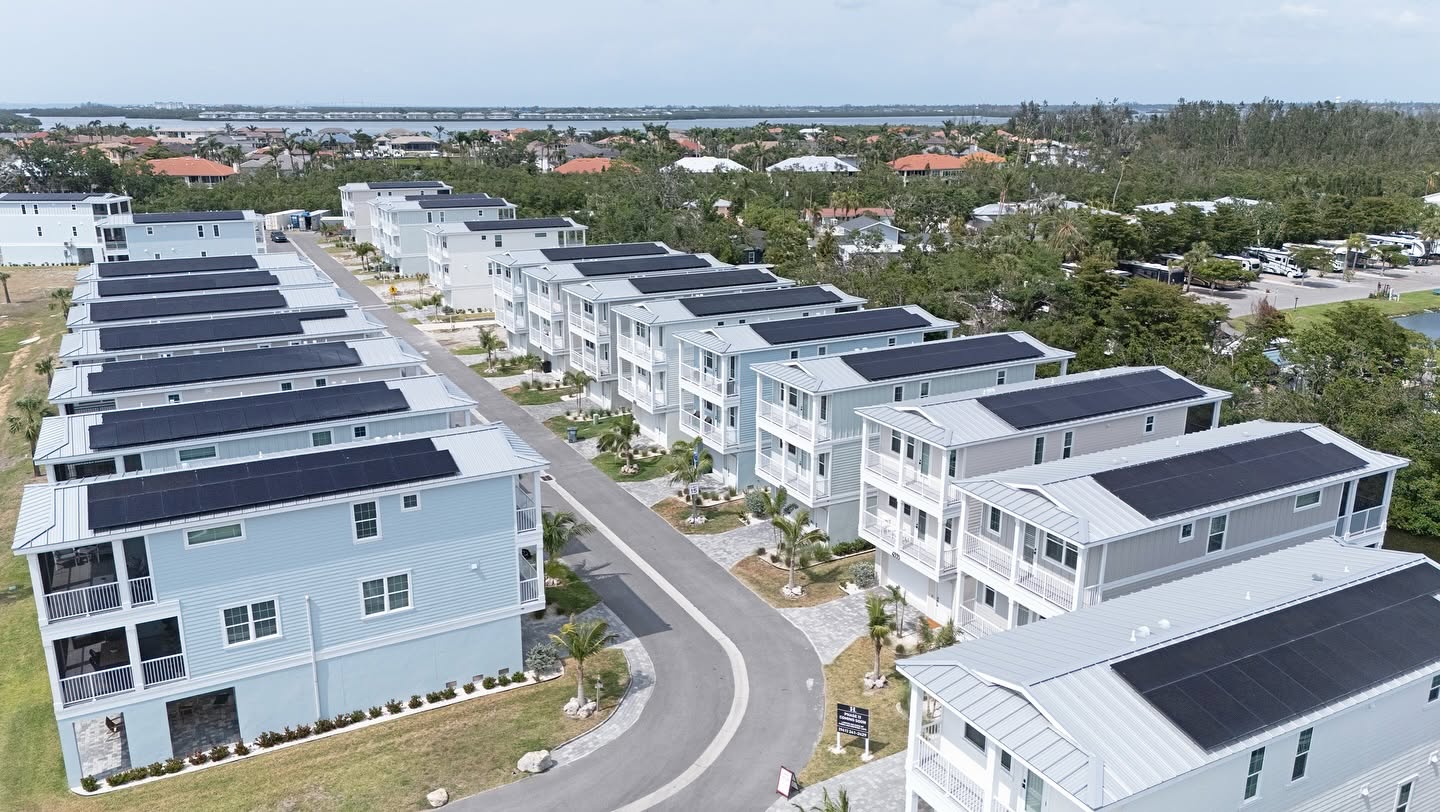
Each home pairs rooftop solar panels with a sonnen battery that banks daytime solar to carry the house through the night and through overcast weather. In emergency mode, the batteries hold a full charge in case the grid fails. The Federal Emergency Management Agency (FEMA) says the systems can supply power for up to 10 days in an emergency.
That battery is the piece most solar homes lack. The U.S. Department of Energy explains that most residential solar systems must be connected to the grid, so when a storm knocks the grid out, the home loses power too, but battery storage is one way to bring the home’s solar back into use. The Hunters Point homes are grid-connected as well, because Florida law requires it.
William Fulford, a retired homebuilder, and his wife bought the community’s very first home and have stayed put through every hurricane since. On the first night after Milton, Fulford told Fast Company, “We were running the refrigerator and a couple of fans. We turned the AC off and everything like that—the bare minimum to keep the power going.” The battery drained to 38% overnight, then climbed back to about 80% by midday as the rooftop panels recharged it.
Photo Courtesy Pearl Homes
National research supports that daily rhythm. A 2022 simulation study by Lawrence Berkeley National Laboratory and the National Renewable Energy Laboratory found that rooftop solar paired with 30 kilowatt-hours of storage could cover an average of 96% of a single-family home’s essential power needs, including heating and cooling, through a three-day outage. Because the panels recharge the batteries each day, performance slipped only from 100% in a one-day outage to 92% in a 10-day outage, the researchers reported. They also identified hurricanes as the hardest test, since heavy cloud cover can hold down solar output.
The batteries are part of a larger design. According to FEMA, each home sits 16 feet above the flood zone, with two-by-six framing in place of standard two-by-fours, steel roofs, impact-resistant glass, and steel straps tying each floor together. Alex Velichko, Pearl Homes’ director of construction, told the Bradenton Herald, “Everything that we do is double code. That’s why we’ve stood up to the last four hurricanes.”
That approach has held through Hurricane Ian in 2022, Hurricane Idalia in 2023, and Hurricanes Helene and Milton in 2024, and Gobuty said that after the 2024 season, “We didn’t have one insurance claim. It’s supposed to be that way, but it was a great attaboy.”
The morning after Helene, Gobuty called his insurer to report that everything was fine, and the representative on the line replied, “Finally, [some] good news,” he told Fast Company.
Victoria Salinas, a former FEMA deputy administrator for resilience and now a senior resilience fellow at the University of Miami Climate Resilience Institute, told the Bradenton Herald that net-zero energy alone would have made Hunters Point a good sustainability story. What makes it a resilience story, she explained, are “all the things they did so that you can not only have your power on, but you can survive — that’s the distinction.” FEMA’s case study cites the 2019 Mitigation Saves report, which found that above-code design can save $4 for every $1 invested.
The homes are not cheap. Recent sales have ranged from $1.1 million to $1.9 million. Gobuty explained that proving the idea in a high-hazard zone, on waterfront land that then had to be elevated, drove the price up, and Pearl Homes is now applying the same ideas to rentals, including The Met, a 199-unit affordable apartment building in Bradenton that opened in 2024.
Looking back on the 2024 storms, Fulford described the contrast to National Geographic: “Every neighborhood around us was black, and we’re sitting here with the power on.” His verdict on the place is simple. “This is what Florida needs,” he told the Bradenton Herald.
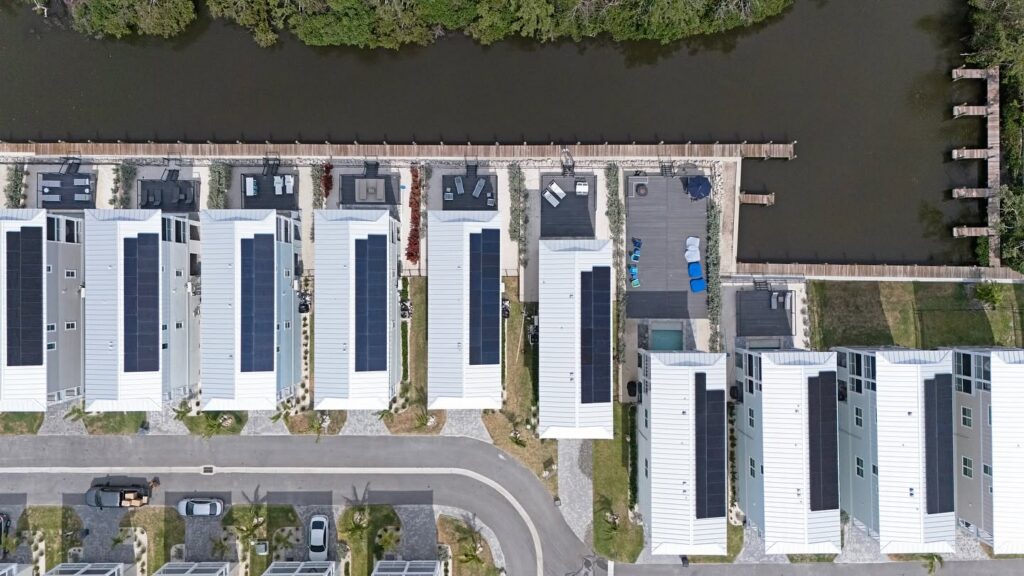
Photo Courtesy Hunters Point Resort & Marina