In September 2017, a North Slope oil engineer named Kris Hall sat down and wrote a white paper. It proposed a three-phase plan for a Tesla Supercharger network across Alaska, complete with GPS coordinates for parking lots in Anchorage and Fairbanks and corridor stops at Talkeetna Junction, Healy, Delta Junction, and Glennallen. Hall noted in the paper that Tesla had no service center, no sales center, and no Superchargers anywhere in the state, though he counted roughly 200 of the company’s cars already on Alaska roads. He sent it to Tesla’s Supercharger team and never received a response.
Three years later, he stopped waiting, and the company ReCharge Alaska was founded. Started with his wife Sara, their company still lists the document on its research page with a one-line description: “submitted to the Tesla Supercharger Team in 2017 with no response.” The decision to start ReCharge Alaska dates back to August 2020 when Hall drove a new Model Y from Anchorage to Fairbanks, after making the same trek in a Model 3 the year before. He needed to stop in Cantwell and take on 36 to 40 kilowatt-hours to finish the trip, and the fastest option available to him, a portable charger drawing 40 amps, took just under four hours. On the slower unit, it would run about five and a half hours. Even with the faster charger, a six-hour drive became an eleven-hour day.
“It’s frustrating to me that we do not have access to DC fast chargers and that we have these groups throughout Alaska that are all working toward a solution, but as of August 2020, we still do not have a single DC Fast Charger in Mainland Alaska,” Hall wrote that October, in the same post where he laid out nine goals for the project. Some of those goals were technical: the equipment had to withstand the temperatures at which it would sit, and it could not draw enough power to trigger the utility’s demand charge.
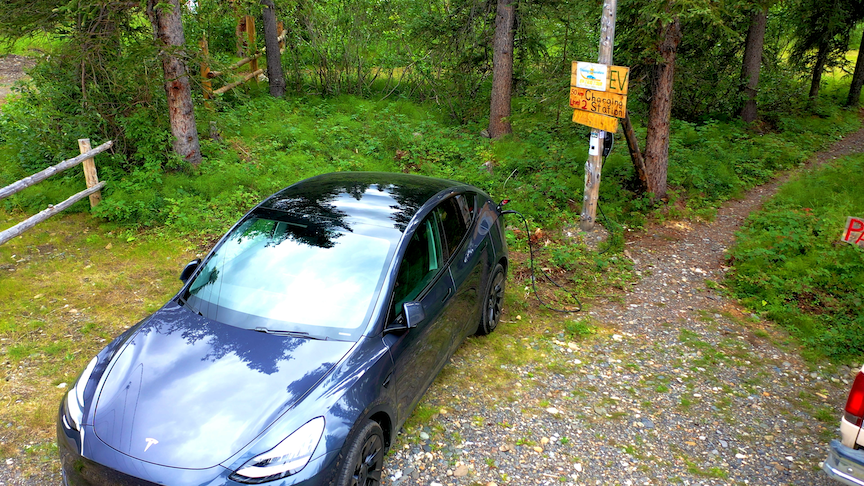
Photo Courtesy ReCharge Alaska
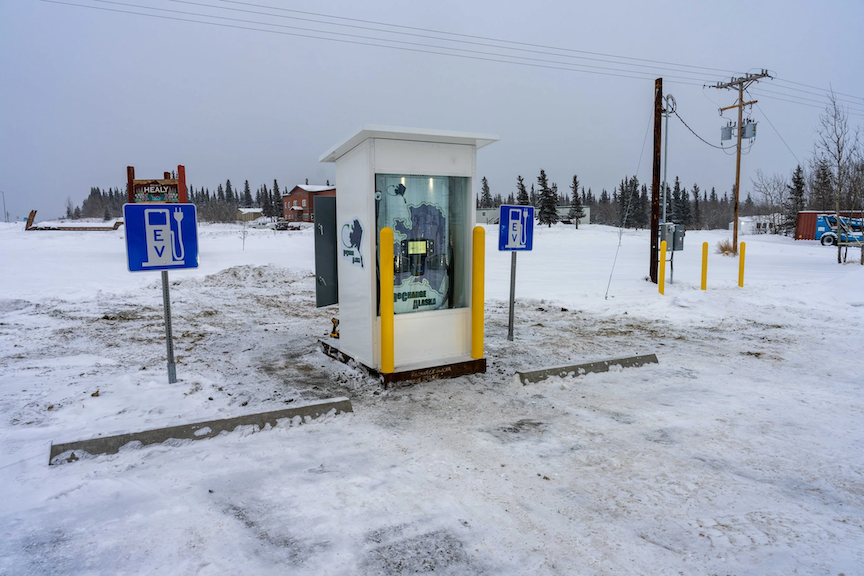
The first charger was planned for Cantwell with grant support from Golden Valley Electric Association. Hall told KTOO that it was “the first endeavor ever for doing a DC fast charger in mainland Alaska,” and, he added, “the first endeavor ever for trying to figure out how to make these things operate in the cold weather.” By July 2021, the charging location in Cantwell was installed and operational, and an installation at Healy followed by the end of the year.
Kirk Martakis, a friend of Hall’s, provided ReCharge Alaska with a land lease agreement for the Cantwell station, which includes a fast charger five times faster than his other units. Kirk had been generating and selling solar power to EV drivers at his Driving on Sunshine station in Cantwell for four years prior. He noted in 2022 that local demand was increasing: “Last year we saw a tripling of the number of vehicles that stopped in. And this year we’re looking at doubling it. Most everybody who comes and charges here are so grateful that somebody has stepped up to the plate to allow for them to be able to travel from Fairbanks to Anchorage and to the Kenai.”
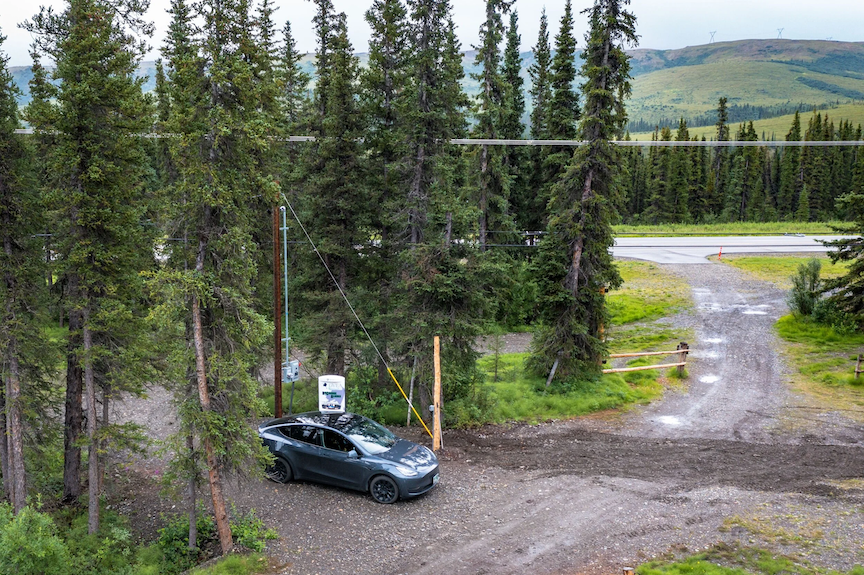
Photo Courtesy ReCharge Alaska
The decision that defines the company looks small on paper. Some charging networks let the equipment manufacturer own and service the hardware. While evaluating suppliers in 2024, Hall wrote, “We want to establish contracts where ReCharge Alaska is the owner, operator, and does maintenance of the equipment because we’re closer to the charger and wouldn’t need to mobilize support from out of state,” he wrote. He also screened vendors to ensure they would still be in business in a few years, so that a supplier’s failure would not leave him holding equipment for which he could not obtain replacement parts.
He had learned that lesson the expensive way. On the evening of September 5, 2021, lightning struck near the Railbelt intertie while a customer was charging at Cantwell. The voltage swing damaged the machine beyond field repair, and it went back to the manufacturer, Tritium, in California. It left on September 23 and arrived on November 4. Hall said that he “could not get a straight answer from the shipping companies as to the cause of the delays, and even where the RT50 was located, during certain sections of the shipping.” Six weeks of freight is a long time when the next charger is a hundred miles away. “We knew we would have lessons learned; we didn’t realize we were going to learn all of them the first year of operation,” Hall joked. “At least it’s not boring!”
An increased focus on in-house capabilities emerged over time. Swapping a charger between sites in September 2024, Hall logged the job: 680 miles driven, 16 hours driveway to driveway, two machines moved, and every software change handled remotely without needing to contact Tritium.
Other operators have noticed. ReCharge Alaska installed two chargers for Alyeska Tire near Palmer in August 2023, its first job on equipment it does not own and operate. In 2025, the company was called back to diagnose and repair that hardware. The company explained the importance of that work: “Hands-on support for legacy EVSE helps reduce downtime, extend equipment life, and maintain charging access for the public.”
The work stays local by design. The 2025 report lists vendors and suppliers in seven Alaska towns, from Anchorage and Wasilla out to Glennallen and Delta Junction. “Alaska is an islanded community,” Hall wrote in 2022, explaining why he moved fabrication work from a company in Washington to the Weona Corporation in Alaska. “We all need to work together to build our community. Keeping the work local is a start to building our community, and we’ve been enjoying meeting people along the way!”
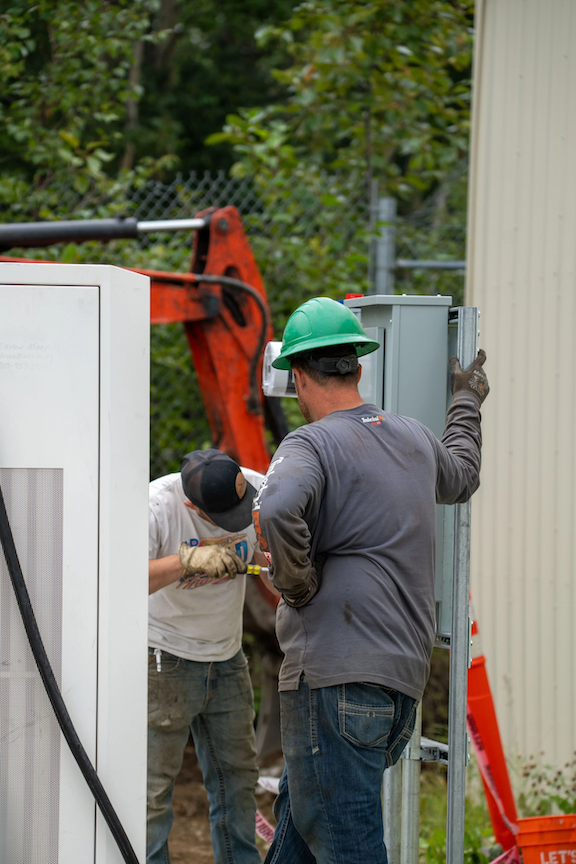
Photo Courtesy ReCharge Alaska
Sara Hall has been direct about the business side. “Honestly finding site hosts has been one of the larger challenges for us,” she told the Alaska Beacon in 2023, describing potential hosts who were not opposed to electric vehicles so much as inclined to wait and see. Nonetheless, the company has managed to expand to additional sites, including two in Anchorage, plus Glennallen and Delta Junction, which it bills as that highway’s first DC fast charger. Fleet uptime ran 93.5% in 2025, according to the company’s annual report, which it expected to be even higher this year with the help of “new modems, power module changes, and changes to comms in Glennallen.”
The company tracks what it calls a user success rate, the share of attempted sessions that actually deliver power. In 2024, the Chugach South Campus site came in at 36% against a company goal above 90%, which three of the other four sites achieved. Rather than bury the number, Hall published it along with the diagnosis: charging cords that stiffen in the cold, a confusing activation sequence, a session timeout set too short. After the fixes, the site ran 73.3% over a 24-hour stretch, which Hall called “measured progress.”
A new ReCharge Alaska App, developed by Lynkwell, now also allows users to check equipment before leaving home and start charging sessions without the credit card reader.
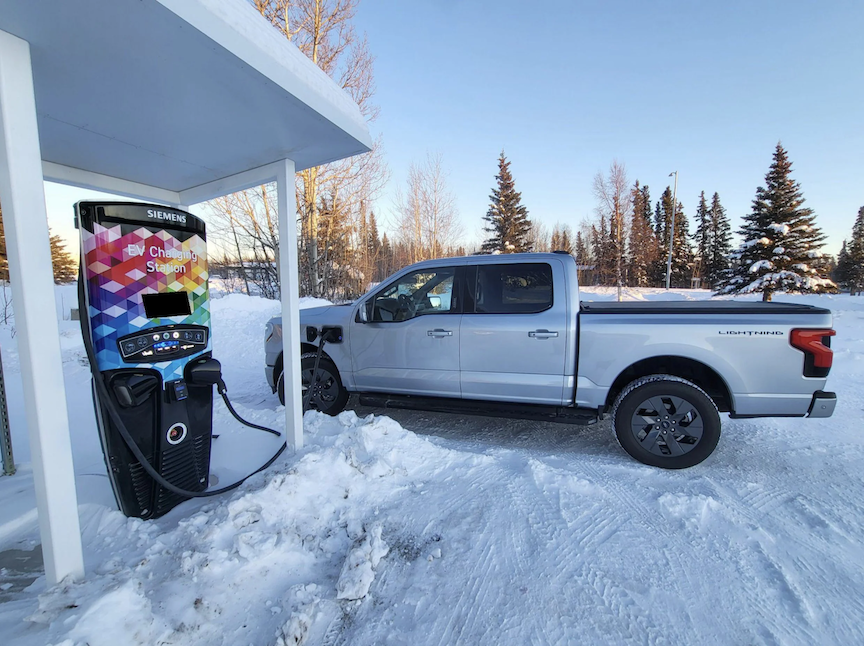
Photo Courtesy ReCharge Alaska
This past March, the Federal Highway Administration certified Alaska’s charging corridor between Anchorage and Fairbanks as fully built out. The sites that closed the last gaps were Tesla Superchargers in Fairbanks, Nenana, Trapper Creek, and Cantwell, built without federal funding after the program paused, then counted toward the requirement at the state’s request. Several of those towns appear in the white paper Hall mailed off in 2017.
One of them ended his pilot project. With a Supercharger running in Cantwell, ReCharge Alaska shut down the site where it all started. The charger that had proved fast charging was possible on mainland Alaska was now redundant. The equipment came out of Cantwell and went to Healy. Hall wrote, “The business case for maintaining our Cantwell location no longer aligned with our long-term strategy”: the pilot had done its job, and the hardware was worth more somewhere it was still needed. Planning for that kind of move was deliberate from the start. “While moving our equipment is not ideal, we did plan ahead with mobility in mind,” Hall wrote, describing the skid-mounted, relocatable design as part of the company’s phased approach.
Demand, meanwhile, keeps outrunning supply. When Tesla opened an East Anchorage Supercharger last December, roughly doubling the fast-charging cords in the city, ReCharge Alaska’s own usage went up rather than down. The company reads that as evidence Anchorage is still short on chargers and that “further investment in reliable, high-power infrastructure is warranted.”
There is more road to cover. Barge companies have stopped carrying electric vehicles to Alaska over battery fire concerns, so more owners now buy in the Lower 48 states and drive north, with a specific need for Hall’s chargers in Glennallen to be working. His targets this year include a high-power installation in Valdez and three more sites somewhere in the state. Nine years after no one from Tesla wrote back, ReCharge Alaska will keep building out the state, one skid-mounted charger at a time.