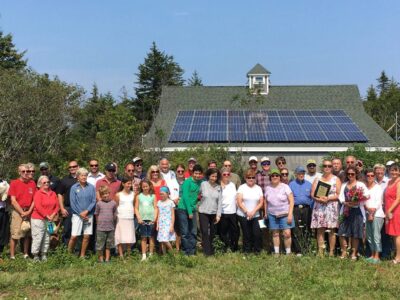

Last September, EarthDay.org announced that the global theme for Earth Day 2025 would be “Our Power, Our Planet.” In the press release, the organization explained, “Renewable energy is not only cleaner and healthier — it represents a huge economic opportunity and will create 14 million new jobs globally. In 2023, renewable energy, worldwide, was worth $1.21 trillion and is projected to grow 17.2% annually from 2024 to 2030.”
Earlier this year, EarthDay.org published its list of “6 Unexpected American Cities Leading the Way in Renewable Energy.” It acknowledged that the topic of clean energy often leads people to think of solar farms in California or wind turbines off the East Coast, for example. “However, this couldn’t be further from the truth,” the environmental movement wrote. “In reality, much of the United States’ clean power production happens in the politically-diverse heartland of Middle America, with some of the most exciting renewable energy transitions occurring in unexpected places.”
One of these places is Iowa City, Iowa. As a result of action by Massimo Paciotto-Biggers, then a 14-year-old student at the Iowa City High School, and a group called the Climate Strikers, the Iowa City Council declared a climate crisis in 2019 and amended its Climate Action and Adaptation Plan. Previously, the city’s emission goals were a 26% to 28% reduction by 2025 and an 80% reduction by 2050. Now, the goals are far more ambitious, aiming for a 45% reduction between 2010 by 2030 and net-zero by 2050. In 2020, the City Council officially adopted a follow-up report that outlined specific measures to accelerate progress across categories, including buildings, transportation, waste, adaptation, and sustainable lifestyles. Some of these 64 actions, such as creating a more robust energy code inspection program and establishing an electric and fuel-efficient vehicle purchasing policy, were highlighted as ready to roll out in 2020.
In 2021, Iowa City successfully decreased its carbon emissions by 49%, exceeding even its updated goals. “We are very excited about the emissions reduction progress we’ve made in such a short time, but we know there is still plenty of work ahead to reach our goal of net zero emissions by 2050,” Assistant City Manager Rachel Kilburg explained to The Daily Iowan.

Photo Courtesy The City Of Iowa City Government
Although wind energy is prominent, courtesy of the city’s utility partner MidAmerican Energy, solar power is another highlight of Iowa City’s clean energy transition. In 2023, SolSmart awarded the city its Gold designation. “Adding solar in the mix is a way of helping maintain that 100% renewable energy access, while also increasing the reliability and resilience of the city’s energy system,” reflected Sarah Gardner, the city’s Climate Action Coordinator. After a feasibility study revealed that current municipal buildings had limited solar capacity, the city made adjustments to ensure more solar energy could be deployed in the future. In October 2023, a 40 kWp rooftop solar array on the Public Works building became operational, generating more than 1 megawatt of power in its first month and now meeting all of the building’s energy needs. The city has also provided funding for solar projects on buildings, including the Free Medical Clinic and the local Habitat for Humanity.
Additionally, in 2024, the city cut the ribbon on a solar installation at the Iowa City Municipal Airport, funded by the Federal Aviation Administration through the Bipartisan Infrastructure Law. “It serves dual purposes for everybody, it helps protect the environment, it helps the airport with our utility bills and our expenses here,” explained Iowa City Municipal Airport manager Michael Tharp.

Photo Courtesy Iowa City Municipal Airport
The city also offers a variety of grants aimed at helping achieve its climate goals. A Whole Home Electrification Grant pilot program covers the full cost of home electrification and energy efficiency upgrades. These include attic insulation, replacement of exterior doors and windows, and upgrades of electrical service panels, air conditioning units, furnaces, and water heaters to air-source heat pumps, as well as the conversion of gas stoves to electric stoves or induction stoves. In exchange, the landlords of these rental properties agree to accept Housing Choice Vouchers for low-income housing. The first five upgrades are expected to be completed this year.
Separately, climate action grants of up to $10,000 to both non-profit and for-profit organizations for the purchase of equipment or supplies. Between 2018 and 2022, the city awarded more than $88,000 to organizations such as the Domestic Violence Intervention Program Emergency Shelter for rooftop solar panels and to the small jewelry business Beadeology for a high-efficiency furnace and LED lighting. Meanwhile, both The Bike Library and the Hawkeye Model Railroad Club used funding from the program to install heat pump systems.
A former Energy Efficiency Grant program provided about $1.4 million to commercial and industrial locations for energy efficiency and solar installations. Eric Jones, co-owner of Adamantine Spine Moving, who received funding through the program to install panels on a warehouse, noted, “Right now, the hundred solar panels on our roof are meeting about 80% of our energy needs for the year, which is great. I feel grateful to live in a community where it’s a priority because action was needed yesterday. The local action for small businesses like us who don’t have unlimited resources but want to do the right thing is just huge.”
Additionally, $500 youth mini-grants are available for students in grades five through 12, such as for projects that distribute products like smart power strips to encourage others to reduce their energy consumption.

Photo Courtesy Iowa City Bike Library
Lastly, the city has placed a significant emphasis on electric vehicles (EVs). 2021’s Eastern Iowa Electric Vehicle Readiness Plan found that the state needed 450 public charge ports per million population to reach a tipping point for EV adoption. Adjusted for population size, Iowa City surpassed that goal in 2022 with the equivalent of 660 charge points per million population. Between 2018 and 2022, EV charging saved the same amount of greenhouse gas emissions as would be reached by growing 2,000 new trees over a decade.
Through its Electric Vehicle Charging Rebate Program, the city offers a 50/50 match for the costs of equipment, materials, and labor required to install Level one or Level two charging at multifamily residences. Patricia Valderrama, a local Climate Ambassador, explained the importance of EVs for her community, “Because I live in an apartment, I usually plug my car into a nearby public charging station and leave it there for a couple hours while I go about my life. If you live in a house, you can install a charger there and just leave your car plugged in overnight. I really love zipping around in my wind-powered car!”
Electric vehicles are also being deployed for public services. Between 2015 and 2023, the addition of four electric buses cut emissions from the city’s fleet by 10%. This year, the city will also receive the state’s first patrol-rated electric police vehicle.

Photo Courtesy The City Of Iowa City Government
In the words of Mayor Bruce Teague, “Iowa City continues to demonstrate leadership in climate action in 2025 with exciting projects that build on our commitments to renewable energy and clean transportation… By accelerating our innovative sustainability programs, investments in renewable energy, and efforts to reduce carbon emissions, we are ensuring that Iowa City is not only resilient today but sustainable for generations to come.”