Every landfill makes methane. In 2021, John Klostermann, Dubuque’s now-retired public works director, explained the conventional way to deal with it: “One way to control it is to flare it off.” However, Dubuque decided on a different approach. Klostermann put the distinction simply: “In this case, we are actually going to collect it.”
The collection wells came first, and they came slowly. Klostermann said the first ones went into the ground in 2010. By 2021, there were 57 of them threaded through the buried garbage at the Dubuque Metropolitan Area Solid Waste Agency landfill. Now they draw gas toward an on-site processing facility. Ken Miller, the agency’s administrator, described, “We are drawing from all of those 57 wells into the wellheads and down here into the facility. We will continue to look for opportunities to expand the number of wells in the cell as the cells grow and change, and if we identify any areas where additional wells would be useful to capture that gas, those would be added in the future also.”
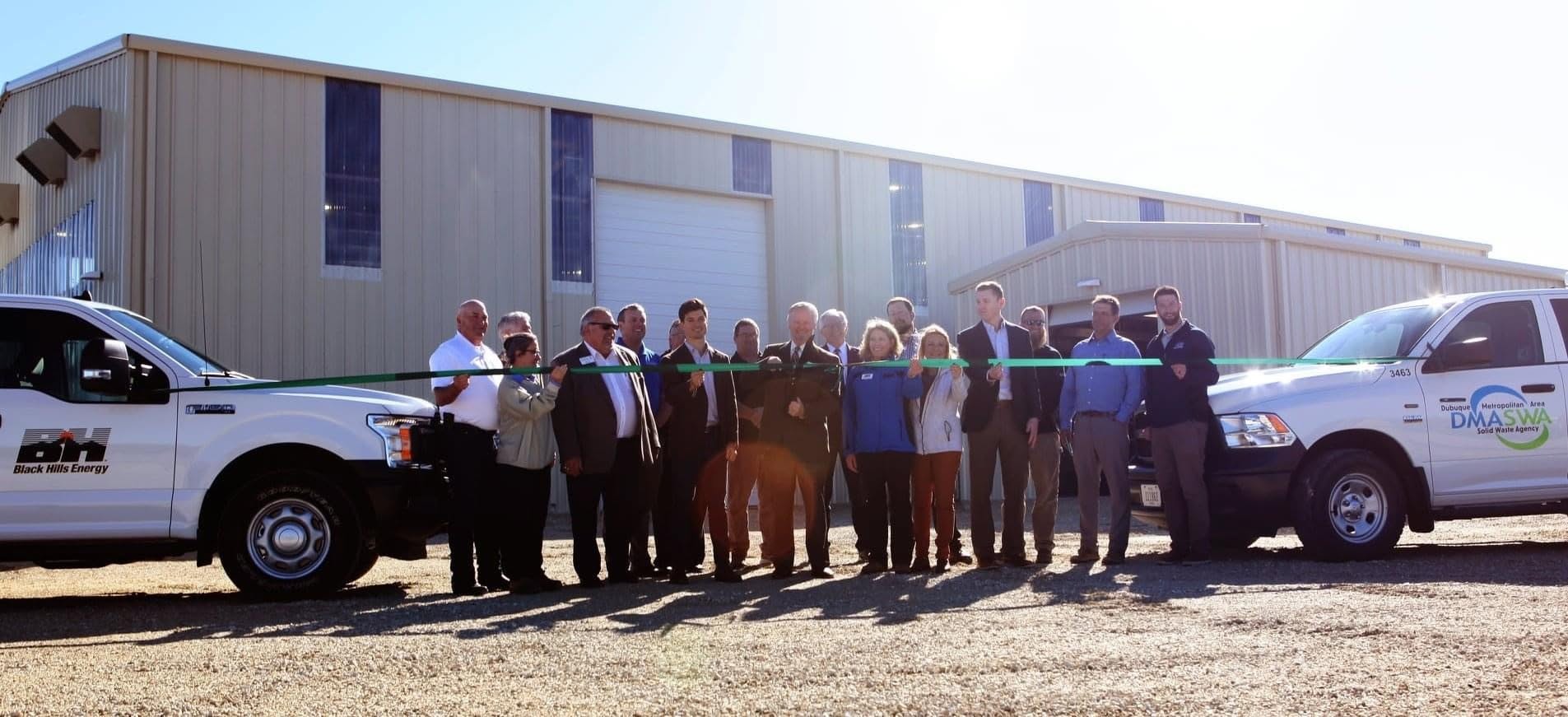
In 2018, the solid waste agency began looking for a partner to capture the landfill’s methane, convert it to natural gas, and sell it. In 2020, they found such a partner in Enerdyne. The economics were structured so the public side bore very little of the risk. The solid waste agency contributed $720,000 of the roughly $10 million cost, with Enerdyne’s local subsidiary, Dubuque Gas Producers, covering the rest. Dubuque City Council member Ric Jones, who chairs the solid waste agency board, told the Telegraph Herald, “The program we put together with our partner gave them all the risk. We just had to put in the collection infrastructure to mine the field of garbage. They were responsible for all the equipment to cleanse the product.”
The agency takes 3.5% of all gas sale revenues, as well. Jones added, “Capturing that much methane and destroying it was a good thing, but putting it in the pipeline for commercial use is just awesome. I like that it has a little revenue stream as well.” Additionally, the build created three permanent jobs and more than 150 temporary ones.
Not only is the arrangement making money, but it is also contributing to cleaner air. The projections turned out to be conservative. Officials had expected the project to bring landfill emissions down from a 2016 benchmark of more than 39,000 tons annually to roughly 37,000 tons. The agency instead reported 13,708.8 tons of carbon dioxide equivalent in 2021, a 65% reduction against that base year. Miller reacted, “So this exceeds that goal by almost 13 times the expectation of the original project.” Klostermann explained, “The benefits to everyone are clean air. We are taking methane out of the air, which is a greenhouse gas, and we are using it in a positive way and that could be used to heat homes, can be used on fuel vehicles.”
Video Courtesy City of Dubuque Government
Since the beginning, renewable natural gas has been injected into the distribution system serving Dubuque, which Black Hills Energy operates through its regulated Iowa gas business. Black Hills Energy is a natural gas utility serving 165,049 customers in Iowa, a figure the company reports in its 2025 Sustainability Report. In 2024, Black Hills also purchased the production facility and long-term rights to renewable natural gas produced there through its subsidiary, Black Hills Energy Renewable Resources. The facility’s two permanent employees at the time continued on in their roles. At the landfill, Black Hills Energy is now responsible for cleaning and testing the gas before it is sold to a third party under a long-term contract.
Todd Jacobs, senior vice president of growth and strategy, explained, “This investment advances our goal to responsibly integrate renewable resources as a component of our overall emissions reduction strategy. This acquisition represents our entry into the production of RNG as a nonregulated business while leveraging our expertise in owning and operating regulated natural gas pipeline systems, including RNG interconnections.”
Katie Fleming, the company’s chief sustainability officer, described the result as recycling rather than disposal. “You’re not burning the methane and releasing it as CO2; you’re actually capturing all of it and essentially recycling it. You’re taking that methane and then using it as fuel to either power vehicles or heat homes, which is exactly what’s happening in this case,” she explained to WVIK. In 2023, the facility produced enough gas to heat more than 1,800 homes. It could eventually heat more than 2,700 homes in Dubuque annually, according to the Environmental Protection Agency.
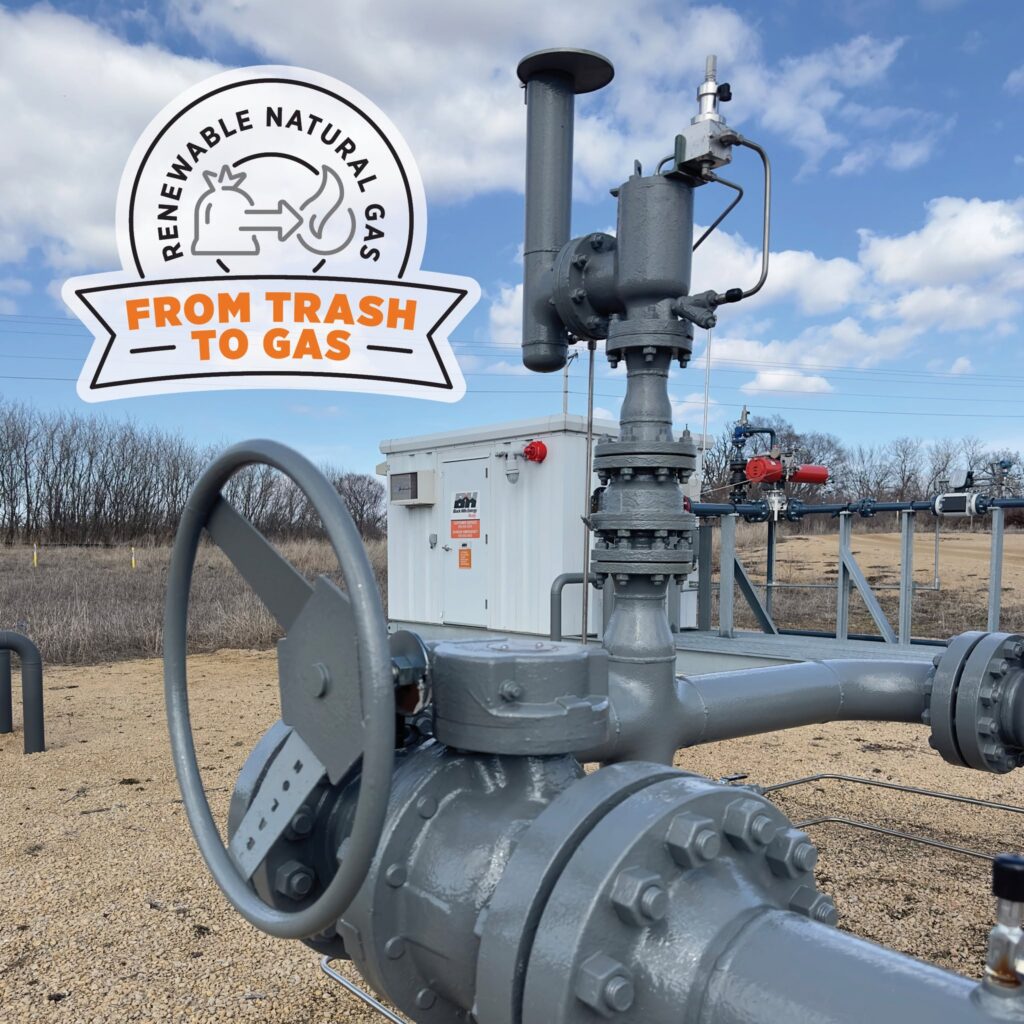
Photo Courtesy Black Hills Energy
The landfill was not Dubuque’s first experiment of this kind. The city’s Water & Resource Recovery Center, a wastewater treatment plant, has been supplying gas since Feb. 28, 2018. Black Hills Energy describes the arrangement as another division of labor: the city owns the plant and takes revenue from the biogas it sells; BioResources Development processes the raw gas into roughly 200 Mcf per day of pipeline-quality renewable natural gas; and Black Hills Energy tests it and puts it into the system.
Two waste streams, then, come from one mid-size Iowa city, both feeding the same pipeline. Accepting gas from a landfill or a treatment plant is not how a distribution system is designed to work, and doing it takes metering, quality testing, and compression at every entry point. Black Hills Energy now runs 10 such interconnects across its eight-state footprint, enough, the company says, to meet the energy needs of 33,000 homes in a year.
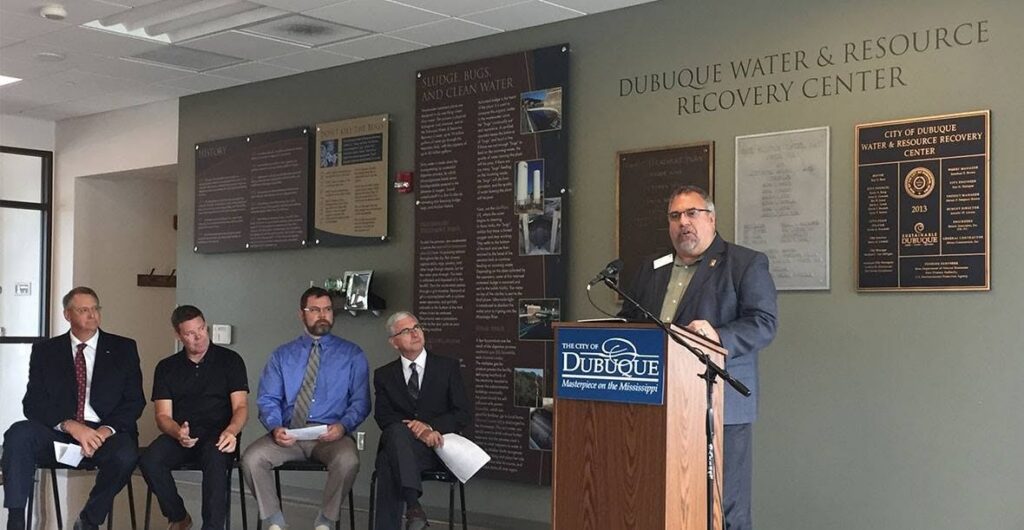
Photo Courtesy Black Hills Energy
The impacts are evident in Iowa, but they extend beyond its borders. Between 2021 and 2024, the utility invested roughly $100 million in Iowa to replace aging pipes, safeguard meters, and connect renewable natural gas projects. Company-wide, Black Hills Energy notes that cast iron pipe has been absent from its system since 2014, and that nearly 98% of its gas infrastructure is protected steel or plastic.
In Iowa alone, the company supports 244 employees. At the same time, company-wide, Black Hills Energy has invested $900 million in infrastructure improvements and maintenance, and it contributed approximately $1.65 billion in direct economic impact in 2025 by supporting jobs, paying taxes, investing in communities, and maintaining and upgrading electric and natural gas infrastructure.
Overall, Black Hills Energy has reduced its natural gas emissions by 25% since 2022, while energy efficiency programs have saved over 13 million kWh of electricity and over 295,000 dekatherms of natural gas. “Through reductions achieved by replacing unprotected steel pipelines, improving data integrity and expanding leak detection and repair, we have made significant progress toward our 2035 net-zero target,” the company wrote.
Klostermann made the point plainly at the start, before any of the results were in. The gas was coming out of the ground either way. The only question was whether anyone would catch it.