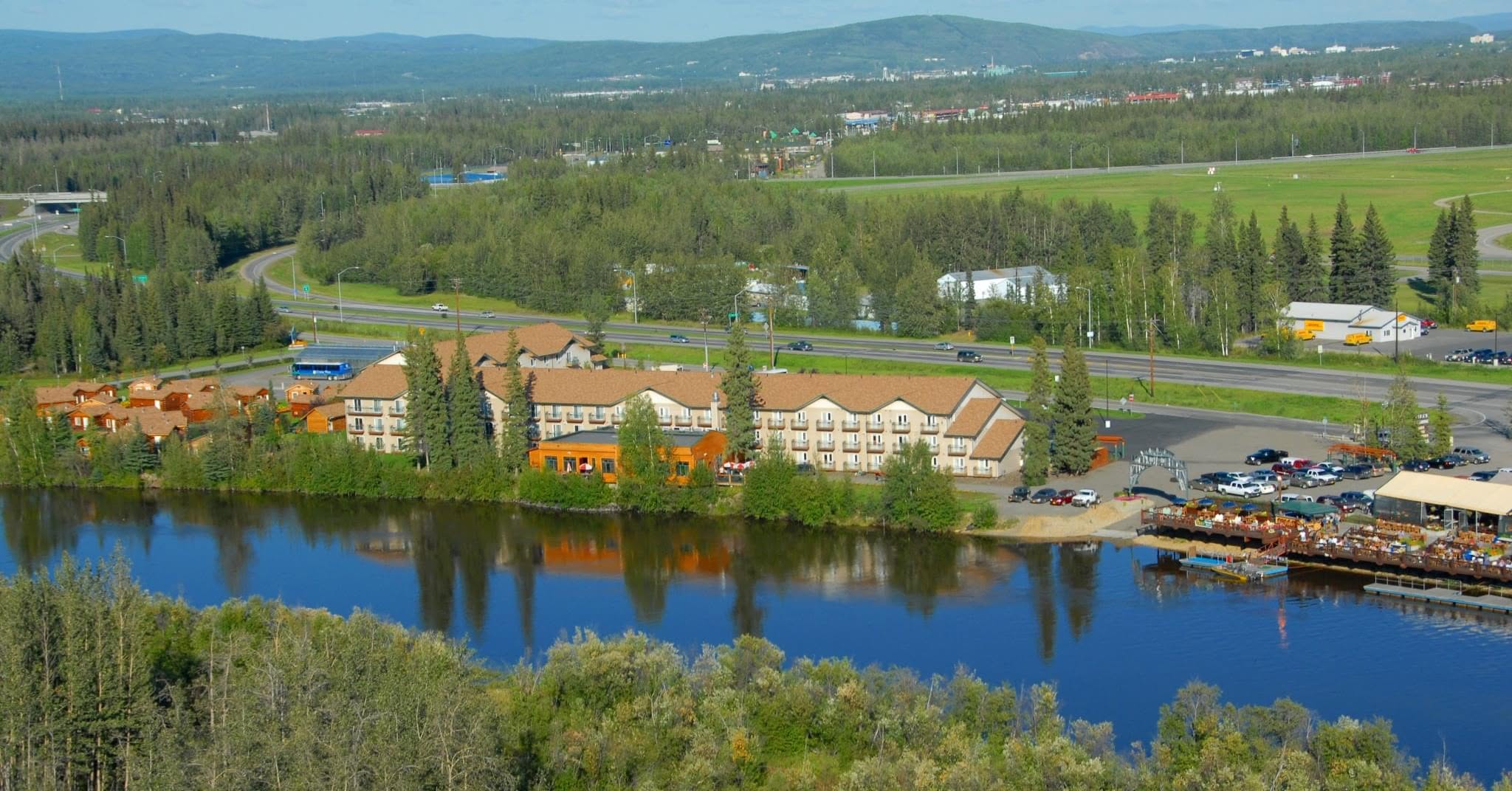
The land along the Chena River in Fairbanks has been earning its keep since before Alaska was a state. Lloyd Pike homesteaded the spot under the U.S. Homestead Act after World War II, and in 1959, the year Alaska joined the union, he built a riverside restaurant called Pike’s Landing. After the 1967 flood swept it down the Chena River, Pike rebuilt it into the log structure that still stands. The property changed hands twice more before Jay Ramras, its fourth owner, bought it in 1999 and opened Pike’s Waterfront Lodge the next year.
What Ramras built around that history is unmistakably Alaskan: 180 rooms and 28 cabins made from Nenana spruce logs, a greenhouse, and gardens that “explode with color and vivacity as thousands of perennial flowers burst into life” in the summer. There is also a “uniquely Alaskan art collection” throughout the hotel and a 1,000-Book Alaskan Library with topics covering “aurora, native culture, history, gold rush, and fiction inspired by the last frontier.” Locals also visit Pike’s Landing restaurant to enjoy traditional Alaskan fish and seafood specialties “prepared by some of Alaska’s best chefs.” It is a family-run operation, and Ramras, who also served in the Alaska Legislature from 2005 to 2010, is the kind of owner guests still see walking the property. Amid all of that, he made a decision that, for Interior Alaska, was ahead of its time. He put solar panels on the roof.

Photo Courtesy Pike’s Waterfront Lodge
In Fairbanks, rooftop solar can be a more difficult case to make. The city sits roughly 150 miles south of the Arctic Circle, and in the depths of winter, the sun barely clears the horizon before it sets again. Energy costs are high, and for decades, the Interior leaned on diesel and coal. Putting panels on a hotel roof in that environment was less a fashion statement than a bet that the sun, even limited winter sunlight, was worth capturing.
The panels went on the roof of the property’s Copper Lodge building. The lodge says the array produces 21,000 kilowatts of power, “even in the winter,” and it describes the system as the first large commercial solar installation in Alaska. The array was in place by 2009, when the Anchorage-based nonprofit Green Star, a program that has certified Alaska businesses on waste reduction and energy conservation for more than 20 years, recognized the lodge with a Green Star Award for its sustainability practices.
The lodge also participates in Golden Valley Electric Association‘s Sustainable Natural Alternative Power program, known as SNAP, and invites guests to contribute a dollar at check-in or check-out that the hotel passes along to the utility. Golden Valley Electric, the member-owned cooperative that has served the Fairbanks area since 1946, launched SNAP in 2005 to pay local producers for the renewable power they feed into the grid and to encourage neighbors to invest in local wind or solar power resources. When the lodge put up its panels, that ecosystem barely existed in the Interior.
It does now. In 2021, Golden Valley reported that its SNAP producers numbered 578 members, 111 more than the year before, with 99% of participating generation coming from solar. An early commercial array on a hotel roof looks less like an outlier today than it did when the panels first went up, a common outcome when early adopters are eventually followed by others.
Solar was never the whole story, only the most visible part. The lodge highlights a range of additional efforts: more efficient light bulbs and televisions, and dryers adjusted to reduce drying time. They have also switched to compostable materials at winter breakfast, low-flow showerheads, recycled-material carpets and window coverings, and have made recycling efforts for paper in the office and aluminum cans in the gift shop, in addition to using cooking oil donated to a biofuel cooperative. None of it is glamorous. All of it is the work of an operator watching his costs and his waste. Guests have embraced many of the lodge’s sustainability practices. About 60% of Pike’s guests reuse their sheets and towels for multiple nights.
As the business explained, it is committed to “reducing waste and our carbon footprint while maintaining the high level of service and comfort our guests know to expect. Through our continual efforts, and with your help, we can continue to improve.”

Photo Courtesy Pike’s Waterfront Lodge
The stewardship instinct runs through the rest of the operation, too. The lodge’s greenhouse has hosted hydroponics research by the University of Alaska Fairbanks and employs members of Future Farmers of America each summer to assist with landscaping and produce cultivation. Professor Meriam Karlsson, whose work focuses on showcasing innovative agricultural methods for the public, said, “This is a working partnership at all levels. It’s a perfect setup. This is an opportunity we can build on.” The lodge also encourages guests to view and enjoy the local environment by offering the Aurora Conservatory with three glass walls facing the Chena River, and maintaining a “Lucky Duck Hotel” on its grounds for local waterfowl.
Ramras, for his part, has kept building. Pike’s Landing was designated a National Historic Site in 2025, and the owner has added a statue of Lloyd Pike and a “Kissing Bridge” for aurora viewing across the 12-acre property. He also opened the Aurora Discovery Institute, a free aurora education exhibit anchored by a seven-foot illuminated globe to help people understand how the Arctic impacts the rest of the world. “We don’t want this just to be for hotel guests. This is a free exhibit,” general manager Elizabeth Griswold said.
It is part of the same mission as the panels on the Copper Lodge roof: a family business in a hard climate, betting on its own history and a more self-reliant Alaskan future, and treating doing right and doing well as the same job.

Photo Courtesy Pike’s Waterfront Lodge