

James Vernon Glade was a Park City miner who was struggling to keep up with his bills after his second child was born. With a little pocket change left over, he decided to buy ingredients for peppermint chews to sell for a profit. “Within just a couple of months, he had a bicycle delivery and over 50 different accounts, and we just grew from there,” said his great-grandson Derek Glade to The City Journals. That was 1916, when the Glade Candy Company was founded, primarily producing chocolate. Fast forward to the present: it is now Taffy Town, a saltwater taffy manufacturer in West Jordan, Utah, run by Glade’s great-grandsons, Jason Glade, president and chief executive, and Derek Glade, chief marketing officer. The brothers own about 90 percent of the business and a group of employees owns the other 10 percent, Derek Glade told the paper in February 2026, when the company marked its 110th year.
Chocolate is not what carried it there. Third-generation president David Glade renamed the company Taffy Town in 1994, and two years later he finished the job. “We got rid of our last piece of chocolate candy making equipment in 1996 when we went exclusively to taffy,” Jason Glade said. “My dad was president at the time, and sales of our high-end chocolate became hard as cheaper chocolate competed against us. But our taffy sales were starting to take off. Taffy had pretty much been a summer-only candy. But we decided to go year-round with it and focused on expanding our national market.”
That decision built a national wholesale business. Taffy Town now produces 6.5 million pounds of taffy a year, roughly 390 million pieces, and carries 80 regular flavors, up from the 45 to 50 it sold when Jason Glade started. They try new flavors monthly, such as boysenberry, French toast, pineapple upside-down cake, and sea salt caramel. Wholesale accounts across the United States and abroad make up 89% of sales, with about 10% online and less than 1% through the single factory store in West Jordan.
The full production of the taffy stems from one building. Taffy Town says its 43,000-square-foot West Jordan plant turns out more than 20,000 pounds of taffy per day and distributes to all 50 states. Rather than pulling its taffy on a machine, the company whips it into an egg meringue, a method Derek Glade laid out on the company blog, and a batch takes three days from cooking to packaging.
Lamont Snarr, board director of the West Jordan Chamber of Commerce, reacted to the company’s move to West Jordan in 2017: “It’s a symbol of industry and the longevity of family businesses. Family businesses can stick around. That can happen. It’s the American Dream. It really is.”
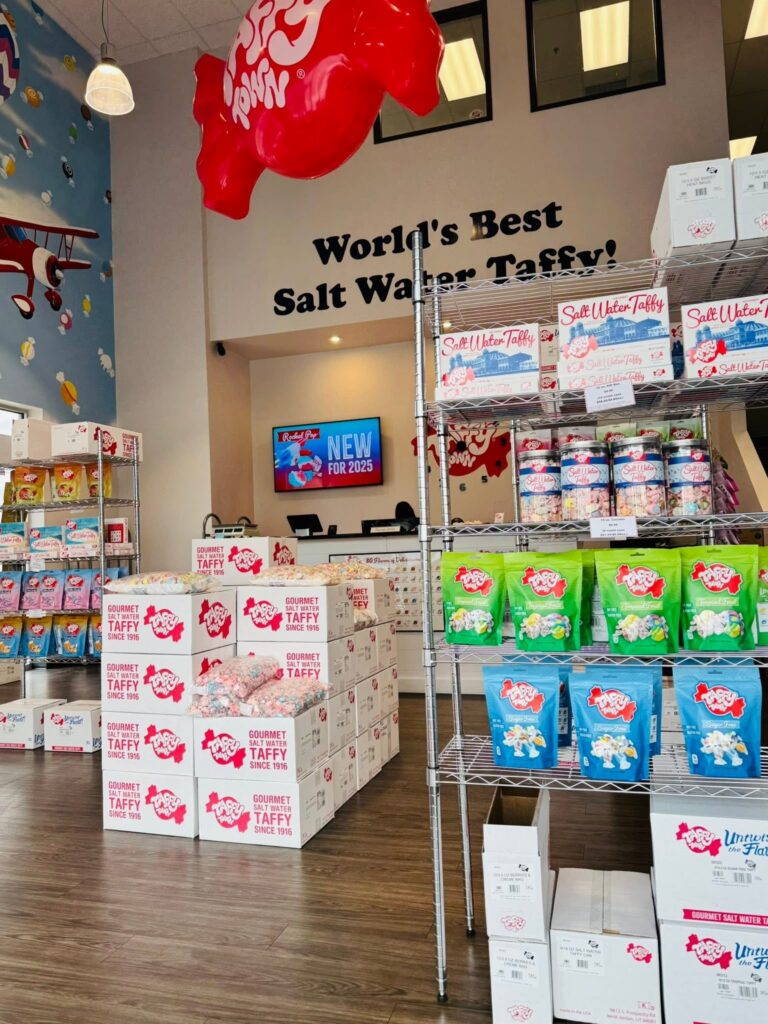
Photo Courtesy Taffy Town, Inc.
Rising demand eventually outran the way the plant was being run. In a case study published by its software vendor, QAD Redzone, Taffy Town reported that its production teams had been working from reports two to three weeks old, which left supervisors managing a floor they could not see. The company put screens on the production floor and tablets beside the equipment, then trained operators to raise and solve problems themselves rather than route them upward.
The results Taffy Town reported were substantial: production lead times down from 10 weeks to 3 weeks over 9 months, production output up 33%, equipment effectiveness up 48%, and reduced maintenance ticket closeout time from 16 days to 2 days, with monthly equipment breakdowns eliminated. In the cut and wrap department, which had averaged 45% overall equipment effectiveness, operators gained 40 points in 90 days.
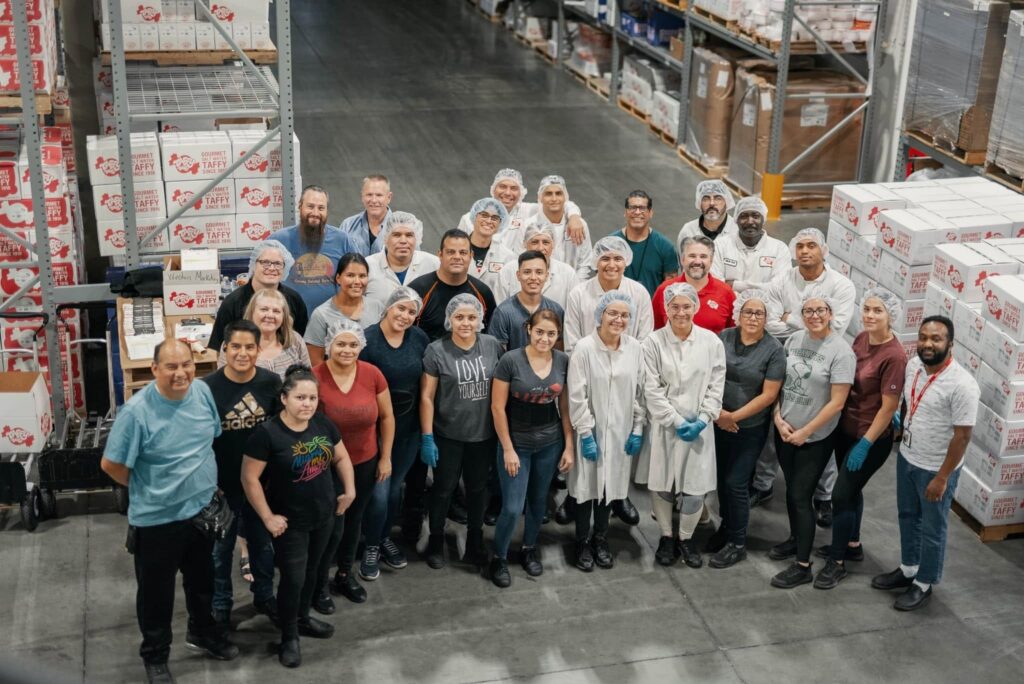
Photo Courtesy Taffy Town, Inc.
Taffy Town employs about 75 people, nearly all of them full-time, and the gains reached that workforce first. In the same case study, Taffy Town reported that staffing increased 20%, that overtime fell to zero, and that a move to a four-day workweek was a reward that cut turnover 13% and serves as a recruitment benefit. “Our employees are our most valuable asset,” Jason Glade said. “You can put money into software and equipment, but these assets only become valuable when you have employees to use them. As a result, I’ve always tried to keep people here: developing leaders from within and helping people understand the value they provide in making our business run and improving our processes.”
The plant also bought itself time. Glade estimated, “We think we can wait another 6-7 years to open a new facility because QAD Redzone provides so many different ways we can increase efficiency. We can take our current assets and use them better.”
Utah has reasons to want plants like this one. Manufacturing is the state’s fifth-largest industry and provided 143,461 jobs as of 2018, the Utah Governor’s Office of Economic Opportunity reported, citing a Kem C. Gardner Policy Institute study. Average annual manufacturing earnings ran 38.6% above the statewide average for all industries. In 2018, the industry was also Utah’s third-largest source of GDP and the second-largest private sector industry.
Taffy Town puts the state into the product itself. It belongs to Utah’s Own, the state agriculture department’s directory of Utah producers, and several seasonal flavors are built on Utah fruit. The company makes one with tart cherries from Santaquin, another with raspberries grown near Bear Lake, and a third with peaches grown in Brigham City. The company says, “Never looking back, we’ve developed a process uniquely Taffy Town, reflecting Utah’s entrepreneurial culture’s charm and innovative spirit.”
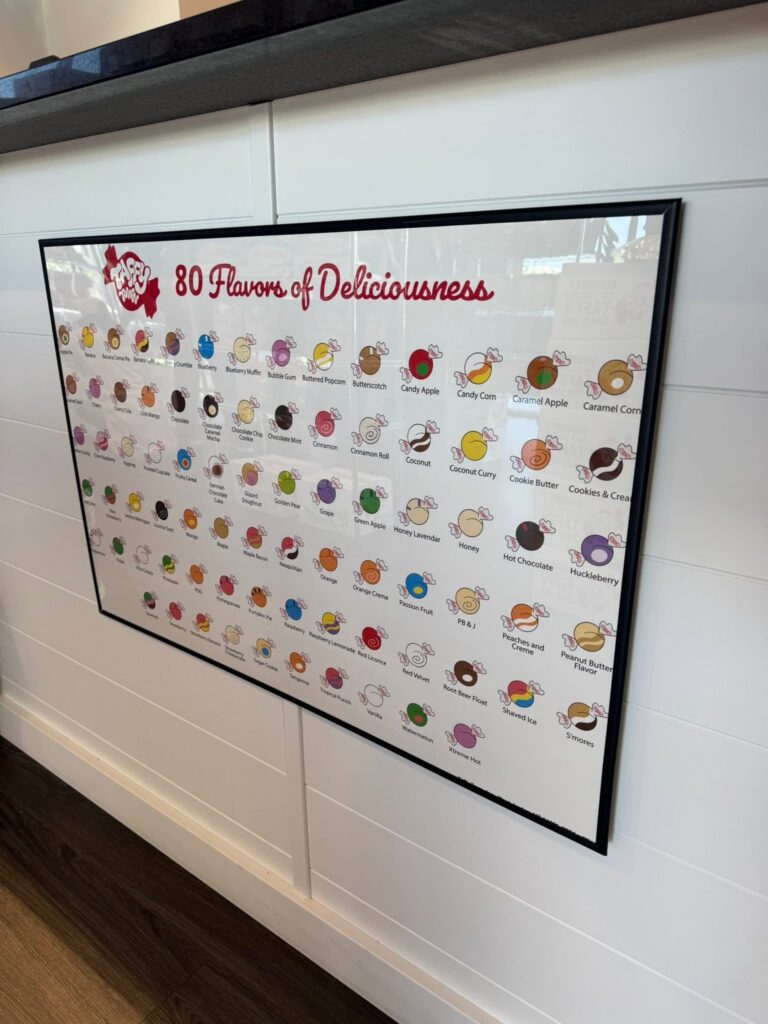
Photo Courtesy Taffy Town, Inc.
Jason Glade told Utah Business in July 2025 that a long company history is something he draws on: “The [early manufacturing] labor force in Utah was very positive and industrious [enough] to make it through difficult times. Being a 100-year company, there were things that we had to get through, whether they were multiple wars, Depression, or different inflationary issues with the economy. [Utah has] been a solid ground for us to steady ourselves and not be affected by some of those major catastrophes that came into the economy… We’re still here, and we’re still growing. It’s a great blessing to look back on those things [for] the encouragement and to have that knowledge going forward.”
He explained more plainly to the City Journals, “I put more pressure on myself when I first started as president,” Glade said. “Then I learned pressure does not improve my work. Now I remind myself, candy should be enjoyable.”