
Since its founding in 1882, Ash Grove Cement Company has expanded to 12 cement plants and 41 cement terminals across the U.S. and Canada, operated by more than 2,200 employees. “We stand together to reinvent the way our world is built,” the company wrote. “That’s why every time we make something, we work to make it better. We rethink, reimagine, and reinvent solutions for the built environment, making homes, buildings, and infrastructure that stand the test of time.”
Ash Grove, now a subsidiary of the leading building materials provider CRH, is aligned with America’s other cement manufacturers as a member company in support of the American Cement Association’s Roadmap to Carbon Neutrality, which sets a 2050 target date. The roadmap aims to build energy efficiency into every step of the process, starting with production at the cement plant to reduce the carbon emitted per ton of product, and extending to the end use of concrete infrastructure in everyday life, as seen in buildings that use less energy for heating and cooling.
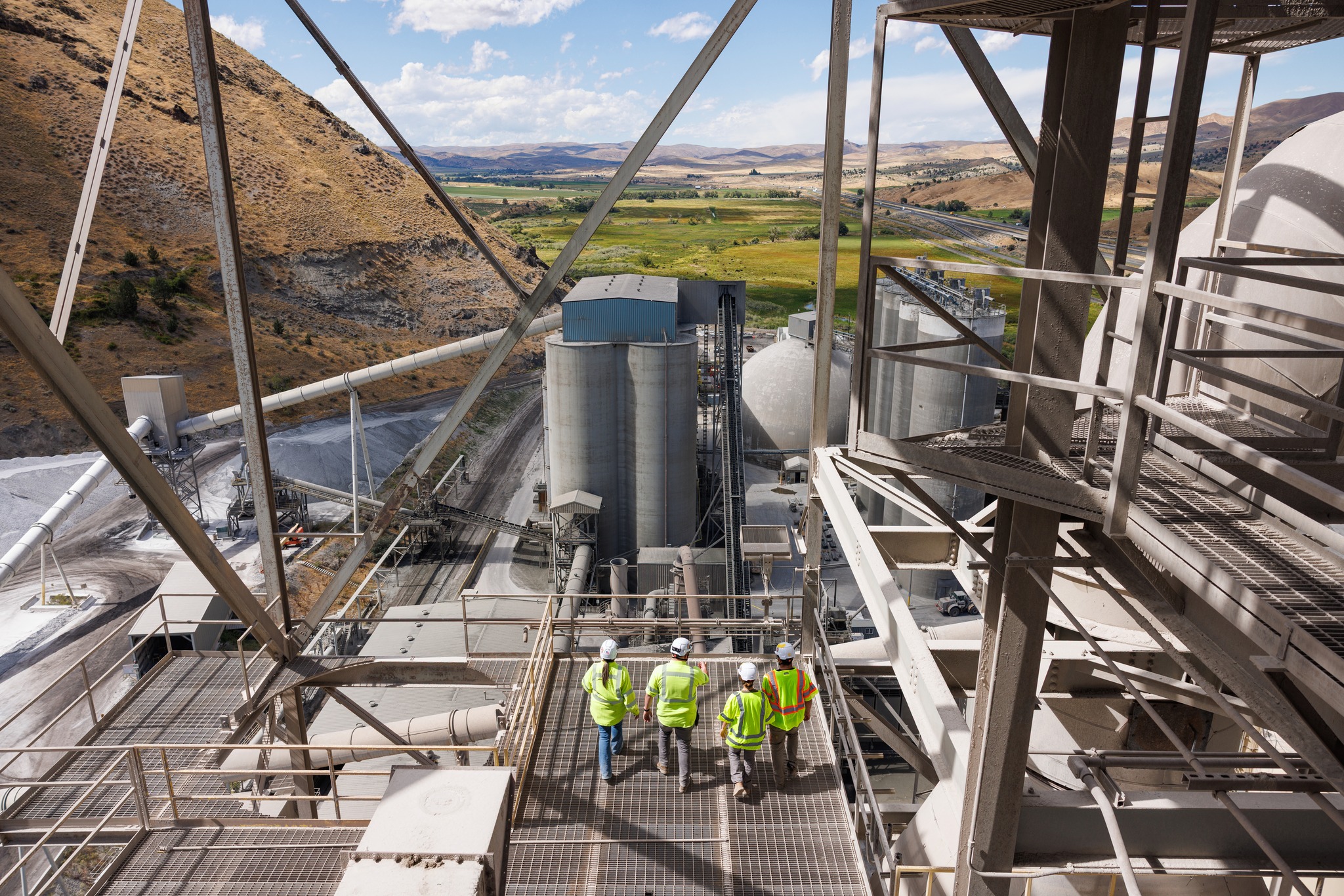
Some of these energy-efficiency upgrades can be seen at Ash Grove’s plant in Leamington, Utah, which the company bought in 1989, nine years after it opened. Since then, the company has upgraded the facility, installed a new finish mill, and converted to producing lower-emission Portland Type 1L Cement, which includes a higher percentage of raw limestone. The plant reached a production capacity of 962 tons of cement annually, supplying Salt Lake and parts of Nevada and New Mexico. As of 2024, the plant employs 104 people and supports an additional 800 local jobs, contributing about $12 million in payroll and more than $798,000 in local taxes per year.
For more than 15 years, Ash Grove has worked with Rocky Mountain Power’s Wattsmart Business program to improve the site’s energy efficiency. Production manager Josh Nelson described the process of working together: “We talk about projects that are in the queue, projects that we’re doing. We also brainstorm a bit on projects we can push up that would make sense for this facility.” Process engineer Kendall Taylor elaborated: “It’s very important for our Wattsmart Business partners to understand how our plant operates because it allows them to see exactly how projects are going to work in our plant.”
One of Ash Grove’s most notable upgrades was to the site’s finish mill, where it grinds a mineral mix called clinker into fine cement powder, eliminating 3.3 million kilowatt-hours of energy use. Then-plant manager Paul Pederson told Utah Business, “The program allowed us to install a new fan on our cement mill, and that fan typically would go down every 30 to 45 days for maintenance. Now we can run a whole campaign – which is a full year for us – without having to do any maintenance.” Although the project cost $1 million, about half of it was covered by $500,000 in cash incentives from Rocky Mountain, and it has translated into $200,000 in annual savings on electric bills, plus additional maintenance savings. “It was a very successful project that paid itself back very quickly and set us up for the long term,” Taylor said.
Another highlight of the collaboration with Rocky Mountain was Ash Grove’s conversion of the facility’s lights to LEDs, along with other examples of environmental leadership, including the deployment of Continuous Emissions Monitoring Systems and the use of alternative fuels. “We have one of the highest fuel substitution rates in the industry, significantly reducing our reliance on coal,” the company wrote.
Over seven years leading up to May 2024, the company cut its energy use by more than 15 million kilowatt-hours, the amount needed to power 2,900 homes for a year or to charge 1.3 billion smartphones. In total, with the help of more than $1.4 million in cash incentives and bill credits from Rocky Mountain, Ash Grove has eliminated 10,772 metric tons of annual emissions, equivalent to recycling 3,700 tons of waste rather than landfilling or removing 2,300 gas-powered cars from the road for one year.
Last year, the Utah Inland Port Authority (UIPA) approved an annual property tax differential rebate for Ash Grove to upgrade its kiln and install a second finish mill in Leamington, thereby helping the company further enhance energy efficiency and produce lower-carbon cement. Ben Hart, executive director of UIPA, reacted, “Ash Grove Cement’s investment in Juab County reflects the strength of Utah’s manufacturing sector and our commitment to sustainable economic development. By supporting this project, we are not only securing high-quality jobs and economic benefits for the region but also fostering long-term environmental improvements in cement production.” Brent Boswell, economic development director with Juab County, added, “This expansion represents a major win for Juab County. Ash Grove Cement has been a valued employer in our community since 1984, and this investment solidifies its role in our economic future.”
Video Courtesy Rocky Mountain Power
Other Ash Grove facilities are also leading in energy and efficiency. In 2024, the U.S. Environmental Protection Agency awarded Energy Star Certification to its plant in Seattle, Washington, followed by the plant in Branford, Florida, last year. In Seattle, the company automated its support equipment so it would stop operating in conjunction with the rest of the grinding mill, thereby saving energy. “This certification places our Seattle Plant in the top 25% of similar cement manufacturing facilities across the United States,” Ash Grove reacted.
Colorado-based NovoHydrogen has announced plans to build a hydrogen production facility at Ash Grove’s Durkee, Oregon, plant, with the fuel planned to power vehicles like trucks, and maybe even the plant itself, starting in 2028. The plant already produces low-carbon cement, cutting carbon emissions by up to 30%. Phillip Teintze, manager at the site, explained, “As hydrogen becomes environmentally and economically viable, we believe our facility could act as a distribution site, and potentially utilise hydrogen as a fuel to displace traditional fossil fuels.” Meanwhile, at its facility in Lincoln, Nebraska, Ash Grove began burning biomass in its kilns in 2023 as an alternative to burning coal or natural gas, resulting in lower emissions.
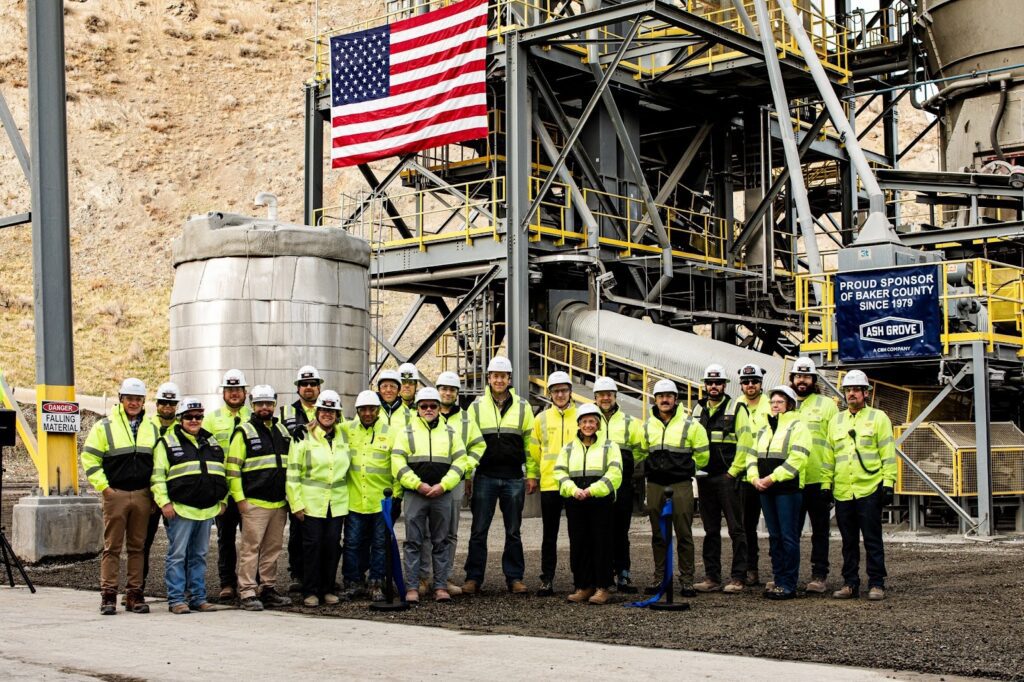
Photo Courtesy Ash Grove Cement
The company is also working to advance sustainable initiatives in other ways. Last year, the U.S. Department of Energy’s Office of Clean Energy Demonstration (OCED) announced Ash Grove as one of the awardees of its Carbon Capture Demonstrations Projects Program. Over two years and with a budget of $15.2 million, a project team will study how to deploy an integrated carbon capture, transport, and storage project at Ash Grove’s facility in Foreman, Arkansas. Additionally, Ash Grove uses its subsidiary, Sapphire Americas, to manage over 650 million pounds of waste annually, converting non-recyclable materials into cement inputs or alternative fuels that power the manufacturing process. Through its zero-landfill pathway, the company describes, “We reduce landfill dependency, lower carbon emissions, and unlock long-term environmental and economic value.”
Its workforce benefits along the journey. Every year, children of employees in their senior year of high school or already in college, “who have demonstrated remarkable academic achievements and shown exceptional dedication to their futures,” can apply for the Ash Grove Scholarship, which grants awardees a $2,000 check to assist them as they continue to study and prepare to impact the world in a variety of positive ways. Through the Ash Grove Foundation, the company has also supported local educational programs. In Louisiana, a $25,000 went toward funding career and technical education for students at Branford High School, as well as a new building for the welding program.
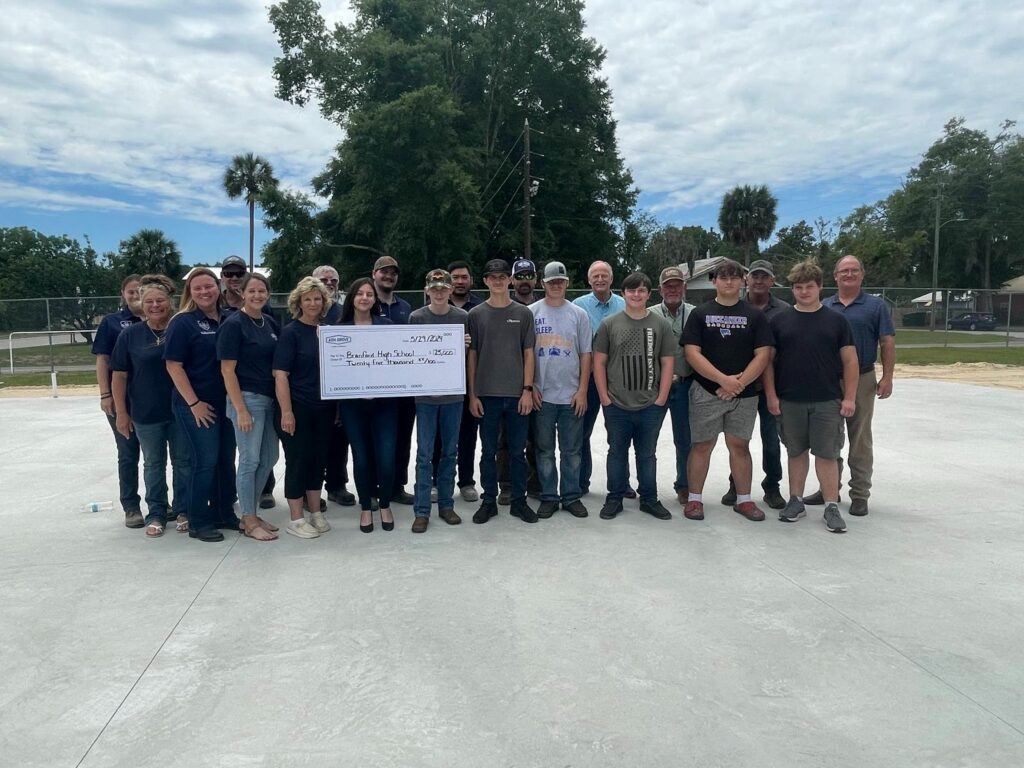
Photo Courtesy Ash Grove Cement