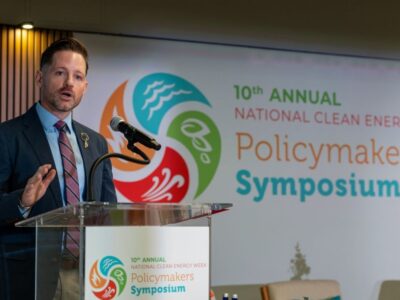

In March, Vida Gabriel, Ph.D., founder and COO of TerraFixing, and Penny Gage, chief policy and partnerships officer at Launch Alaska, penned an op-ed published in Anchorage Daily News. In the opinion piece, the two make the case that carbon removal could transform Alaska’s economy.
Launch Alaska and TerraFixing are working on the front lines of carbon removal and are well-versed in the economic opportunities carbon removal initiatives present across the state. Anchorage-based Launch Alaska runs an eight-month deployment accelerator program, the Tech Deployment Track, that helps energy, transportation, and industrial technology startups connect with industry experts and community leaders and advance toward project deployment.
Canada-headquartered TerraFixing is one such participant. The company aims to scale direct air capture (DAC) with a five-step process that uses 25% to 50% less energy than comparable technologies. The company’s process uses inexpensive zeolite materials that are available at scale and can continue to capture carbon for more than two decades. It does not use water or any other liquids, thereby avoiding the possibility of freezing in northern temperatures.

Photo Courtesy Launch Alaska
The key to TerraFixing’s plan is taking advantage of the opportunities in the Far North. Notably, the region has cold climates that are ideal for the efficient separation of carbon. The company explains on its website, “According to the 2nd law of thermodynamics, the work (energy) required to separate gases decreases as temperature decreases. Therefore, separating CO2 from cold air requires less energy than from warm air.”
Northern regions also have abundant and cheap wind energy with plenty of empty land for project development. By creating demand for clean energy, Terrafixing’s process enhances the economic attractiveness of wind farm development, also benefiting local communities with more affordable power.
Launch Alaska adds that the state’s well-established oil and gas industry is carbon intensive but welcoming the energy transition, with suitable locations for sequestration. As Gwen Holdman, chief scientist at the Alaska Center for Energy and Power, wrote in an op-ed in the Alaska Beacon at the beginning of the year, “Alaska has an abundance of oil and natural gas, largely thanks to its unique geology. . . Depleted oil and gas fields are prime candidates for carbon storage because data exists from years of production that allow us to understand the size, seals, and faults that have held materials in that container over geologic time.” She points specifically to the Cook Inlet, claiming, “Preliminary estimates of its depleted oil and gas fields and unmineable coal seams indicate it may have some of the greatest storage capacity on the West Coast of North America.”
As Gabriel and Gage explain, “We believe Alaska is poised to be at the forefront of carbon removal innovation. It’s a failure to lead if we allow these opportunities to go to another state or abroad.”

Photo Courtesy TerraFixing
Not only is Alaska ideally suited to house this industry, but the state would also benefit significantly. The authors note, “Carbon removal is already employing thousands of people in the Lower 48, and with some focus from our leaders, we could bring these jobs to Alaska, too.” According to research from Rhodium Group, with high deployment levels, DAC plant capital investment could support up to 63,620 jobs annually in Alaska, including construction laborers and managers. DAC plant operation could support up to 79,120 jobs annually, including machinery installers and repairers. Gabriel and Gage claim there could be over 140,000 new jobs in Alaska by mid-century.
This opportunity is significant in the face of shifting industries in the state. As Holdmann wrote for Homer News, “As uncertainty around gas production in Cook Inlet grows and state oil revenue has been declining, could carbon management emerge as a new industry to diversify and strengthen Alaska’s economy? The answer may rest in Alaska’s ability to harness its natural strengths and turn the challenges of a shifting energy landscape into opportunities for growth.”
ASRC Energy Services, which is currently evaluating the North Slope, Fairbanks, Anchorage, the Kenai Peninsula, and Mat-Su for deployment of DAC technologies, argued in a research document that a carbon sequestration hub “has the clear potential to create and/or extend well-paying jobs, could provide another revenue source for the State and/or Alaska Native corporations (ANCs) who own the pore space, and sustain the environment.”
The U.S. Department of Energy awarded $3 million for research into the feasibility and design for the “Arctic Direct Air Capture Hub Testing Ground,” which attracted nearly $5 million in total funding. In response to the announcement, U.S. Senator Lisa Murkowski (R-AK) posted about the allocation from the Bipartisan Infrastructure Law for the project: “Congratulations to ASRC Energy Services, Santos, Repsol, and Storegga—can’t wait to see what their good work holds for this project and our state.”
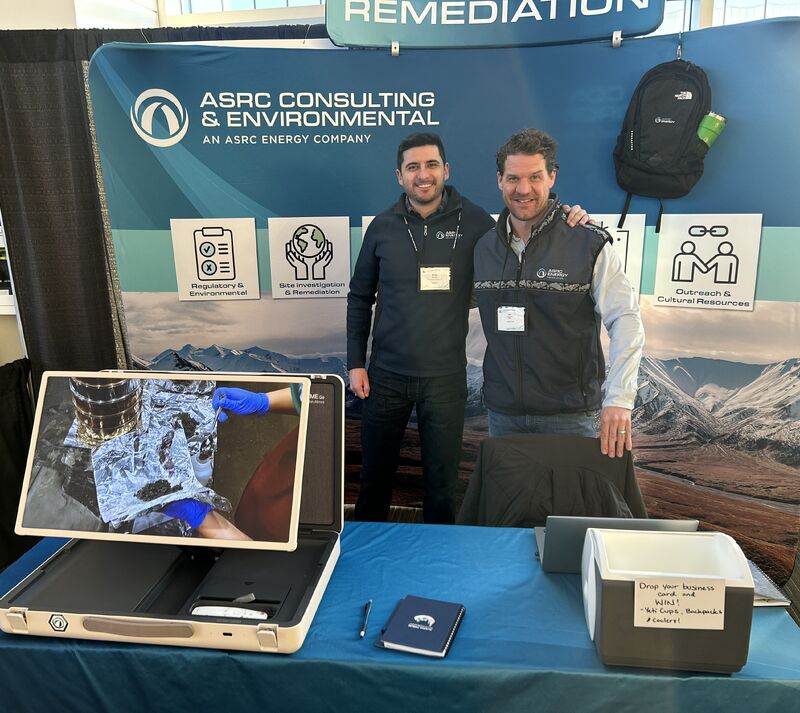
Photo Courtesy ASRC Energy Services
Gabriel and Gage noted, “We believe Alaska’s leaders must make decisions today that will benefit future generations. They’ve already taken great first steps.” Last year, for example, the Alaska Legislature passed legislation establishing a regulatory framework for carbon storage leasing and underground injection, contributing to a new industry in the state. Alaska Senator Bert Stedman (R-Sitka), who also co-chairs the finance committee, summarized, “This bill is about bringing new revenue and new opportunities to Alaska.”
Gabriel and Gage’s op-ed points in particular to the Carbon Dioxide Removal Investment Act, introduced last year by Sen. Murkowski alongside Senator Michael Bennet (D-CO), which would create a production credit to support the development and adoption of carbon dioxide removal practices. Michele Stockwell, President of the Bipartisan Policy Center Action, noted, “Scaling CDR is vital to unlocking the full potential of these technologies to both decarbonize the economy and drive economic growth, and we urge Congress to move forward on this important legislation.”
Sen. Murkowski elaborated on the benefits of the legislation for her state: “Alaska possesses unique characteristics that make it a perfect candidate to be a national leader in carbon dioxide removal. This tax credit will help jumpstart critical projects in this burgeoning industry, helping Alaska realize enormous untapped economic potential.”