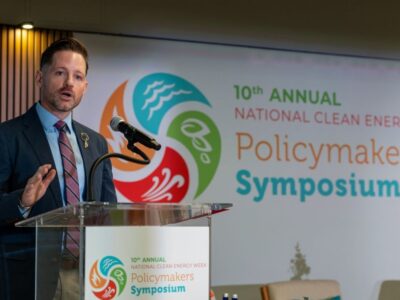
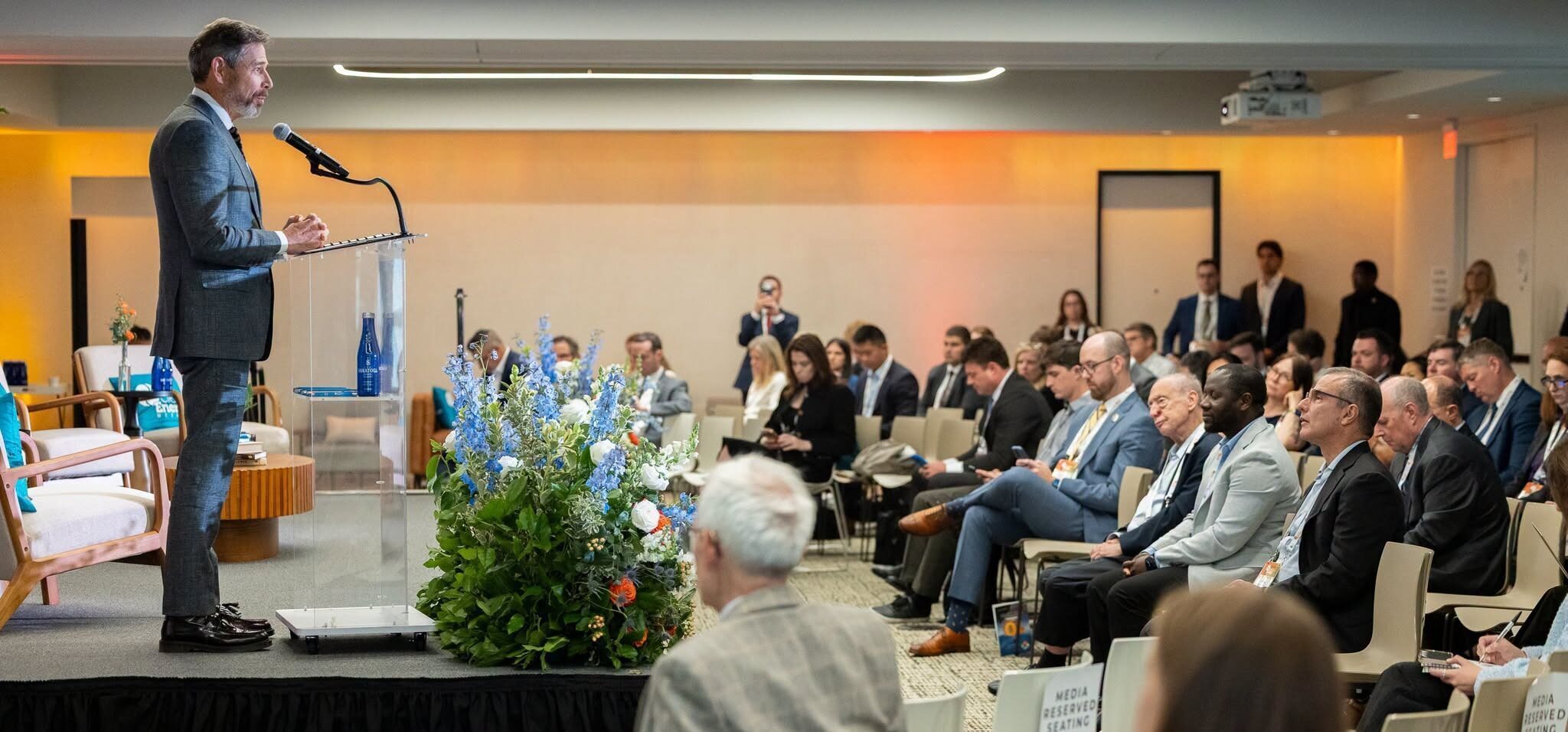
Bipartisan lawmakers, two governors, and senior administration officials spent two days in Washington focusing on permitting, geothermal energy, nuclear power, and household energy bills during the tenth annual National Clean Energy Week, hosted by the Citizens for Responsible Energy Solutions (CRES) Forum.
The Legislative Effort
Sen. Sheldon Whitehouse (D-RI), one of four senators negotiating a permitting package, said that the group recently held a productive meeting. While declining to detail specifics, he highlighted two key provisions. The first would require developers to document prior stakeholder engagement, arguing that early engagement separates the projects that get built from those that do not. The second would establish “waypoints with spotlights” throughout the interagency review process to make clear which agency is causing a delay. Emphasizing the urgency of the work, Whitehouse described climate risk as “systemic” and compared it to economic threats such as uninsurability.
Sen. John Curtis (R-UT), who founded the Conservative Climate Caucus, cautioned about the potential consequences of permitting reform. It will not matter, he said, if a project can be canceled after it is permitted and billions spent. The market needs “predictability, consistency, and reliability,” and a tariff or reversal imposed after the money is committed is among the worst things Washington can do.
Conservative Climate Caucus Chair Rep. Mariannette Miller-Meeks (R-IA-01) noted that the House has already passed its package, warning that serial litigation against fully permitted projects creates unnecessary costs. Rep. Marc Veasey (D-TX-33), who is retiring after seven terms, urged lawmakers to act now rather than wait for the next Congress. Meanwhile, Rep. Nikki Budzinski of Illinois (D-IL-13) pointed out that permitting a single transmission line takes about seven years, framing American energy infrastructure as being at an “inflection point.”
The Agencies
Sworn in May as the 20th director of the Bureau of Land Management, which oversees roughly 245 million acres of public land, Steve Pearce grew up in an oilfield family in rural New Mexico. Raised as one of eight children on roughly $90 a paycheck, Pearce emphasized that he views affordability as a household question rather than a policy abstraction. Under his leadership, environmental assessments that took a year now take fourteen days, he said, and impact statements that took two years now take twenty-eight. He also committed the bureau to plugging every orphaned well on its land by the end of next year, and put its roughly 58,000 abandoned mines on a ten-year schedule.
Alex Fitzsimmons, an associate deputy secretary at the Energy Department, described the same push from his side. The agency has approved more than 18 billion cubic feet per day of new liquefied natural gas export capacity and prevented the early retirement of more than 20 gigawatts of dispatchable generation, which helped during Winter Storm Fern. He also pointed to a $26.5 billion loan package to Georgia Power and Alabama Power projected to save ratepayers $7 billion through lower borrowing costs.
Lastly, Jeffrey McClure, a senior advisor in the department’s Office of Energy Dominance Financing, said his office holds roughly $350 billion in lending authority, and has committed about $100 billion in the past year and intends to deploy the rest during this administration.
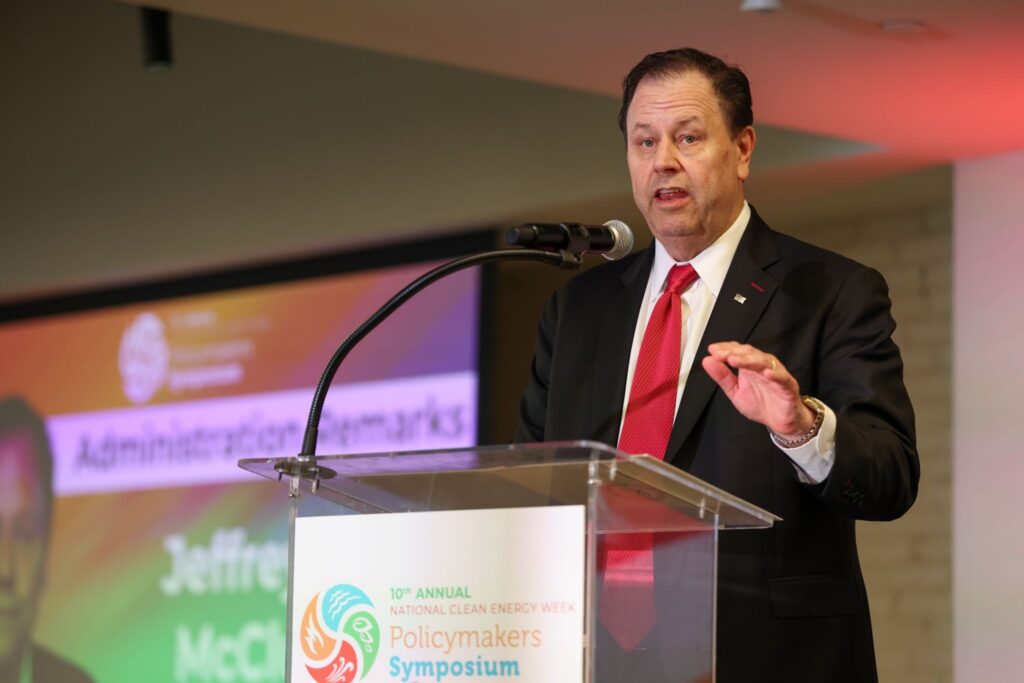
Photo Courtesy National Clean Energy Week
Where The Parties Agree
Geothermal drew more bipartisan enthusiasm than anything else on the agenda. Rep. Jake Auchincloss (D-MA-04), who wrote the Hot Rock Act, explained the politics plainly: Democrats like it because it is clean, and Republicans like it because it involves drilling and the techniques that make it viable came out of the American oil and gas industry. He lives in a state that pays roughly twice the national average for power, and said that abundant, affordable power is the input everything else runs on. He is betting on a microwave drilling method out of MIT’s plasma fusion lab and says it is now a question of whether it can be industrialized into the next great American industry.
Rep. Susie Lee (D-NV-03) highlighted Nevada’s role in clean energy as host to Fervo’s Project Red, the country’s first advanced geothermal plant. Geothermal runs around the clock, she noted, and the U.S. holds more than five terawatts of the resource, enough to meet the electricity needs of the entire world; the Energy Department estimates it could affordably power more than 65 million homes within 25 years. She co-led a six-bill package with a Republican colleague from Colorado that she called the most significant geothermal legislation since 1970, including a measure requiring permits under an existing lease to be processed within sixty days. All six passed the House unanimously. Any permitting deal, she added, should treat solar and wind on the same terms.
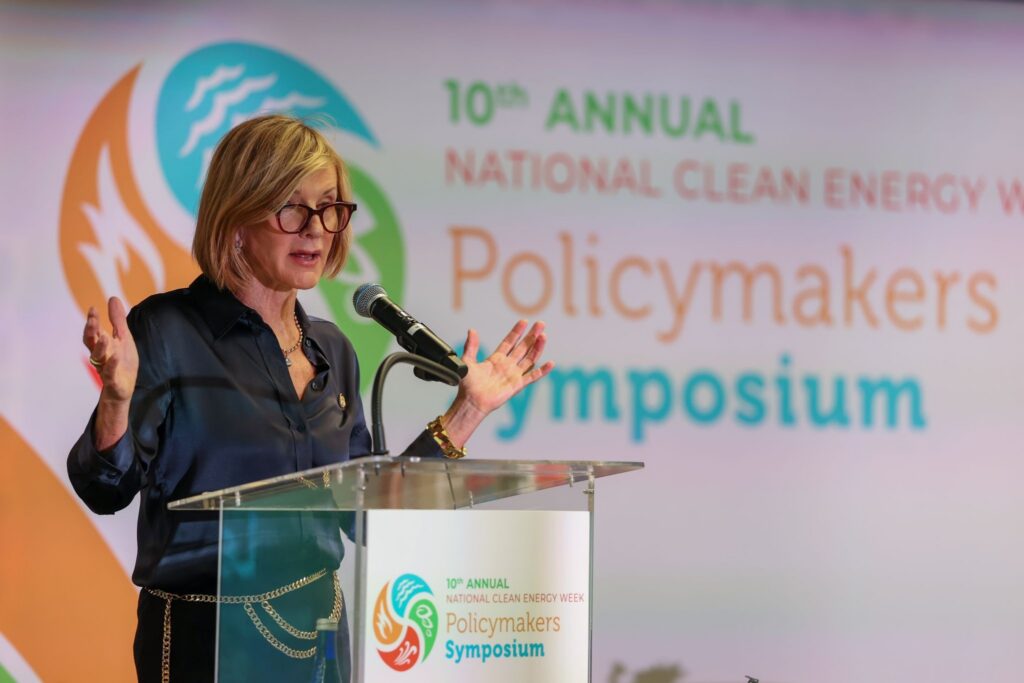
Photo Courtesy National Clean Energy Week
Pearce reported the same momentum on federal land. Fifty-one geothermal plants now operate on BLM acreage producing 2.6 gigawatts, and a recent lease auction drew 200 bidders and a record tract price. Fitzsimmons said the department has opened its largest competitive geothermal funding opportunity, at $174 million.
Nuclear ran a close second. Fitzsimmons said four executive orders aim to quadruple American nuclear capacity from roughly 100 gigawatts to 400 by 2050, backed by a $17 billion loan package. The golden age of nuclear power, he said, is here. He made a similar case for hydropower, the first renewable resource America used, noting that only about 3% of the country’s dams generate electricity and that powering a fraction of the rest could add tens of gigawatts without building anything new. The department is also funding reconductoring, which he said can double or triple the capacity of an existing line at roughly half the cost and half the time, using rights of way the country already holds.
Veasey, first elected in 2012, said that when he arrived in Congress only a handful of Democrats were bullish on nuclear, and that has changed. New Hampshire Governor Kelly Ayotte, in a recorded conversation marking the week’s tenth anniversary, said the state’s legislature has moved on a bipartisan basis to put the state at the front of small modular reactor deployment.
The Bills At Home
Sen. Curtis argued that three things now decide which energy sources win: affordability, reliability, and cleanliness, and that ignoring any one is how policy goes wrong. Government efforts to regulate toward cleaner power have mostly underperformed, he noted. The marketplace moves faster.
Rep. Miller-Meeks made the case for a technology-neutral federal framework and for biofuels, which she said are not an emerging technology awaiting a breakthrough, but something American farmers produce today. Every gallon of ethanol grown here, she added, is a gallon not bought from a foreign supplier. Citing the Energy Department, she put employment across energy and efficiency at 8.5 million Americans. When more American workers and communities hold a direct stake in what gets built, she said, the policy supporting it becomes much harder to dismantle. Iowa leads every state in wind share, generating 63% of its electricity that way in 2024 while keeping among the lowest rates in the country.
Rep. Budzinski co-convened a House working group on gas and utility affordability that heard from more than 100 stakeholders. Regular unleaded gas runs more than $4.50 a gallon in Illinois, and diesel has passed $6 for the first time, she said, arriving as harvest begins. She has pushed a bipartisan bill, already through the House, for year-round E15, a homegrown fuel she said lowers pump prices, reduces emissions, and supports American producers.
Rep. Auchincloss pointed to a lever states can pull without waiting on Washington. There are gigawatts of hidden supply already sitting on the grid, he said, and tapping it through virtual power plants and strategic battery deployment to shave peak demand could bring rates down significantly.
Rep. Juan Ciscomani (R-AZ-06) looked to copper, which supports roughly 50,000 jobs in the southwestern part of his state. He framed domestic extraction and processing as both an economic and an energy security priority, and he has moved a bill aligning the federal government’s competing critical mineral lists so that copper qualifies for expedited permitting. He also pointed to $180 million going into mining education at a time when few American universities still run a mining school, and described the work as the kind of career that keeps people outdoors and employed. He argued that Arizona can be both the “Grand Canyon State” and a copper-producing state; environmental protection and economic development are not mutually exclusive.
American Leadership
Alaska Governor Mike Dunleavy highlighted how the state tests every form of clean energy. Alaska is two and a half times the size of Texas with about 740,000 residents, and more than 220 communities sit off the grid, leading him to call it the microgrid capital of the world. Cook Inlet holds one of the world’s largest tidal resources, Southeast Alaska runs almost entirely on hydropower, and villages along the rivers are installing in-river turbines to let the salmon pass. Wind turbines run above the Arctic Circle at forty below, and solar panels work north of the Arctic Circle, and better in the cold than most assume, with clear skies and snow reflecting light back onto the array. Dunleavy noted that his personal solar setup generates a net credit on his monthly power bill.
Sen. Curtis, reflecting on a decade of National Clean Energy Week, said the movement undervalues small wins. He changed his light bulbs, rode his bicycle to work, and, as a mayor, asked residents to take one fewer car trip a week in a state with half a million vehicles. He also thinks the country can sell the combination abroad, delivering affordable, reliable, clean energy to the world and teaching others how to follow suit.
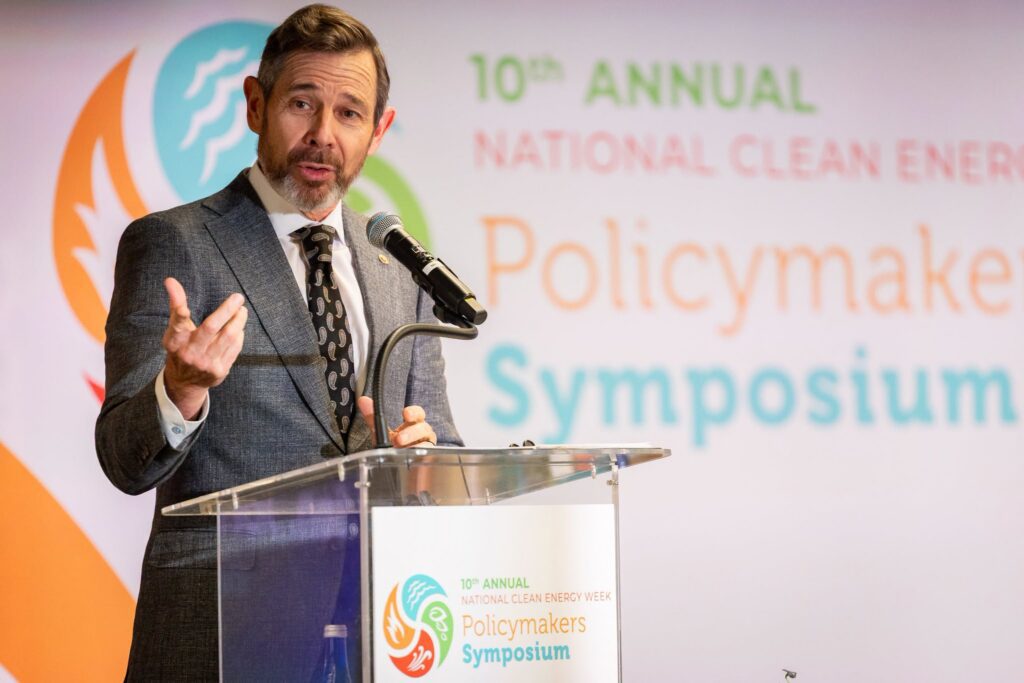
Photo Courtesy Senator John Curtis