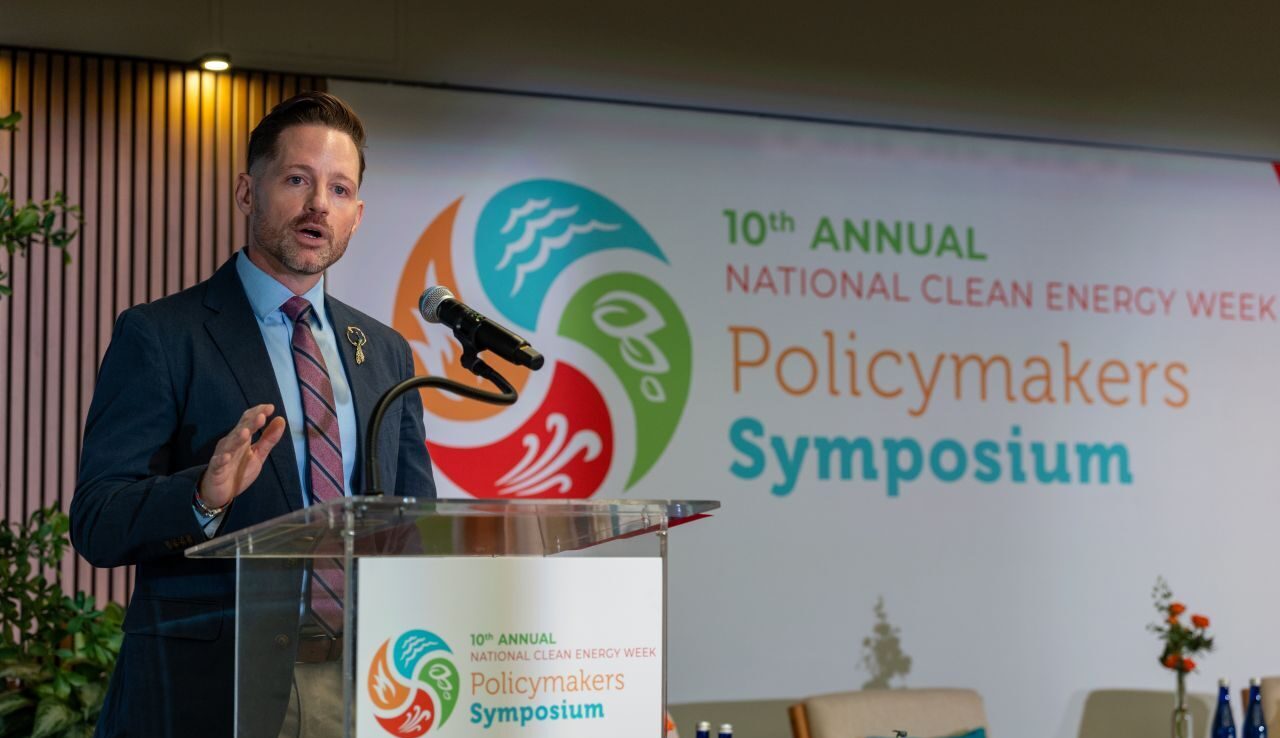
James Dozier has watched the room fill up. A decade ago, he was one of a handful of people trying to give clean energy a national platform, and by his account, that first gathering had “more conviction than chairs.” This year’s program lists six governors, 11 members of Congress and 65 industry leaders.
Dozier chairs National Clean Energy Week and serves as founding president and board chair of the Citizens for Responsible Energy Solutions Forum (CRES), which runs the event. The 10th annual Policymakers Symposium convened yesterday in Washington, D.C.
Demand Set the Terms
After roughly two decades of flat electricity demand, the country is adding load faster than it has in a generation. The North American Electric Reliability Corporation projects summer peak demand to grow by 224 gigawatts over the next 10 years.
David Brown of Constellation Energy said policymakers are tempted to refight the last battle, as though wind winning means nuclear losing or solar winning means gas losing. The fuel wars are over, in his telling: “We can safely triple renewables, triple nuclear, triple gas, and we’re still probably going to need more, including storage.”
Four Sectors, One Complaint
Four trade association leaders shared the morning’s industry panel, and their requests rhymed.
Karen Harbert of the American Gas Association argued for fuel neutrality and letting the most cost-effective source compete. Natural gas supplies about 40% of American electricity, according to the Energy Information Administration, and Harbert said it is three and a half times more affordable for home heating. She pointed to Winter Storm Fern as evidence that the system holds up under strain: 38% of the gas delivered over those 10 days came out of storage, and not a single customer was lost. The industry is adding to that base, with roughly 1,000 renewable natural gas projects now running on landfill, dairy and poultry waste. Nearly everyone who followed repeated her request: permitting reform.
Malcolm Woolf of the National Hydropower Association said it now takes longer to relicense an existing hydropower facility than to license a new nuclear plant. A new study by the association, “Affordable Power, Broken Process,” found projects relicensed since 1986 carry roughly 10 times the conditions imposed at their original licensing, many unrelated to the project. With a wave of relicensing coming for about half the nonfederal fleet, he warned that operators increasingly decide it is not worth it and asked that permit conditions match the project. There is also room to grow without building anything new, he said: 97% of American dams generate no electricity, and roughly 80 pumped-storage projects sit in the pipeline, with none built in 25 years.
John Kotek of the Nuclear Energy Institute counted 94 operating reactors and 39 countries signed on to a pledge to triple nuclear energy worldwide by 2050. Ten years ago, the industry was fighting to keep existing plants from closing early. Today, reactors are being restarted and new projects are under construction. He credited the ADVANCE Act, which directed the Nuclear Regulatory Commission to work faster without relaxing safety standards; processes that took two years now take one. What remains, he said, is the cost and risk of the first few builds.
Brown put that in financial terms. Nearly every Democrat voted for the nuclear tax credits a few years ago, he noted, and nearly every Republican did so last year. What is missing is protection against a catastrophic cost overrun: companies will carry the ordinary risk of building anything, but not the small chance of a worst-case outcome. “If we can figure out a way to address that very small risk, I think you’ll see companies step up,” he said. Constellation is restarting Three Mile Island as a clean energy center.
Jason Grumet of the American Clean Power Association asked for mature tax policy like that enjoyed by oil and gas, permit certainty, meaning federal permission to build actually allows building, and a better path to siting transmission.
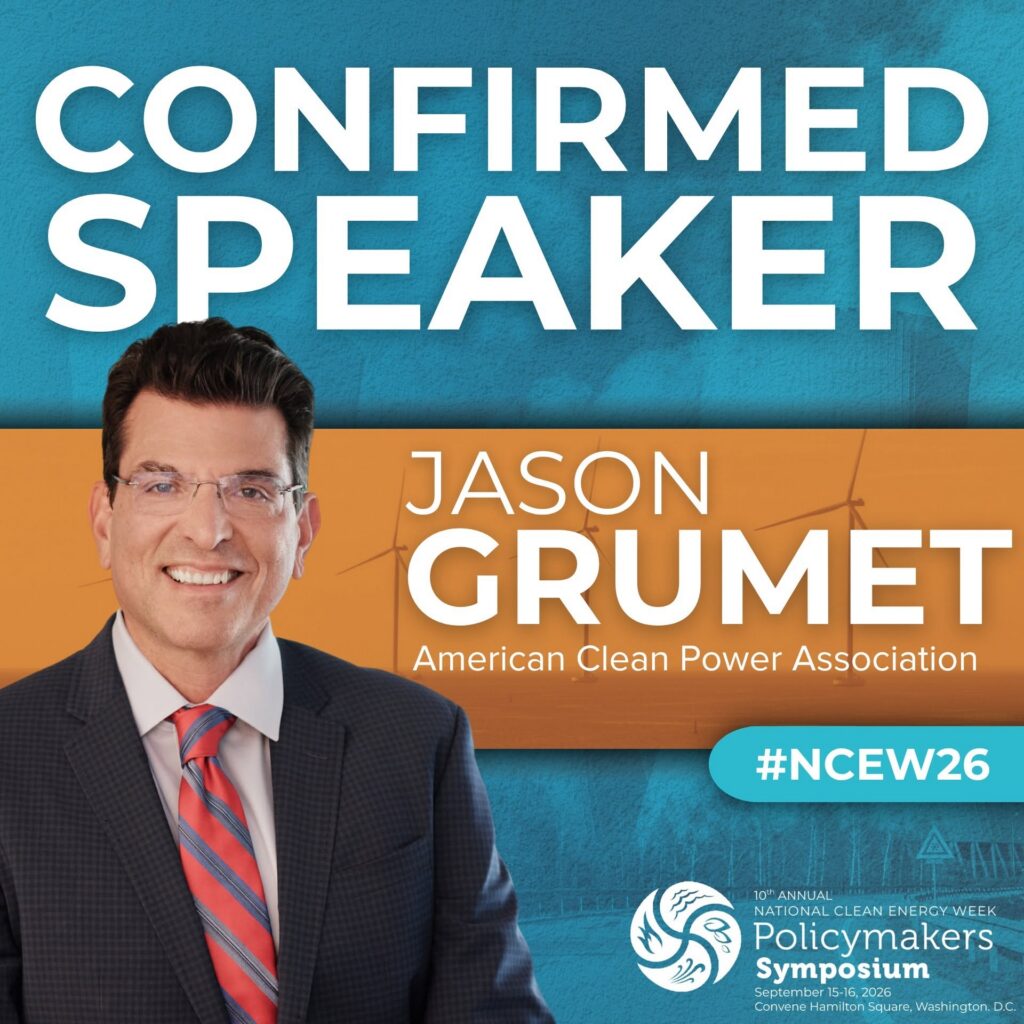
Photo Courtesy National Clean Energy Week
Getting Electrons Where They Are Needed
Caroline Mead of ENGIE North America said buyers who once asked which year a project could be delivered now ask which quarter. The grid already carries more than 300 gigawatts of renewable energy, she noted, and getting more out of what has been built matters as much as adding to it.
Eric Vandenberg of Invenergy said permitting has not been his critical path. His company worked through state regulators on siting, and those processes, though slow, produced approvals with real local buy-in. Invenergy is building the Grain Belt Express, an 800-mile high-voltage direct-current line spanning four states. The obstacles he named instead were the years an interconnection takes, federal rules that make it hard for large customers to fund infrastructure themselves, and the near-absence of interregional planning, which he said is where the country falls short.
Hillary Bright of Turn Forward said the offshore wind technology question was settled in Europe years ago, and roughly six gigawatts are under construction off New England, New York and Virginia. What the industry needs is certainty durable enough to survive a change of administration.

Photo Courtesy National Clean Energy Week
What Capital Needs
A later session stated the argument outright: America has the capital, the technology and the demand to build the most advanced energy system in the world. What it lacks is policy durability, and when rules shift, viable projects stall.
Juan Carlos Puente of Blue Energy said 10% to 20% of a large project’s cost is spent before the final investment decision, which, on a gigawatt-scale project, can mean $300 million to $1 billion committed under one set of rules. One of his projects was under construction when trade policy changed mid-shipment, and he explained, “The delay was probably the most expensive cost we needed to absorb.”
Suzanne Leta of Fluence described the same exposure from manufacturing. Every major component of her company’s storage system is made in the United States, “a huge competitive advantage for us,” which also means a policy change can force a sourcing shift or compliance pause. When a direction is announced before details are clear, she said, deal flow feels it immediately. The American approach is working well enough that the European Union is now trying to replicate its manufacturing tax credits.
Pier LaFarge of Sparkfund builds in small tranches of one to five megawatts at a time, with permitting, financing and construction running about a year. When rules change, he said, the company re-architects for the next tranche instead of rescuing one enormous project.
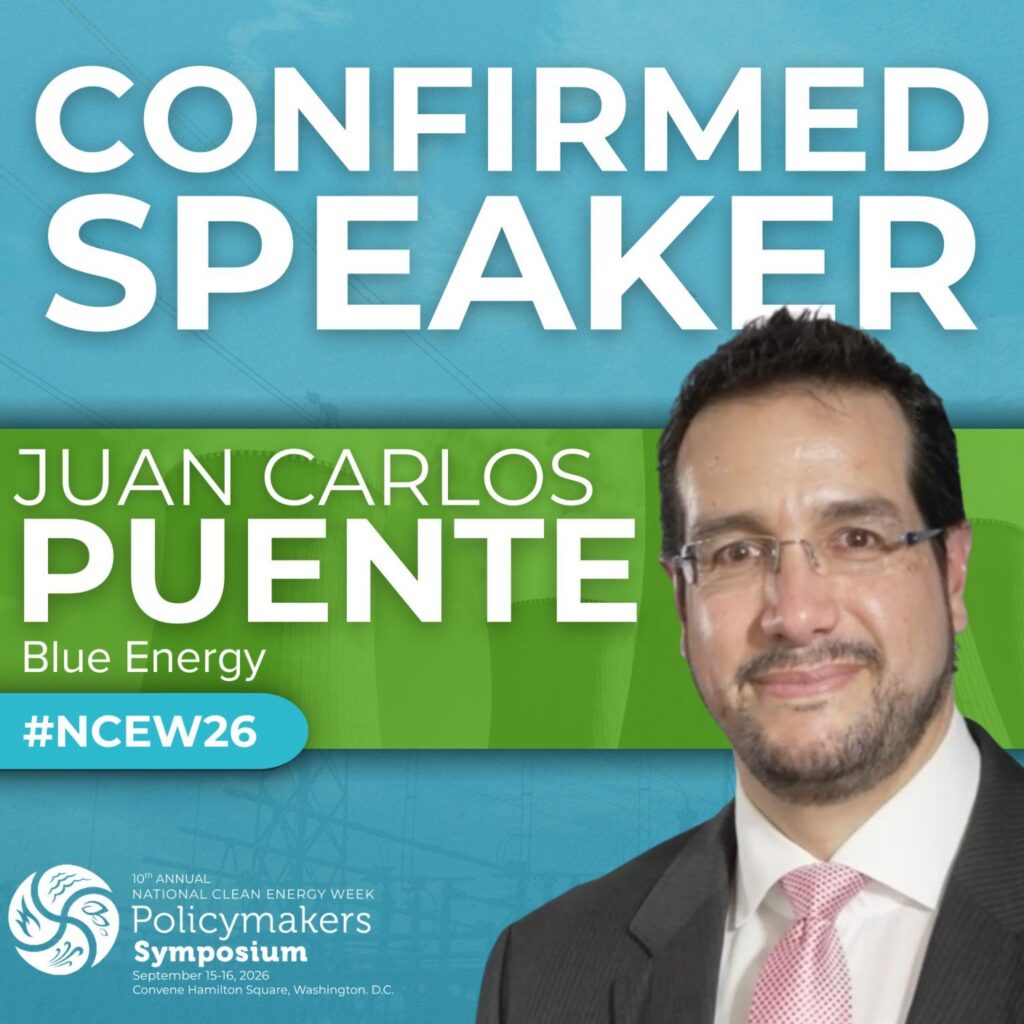
Photo Courtesy National Clean Energy Week
The Load Side
Tom Falcone of the Large Public Power Council divided incoming requests into committed load backed by a long-term financial obligation, probable load with permits and deposits behind it, and speculative load. The distinction once mattered little because a customer needing 10 megawatts changed nothing about what a utility built. One needing 1,000 changes everything, and connecting it can take five to seven years. Underneath sits a supply chain geared to about 1% annual growth and now asked to serve three or four times that rate, which no manufacturer will do without long-term commitments.
Patrick Hennigan of Pacific Gas and Electric said the utility’s grid runs at an average utilization of only about 40% to 45%, making large new customers a chance to spread fixed costs rather than a threat to raise them. He also described a Google-funded pilot testing whether customer-owned batteries, vehicles, and smart equipment can work together through a virtual power plant to relieve local transmission constraints.
The Elder Industry’s Advice
Joe Kakesh of Growth Energy said modern ethanol is “not the ethanol of your parents” and that the industry now competes on lifecycle carbon intensity measured from the moment corn goes into the soil. E15, a blend containing 15% ethanol, saves drivers up to 30 cents per gallon, according to Growth Energy.
His advice to newer industries: build a case you can tell honestly to either party, since no one knows who will write the rules next, and insist that any policy using carbon as a measure stay technology-neutral. He explained, “I’ve been in this particular industry for almost a decade, and that’s what I’ve learned: we can honestly and credibly be players at the table no matter who we’re talking to.”
Durability, Measured in Years
A morning panel of former officials and advisors made the political version of the point: policies passed with votes from both sides have had the most staying power, while those moved through on party lines tend to be clawed back.
John Szoka, now chief executive of the Conservative Energy Network, offered the practical version. A West Point graduate and retired Army lieutenant colonel, he arrived in the North Carolina legislature without being, as he put it, “a clean energy guy,” and approached the subject “the same way my experience has taught me: what works, what’s it cost, and who pays the bill.” He sponsored House Bill 589 in 2017, which introduced competitive bidding into the state’s solar market. Costs came down, and by his account, it saved North Carolina ratepayers more than $350 million by 2021 through competition rather than a new government program.
Jessica Carter, who leads federal government affairs for Ford Motor Company, pointed to a number that moves in one direction no matter who holds Washington. The average vehicle on American roads reached a record 12.8 years last year, according to S&P Global Mobility. A car bought today, Carter said, will still be on the road in 2040, a span covering six congressional elections and three presidential cycles. Every reversal ripples back through the plants, product cycles and the retraining, and lands in the price a customer pays. She said, “The more we have to redo, the higher the cost. The more efficient we are, the more competitive we are, the more affordable the vehicles.”
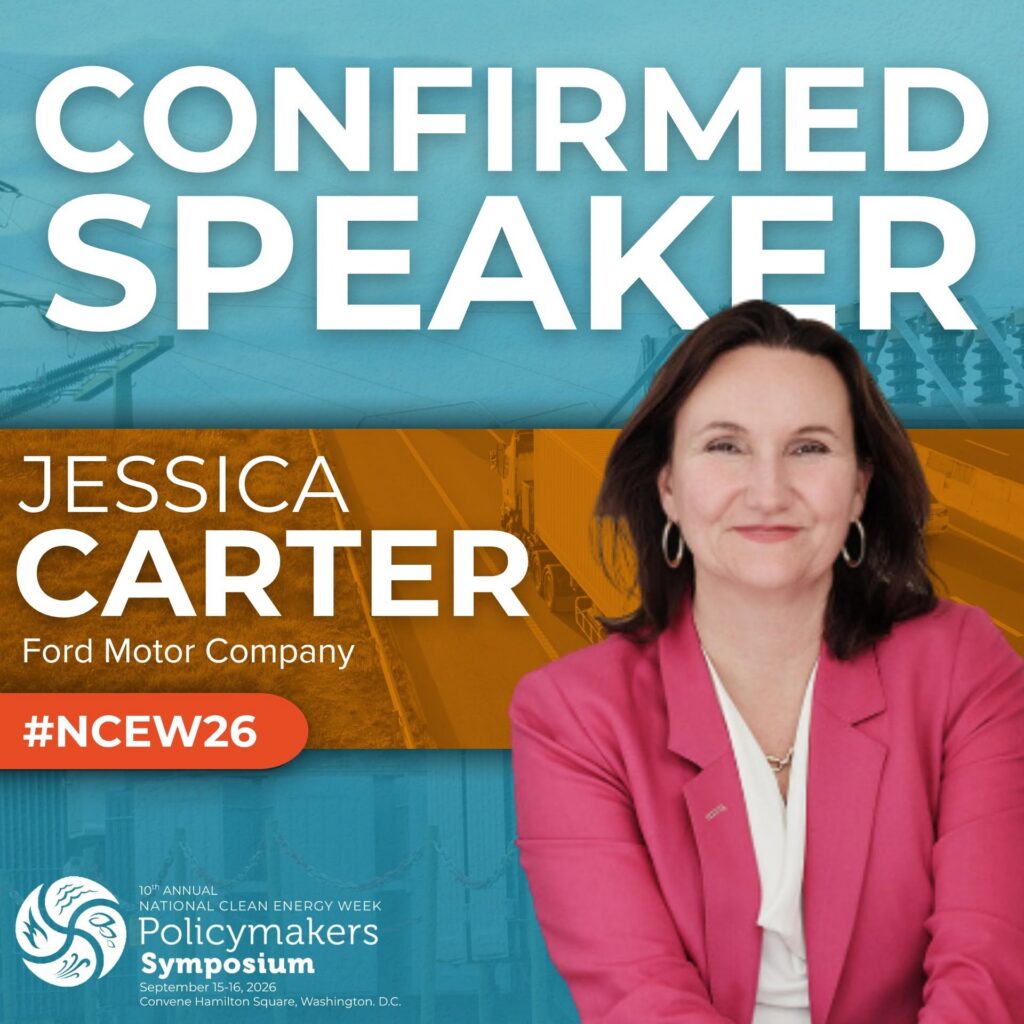
Photo Courtesy National Clean Energy Week
A room full of people who disagree about a great deal had spent the day describing the same wish: not a subsidy or a mandate, but rules that outlast those who wrote them.