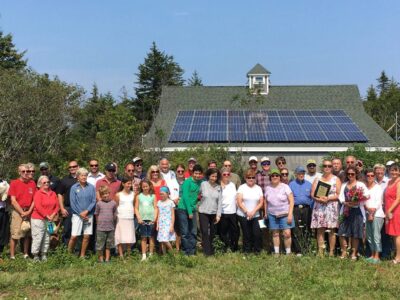

This week is the tenth annual National Clean Energy Week, presented by the Citizens for Responsible Energy Solutions Forum. The Policymakers Symposium concluded yesterday in Washington, D.C. Where the opening day cataloged obstacles, the closing one inventoried work already underway.
The Gap Between Demand And Pipe
Amy Andryszak of the Interstate Natural Gas Association of America pointed to a study by the association’s foundation. Under both scenarios it modeled, she said, the country will need 44% to 55% more power 25 years from now than in 2022, and roughly a trillion dollars of new infrastructure to deliver it.
Liz Bowman of Williams put the shortfall in built terms. Over the past decade, she said, gas demand grew more than 55% while the infrastructure to deliver it grew 27%. “It takes less than a year to build a 400-mile pipeline. Our issue is not building. The issue is permitting takes 4 years,” she said. A permit that can be revoked, she added, is a half promise. Richard England of the Corporate Energy Buyers Association separated two ideas often blurred together. Permit certainty means a permit that holds once issued. Permit neutrality means every project will be judged the same way, regardless of type of political flavor.
The same gap runs a layer down, into the equipment. Debra Phillips leads the National Electrical Manufacturers Association, whose members make the wire, transformers, and switchgear that move electricity from plant to wall. She expects American electricity demand to grow 55% by 2050, a pace unseen in the century since the association was founded during the first wave of electrification. This, she said, is wave two. Transformer backlogs now run for years, and her members have put roughly $200 billion into domestic manufacturing since 2018 to close the distance.

Photo Courtesy National Electrical Manufacturers Association (NEMA)
Fuels For Every Kind Of Movement
About 30% of American energy goes into moving people and goods, Kristine Wiley of GTI Energy told another panel, and the cheapest path for emerging fuels runs through infrastructure the country already owns. Pipelines, terminals and fueling stations built for conventional fuels can carry hydrogen, renewable gas and sustainable aviation fuel, lowering commercialization costs. Subsurface expertise transfers the same way, she said, from oil and gas into geothermal and hydrogen.
Albert Gore of the Zero Emission Transportation Association said one in four vehicles sold worldwide last year was electric, and that the strongest American growth is in used models, where buyers doing the fuel arithmetic often recover the price difference within a year. Fleets returning to the same yard nightly are a natural fit, and the private market installs more than a thousand charging plugs a week.
Geoffrey Dietz of the RNG Coalition made the case for renewable natural gas, captured from landfills, wastewater plants, and livestock operations rather than drilled. Production rose roughly 600% between 2014 and 2024, he said, and his organization has identified about 43,000 organic waste sites across the United States and Canada where more could be built. Dairy farmers hosting projects earn lease and revenue-sharing income, and reuse byproducts as bedding and fertilizer.
What America Already Sells The World
Dustin Meyer of the American Petroleum Institute offered a twenty-year comparison. In 2005, the United States was the world’s largest oil importer, he said, and was projected to become the largest importer of liquefied natural gas. Today, it is the largest energy exporter, with LNG exports exceeding 17 billion cubic feet per day earlier this year.
Samantha Dravis of NextDecade described what building that capacity involves. Her company’s Rio Grande LNG facility supports more than 6,000 construction jobs and $30 billion in investment and indirect jobs, and will come online in early 2027. It applied for federal authorization in 2016, then spent the decade in review and litigation. “10 years to get one energy infrastructure project built is too long,” she said of the project that is now generating clear benefits.
Robert Fee of Cheniere Energy said his company shipped its first cargo in February 2016 and has since exported 5,000 from facilities in Louisiana and Texas. “In the U.S., we have been able to build big things,” he said. Those things are also getting more environmentally friendly. Kendall Stephenson of the U.S. Chamber of Commerce’s Global Energy Institute said that between 2014 and 2024, the oil sector cut its methane intensity by 60% and the gas sector by 40%.
What Capital Is Waiting On
Alfred Johnson of Crux sized the market at roughly $180 billion of capital expenditure this year across generation, storage, manufacturing and critical minerals. Capital moves easily for established sponsors, he said, less easily for new technologies.
Jennifer Von Bismarck of Galway Sustainable Capital works at the smaller end. She described a Midwest project with about a gigawatt in an interconnection queue, expected to wait two years to learn its grid upgrade costs and waiting four, with $90 million on deposit the whole time to hold its place.
Hunter Armistead of Pattern Energy pushed back on the reflex to blame regulators. His company built SunZia, which he described as the largest transmission project in the country, and by his account permitting took four years once Pattern re-entered it, with “extremely responsive” treatment across two administrations. He argued that more had not been built because load stayed flat for twenty years and the demand signal was absent. However, “It’s now game time. There’s no more excuses.”

Photo Courtesy National Clean Energy Week
Who Actually Builds It
Bob Keefe runs E2, a national organization of business leaders that tracks clean energy projects. More than 3.5 million Americans now work in the sector, he said, and after the Inflation Reduction Act passed, companies announced over $145 billion across more than 400 projects and roughly 150,000 jobs. Then the rules changed. More than 100 of those projects were canceled, he said, taking about $40 billion and 66,000 announced jobs with them, and some $90 billion in construction-phase output. “Let us build stuff,” he argued.
Sheila Moynihan of the Energy Infrastructure Alliance Forum, once chief operating officer of the Energy Department’s loan office, made the workforce case through nuclear. Building the Vogtle plant in Georgia took an estimated 9,000 construction workers the country did not have, since nothing comparable had been built in thirty years. Those workers exist now, and the restarts draw on them.
Sarah Griffiths of Hydrostor said its 500-megawatt compressed air storage project in Kern County, California, carries roughly 700 multi-year construction jobs. One site sits across the street from a gas plant, and those workers can walk over and run the same turbines thanks to transferable skills.

Photo Courtesy Sheila Moynihan
Down To The Rock
Roger Martella of GE Vernova said his company’s equipment supports about a quarter of the world’s electricity and roughly half of America’s, and has invested about $1.3 billion since the inauguration. He described an expansion at its Greenville, South Carolina turbine plant that will triple capacity over five years.
Sasha Mackler of ExxonMobil Low Carbon Solutions explained why an oil company is entering the graphite business. North American demand is projected to rise 450% by 2040, he said, and his company has the feedstock, the technology and the project experience. Graphite product charges 30% faster, lasts four times longer, and uses less energy in production than alternatives, he claimed.
Lawrence Kast said his company, Solstice Advanced Materials, is the only American supplier of uranium hexafluoride, an irreplaceable input to nuclear fuel, and one of five worldwide. It has invested more than $100 million since 2022 to restart and expand its Illinois nuclear-fuel conversion facility.
Mike Satre of Hecla Mining Company, founded in 1891, closed the loop. Its Greens Creek operation on Admiralty Island is the largest silver mine in the country, works inside a federally protected national monument, and has spawning salmon running past the portal. Operating safely and efficiently, solar manufacturing now drives much of the silver demand. “If we’re going to have it in America, it starts with mining in America.”
The Long Horizon
Charles Hernick said Amazon’s newest interest is the heat under the ground. The company announced a Nevada project this year pairing 100 megawatts of geothermal with solar and storage, its first move into geothermal at that scale. Geothermal supplies it whether the weather cooperates or not.
Bob Mumgaard of Commonwealth Fusion Systems described today’s energy system as closer to “gathering” than to “making.” Power means finding fuel, moving vast quantities of material, and building where the resource sits. Fusion inverts that, he argued. The reaction releases on the order of a hundred million times more energy per unit of input than combustion, which makes the fuel bill nearly irrelevant and turns the plant itself into the product: a machine that can be manufactured and sited anywhere.
Tim Pawlenty, who leads the Solar Energy Industries Association, closed the day. Independent analysis puts solar among the cheapest sources to add, he said. Batteries have stretched from two hours of storage toward ten, and a project can go from concept to power in about 24 months. No foreign government can block the sun. The sector can add reliable new supply while supporting a cleaner energy portfolio.

Photo Courtesy National Clean Energy Week
Overall, the future looks bright for renewable energy and the demand is there, but there is plenty of work still to be done to meet the demand.