Celia-Marie Bartholomew heard about an apprenticeship with Stadler in her high school welding class. “At the time, I didn’t really know what I wanted to do with my future,” she told the Deseret News. “I wasn’t sure if college was the right path. But now, I’m on track to earn a degree while I’m getting professional work experience and, hopefully, have a job offer waiting for me at the end.”
By June 2026, she was nearing the end of a three-year apprenticeship at the Stadler Rail factory in Salt Lake City through the Talent Ready Apprenticeship Connection (TRAC). The program began in 2018 as Utah’s first youth apprenticeship, with Stadler as one of the founding partners. High school students split their senior year between classes and paid work at the plant, then earn an associate degree in advanced manufacturing at Salt Lake Community College, with Stadler paying tuition. Nearly 100 students have joined the program since 2019, and 13 of the 17 who signed on in April 2026 will be apprentices at Stadler.
“I’ve looked at apprenticeships across the country, and I don’t think there is anything that rivals what’s been created by Stadler for us in Utah in partnership with Talent Ready,” Salt Lake City School District Superintendent Liz Grant told the Utah Board of Higher Education in August 2024.
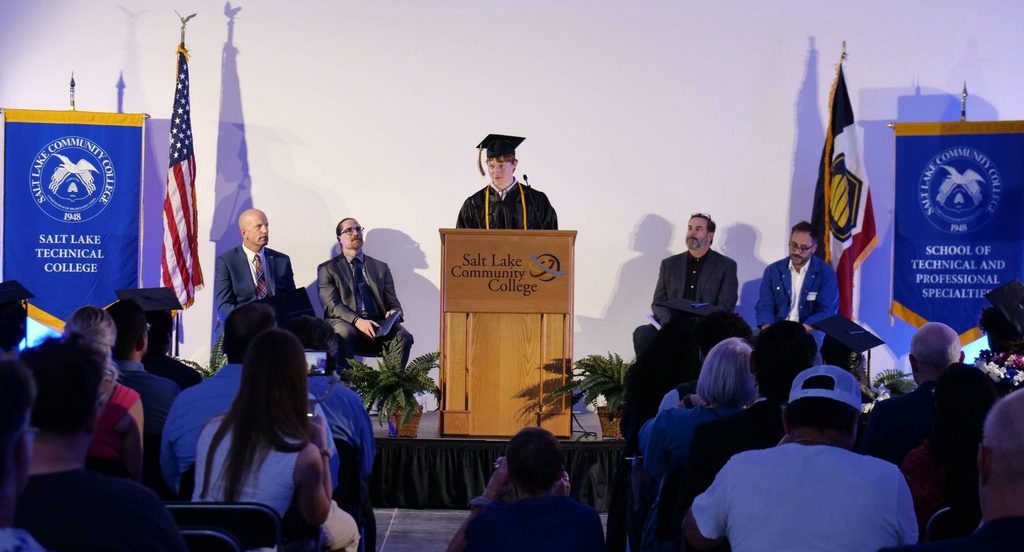
Photo Courtesy Salt Lake Community College
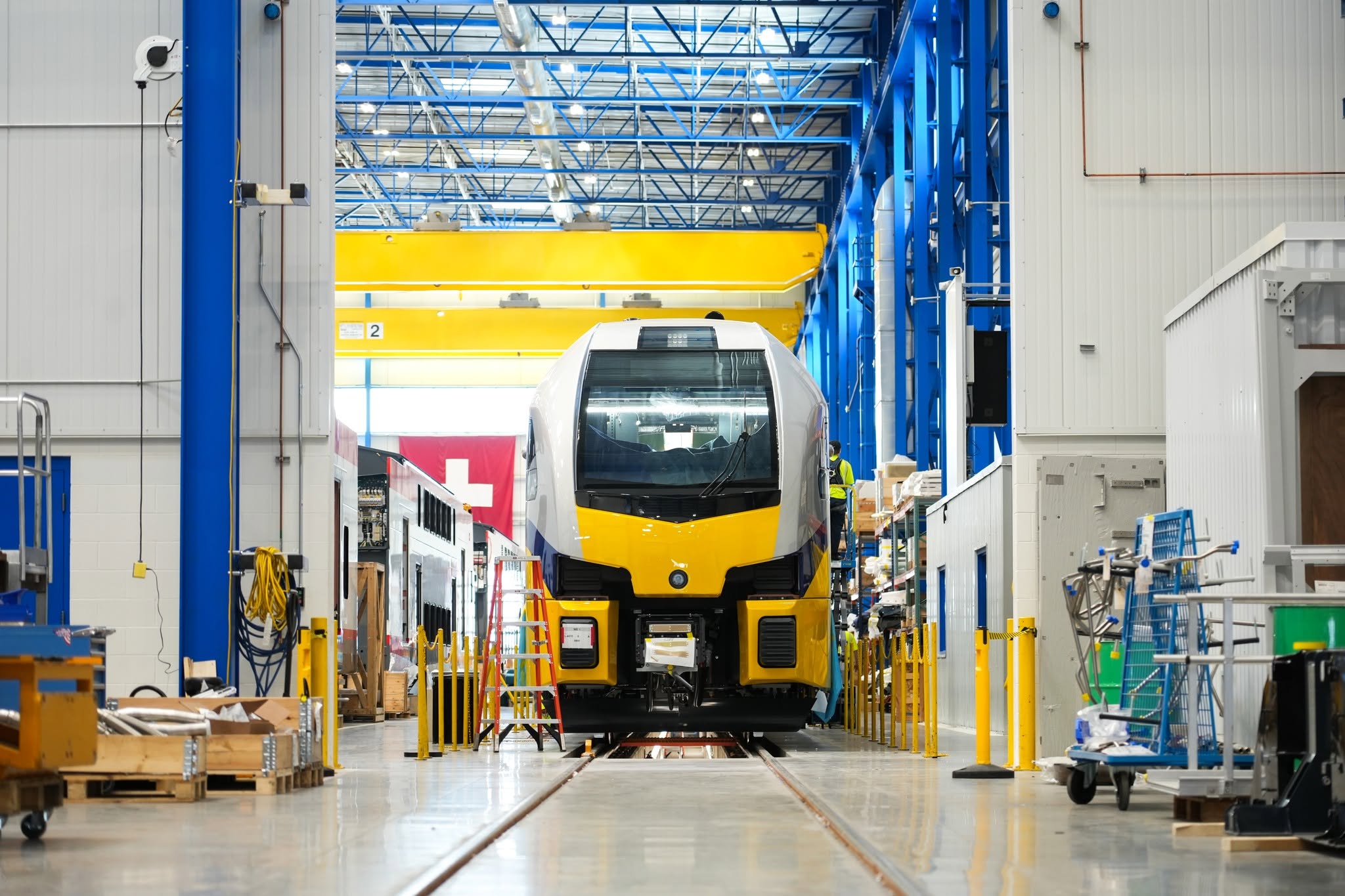
Stadler has built trains since 1942 from its headquarters in Bussnang, Switzerland. In June 2015, the Fort Worth Transportation Authority ordered eight FLIRT (Fast Light Innovative Regional Train) trains for its new TEXRail line. Federal money helped pay for them, so the purchase fell under the Buy America Act and the company needed a U.S. factory. It rented a former Union Pacific plant in Salt Lake City.
Today, transit rail vehicles bought with federal funds must meet a minimum domestic content of 70% of component cost and undergo final assembly in the United States, according to the Federal Transit Administration.
Stadler committed to Utah in October 2017, when it broke ground on a 62-acre site with its own rail siding, an investment of about $50 million. It moved all its Utah operations into the 230,000-square-foot finished plant near Salt Lake City International Airport in March 2019. “It feels great to permanently take root in Salt Lake City and celebrate the beginning of a new age in railroading,” said Martin Ritter, who leads Stadler’s U.S. business. “We are here to stay!”
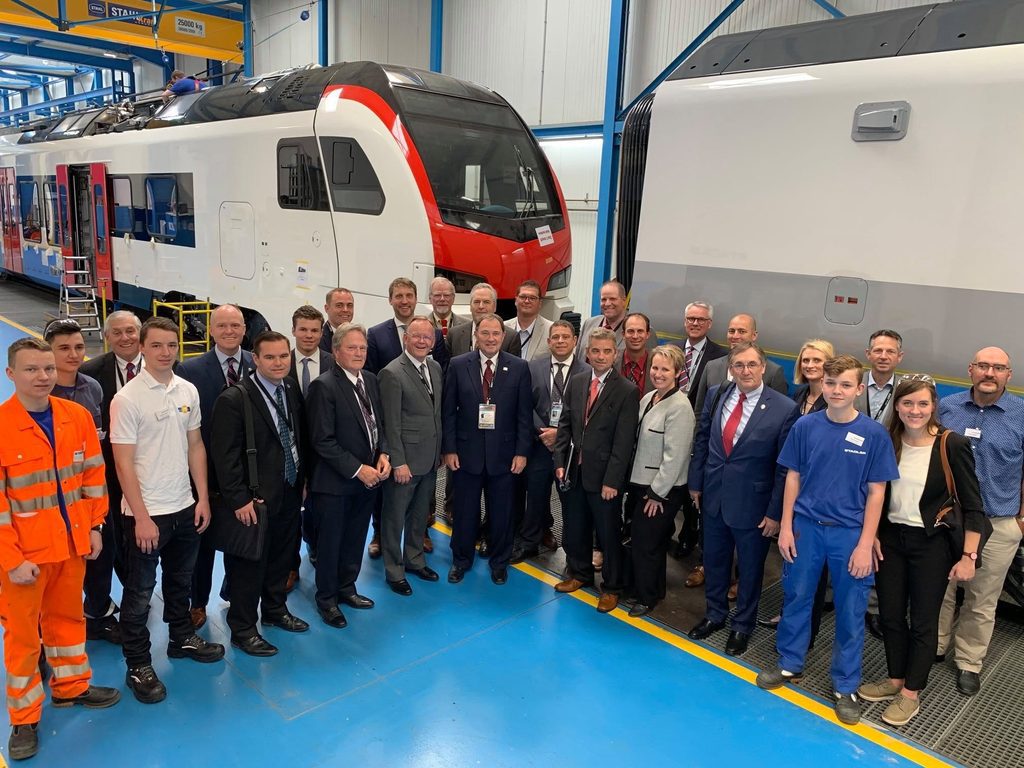
Photo Courtesy Governor Gary Herbert
The biggest step arrived on September 25, 2025, when Stadler’s new 50,000-square-foot welding hall delivered “the first locally welded aluminum car body in the company’s North American history.” Before then, the company’s European welding plants shipped car bodies across the Atlantic. Stadler welding experts from Hungary came to train the local crew, and the hall was set to add up to 20 local welding and technician jobs by the end of 2026. Salt Lake City Mayor Erin Mendenhall reacted, “With the opening of this new welding hall, train car bodies will be manufactured locally. That means jobs, innovation, and a more sustainable future.” Stadler said the change raised the domestic content of its U.S. trains to around 80%.
“We set out to build more than just trains,” Ritter, now CEO of Stadler North America, said at the opening. “We’re building economic opportunity, stronger supply chains, and a future where American-made trains are synonymous with world-class quality. Today, our welders are proof that it can be done.”
On July 1, 2026, Stadler also opened a 245,000-square-foot expansion bringing its Salt Lake City manufacturing area to 475,000 square feet and expected to create up to 300 local jobs, including youth apprenticeships. Stadler now employs around 750 people in Utah. Peter Spuhler, Stadler’s Chairman of the Board of Directors, said, “Ten years ago, we made a strategic decision to invest and to build our own factory in the United States. We believed in the potential of the American market. Over the past decade, Stadler has established itself as a true American train manufacturer.”
As Lucy Knight Andre, CEO of Stadler Signaling North America and chief of staff for Stadler U.S., recalled to the Deseret News, “We looked at a lot of places to locate and decided on Utah. And it’s been an amazing decision for us. It’s easy to say we liked the mountains — but there’s a tremendous workforce here.”
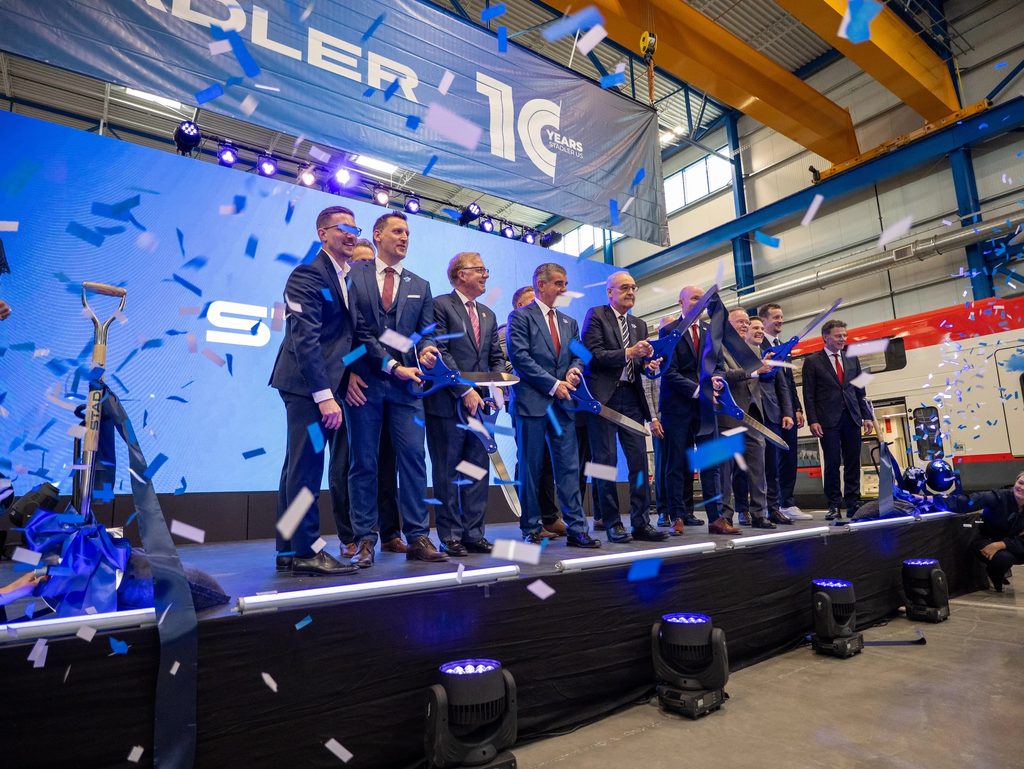
Photo Courtesy Stadler Rail Group
After placing an initial order with Stadler in 2024 and expanding it in 2025, the Utah Transit Authority (UTA) has 40 Citylink light rail vehicles on order for its TRAX system, which Stadler called “the first Stadler-built light rail vehicles to operate in Utah,” as well as the first large Citylink order outside of Europe. When the first contract was signed, Ritter noted that “most of our workforce and their families live in and around Salt Lake City and will ride these new trains.” The company is building the trains in Salt Lake City, describing them as “proudly built in Utah, for Utah.”
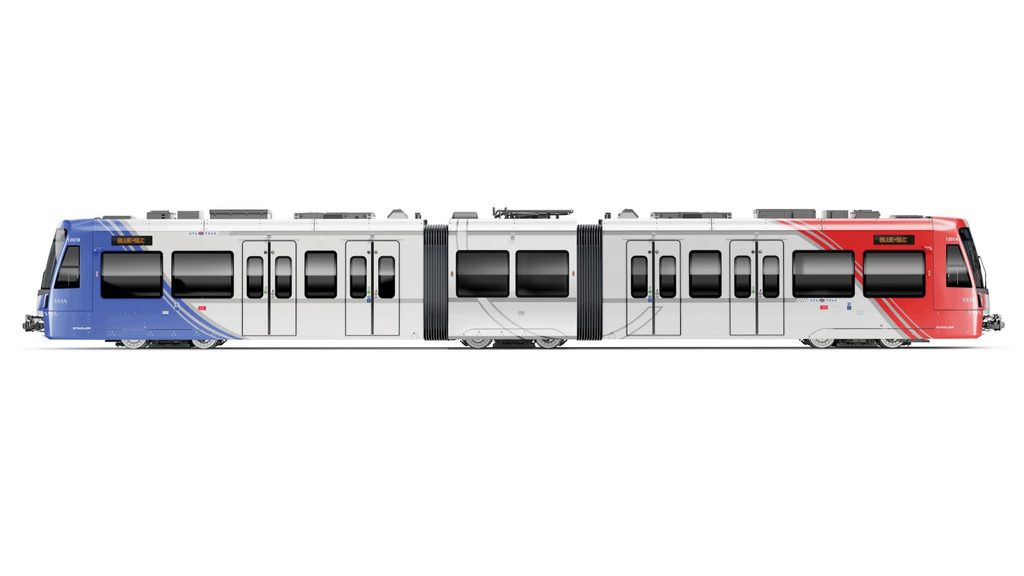
Photo Courtesy Stadler US Inc.
The Utah Department of Transportation also selected Stadler’s $328.3 million bid to build at least 10 trains for the FrontRunner commuter rail line, which runs from Ogden to Provo, The Salt Lake Tribune reported in July 2026. However, the contract was not yet final. The state’s FrontRunner 2X project aims to increase train frequency and travel reliability, and lists “10 U.S.-Made Trainsets” among its planned improvements.
Beyond Utah, the Stadler plant builds trains for Caltrain in California, Metra in Chicago, TEXRail in Fort Worth, and the Metropolitan Atlanta Rapid Transit Authority (MARTA). MARTA’s board approved a $646 million agreement with Stadler in 2019 for 254 new rail cars, which MARTA says was the biggest purchase either side had ever made. In Chicago on Oct. 5, 2026, Stadler and Metra unveiled the first battery-electric FLIRT train developed for the U.S. market, Metro Magazine reported. Metra ordered eight and expects the new trains to be in passenger service by 2028. “This purchase demonstrates Metra’s commitment to cleaner power, to quieter trains, and to thinking outside the box as we plan for our future,” said Metra Executive Director and CEO Jim Derwinski.
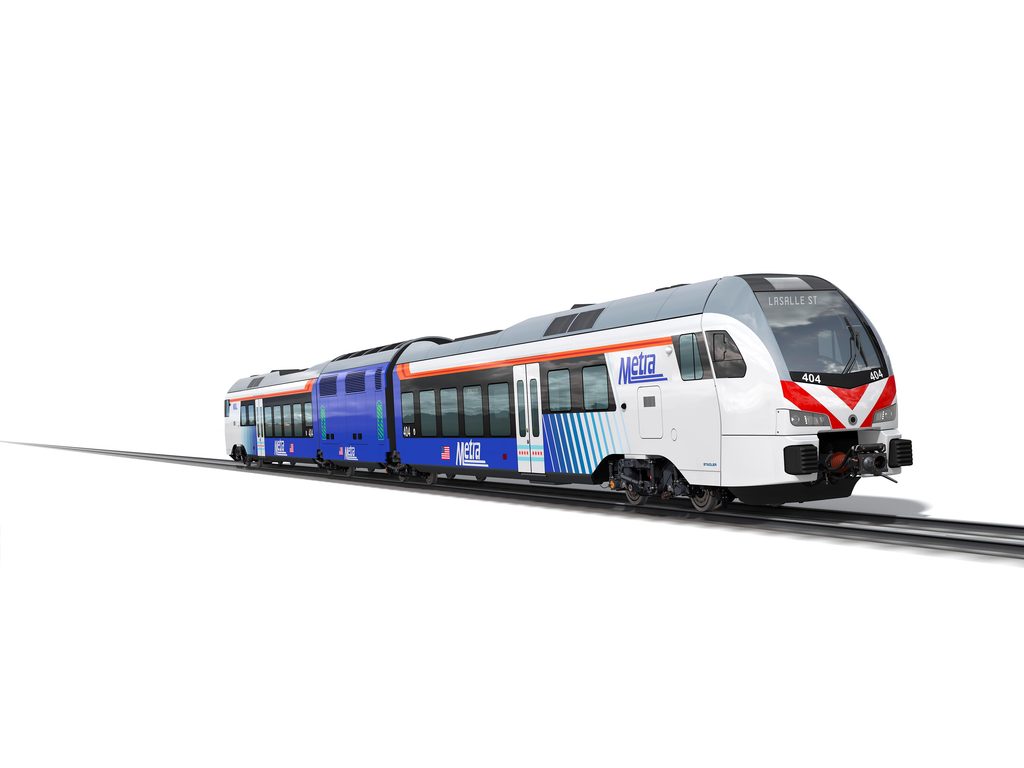
Photo Courtesy Stadler
“Stadler is reminding us that we can build again,” Utah Gov. Spencer Cox said at the 10-year celebration, KSL.com reported. “We can build big things.”
For Bartholomew, the work feels personal. “I want to be a part of contributing to making public transit in Utah as good as it can be,” she told the Deseret News.