

Interest in clean technologies is rising across the nation, according to S&P Global. In a special report released at the beginning of the year, “Top Cleantech Trends for 2025,” the financial information and analytics company found that for the first time, this year’s global investments in clean technology supply – spanning across clean energy generation, green hydrogen production, and carbon capture and storage – will be larger than the year’s investments in upstream oil and gas.
Numerous accelerators, educational institutions, and other organizations are helping the sector to advance and prosper. Across the Southeast, in particular, organizations are working to advance cleantech.
North Carolina
The Research Triangle Cleantech Cluster traces its origins to the Research Triangle Regional Partnership, an economic development organization. Located close to Duke University, North Carolina State University, and the University of North Carolina at Chapel Hill, in one of the world’s biggest research parks, more than 350 cleantech companies can be found. The cluster, therefore, has cultivated a network of members and partners that it regularly convenes to offer opportunities to build relationships, exchange ideas, and foster innovation. Some of the most notable members include ABB, Duke Energy, and Hitachi, all of which have seats on the Research Triangle Cleantech Cluster Board of Directors. The cleantech cluster also deploys programs and taps partnerships to help develop the next generation of cleantech leaders, such as the Cleantech Connect Career Fair, which it claims is the biggest cleantech career fair in the Southeast.
Across the state in Charlotte, the Joules Accelerator launched in 2013 to advise and advance early-stage climate startups, which it connects with industry advisors and provides access to events where they can pitch potential customers. After graduation, the startups can apply for a Joules Camp pilot grant to deploy their technologies in local communities. With two 90-day cohorts per year, the accelerator has seen more than 90 graduates join its portfolio, which have raised more than $1.7 billion in early-stage venture funding and created more than 3,300 new jobs to date. Some of their most notable graduates include Huntersville, North Carolina-based EV charging solution provider Atom Power and San Francisco, California-based EV charging optimization company WeaveGrid. The nonprofit also received support from companies including GE Vernova, Honeywell, and both the U.S. Department of Energy and the U.S. Economic Development Association.
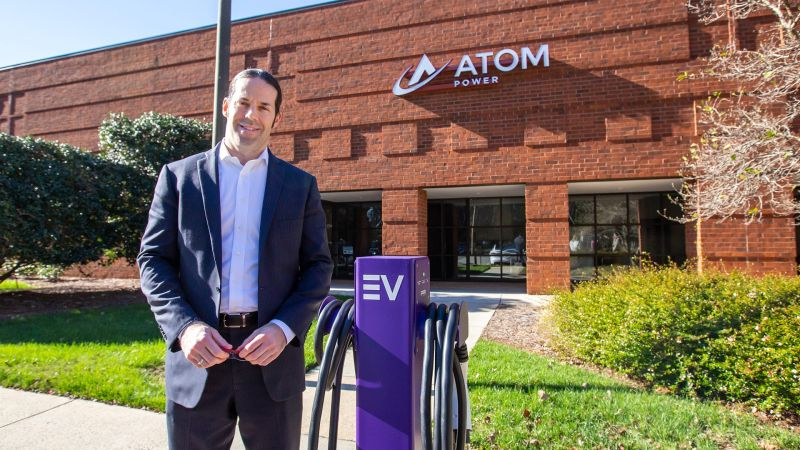
Photo Courtesy Atom Power
Georgia
In 2023, the Greenhouse Accelerator launched the Georgia Cleantech Innovation Hub in Atlanta. The state is located in the battery belt, with universities that spend more than $3 billion on research and development per year. Furthermore, there are more than 800 cleantech companies in Atlanta alone, particularly in the e-mobility and solar industries. The public-private-academic partnership seeks to contribute to this momentum by providing local education to build cleantech expertise, building a connected community of cleantech leaders, creating places for them to meet, and ultimately, “fostering the innovation and sustainability culture in a way that is uniquely Georgia.”
The Georgia Cleantech Innovation Hub last year teamed up with gener8tor and the Cox Enterprises empire to launch the Cox Cleantech Accelerator in Atlanta. The twice-yearly, twelve-week program, with five companies per cohort, has supplied Southeastern early-stage operations with industry connections, mentorship, and $100,000 in capital investment each. Some of the success stories from the first program include Accelerate Wind, whose small wind turbines are meant to be paired with solar panels for commercial rooftop installation to boost energy generation by an additional 25%, and Flux Hybrids, whose plug-in hybrid powertrain technology can be installed on new vehicles to increase their fuel efficiency. The second cohort launched at the end of last month. Moreover, Cox Enterprises and Cox Cleantech have collectively invested more than $2 billion in cleantech businesses spanning a variety of stages, from early startups to more commercially successful companies, since 2007.

Photo Courtesy Flux Hybrids
Tennessee
In 2020, the Spark Innovation Center at the University of Tennessee Research Park teamed up with Evergreen Climate Innovations – previously Clean Energy Trust – to launch the Spark Cleantech Accelerator. In the five years following, the twelve-week accelerator program has assisted 29 early-stage cleantech companies that have together raised more than $77 million in funding and created 108 jobs. Last year, the Spark Innovation Center announced that the country’s biggest utility, the Tennessee Valley Authority (TVA), would sponsor the Spark Cleantech Accelerator, offering its technical expertise, as well as funding to the startups. The companies selected for the 2025 Spark Cleantech Accelerator, which will launch at the end of this month, can expect to benefit from training workshops, prototyping services through the University of Tennessee’s Center for Materials Processing, and practice with pitching. Other sources of funding and support for the program include the City of Knoxville and the Tennessee Advanced Energy Business Council.
Alabama
The Birmingham-based Techstars Alabama Power EnergyTech Accelerator is part of the Techstars network, launched with support from the utility Alabama Power in 2020. The accelerator invests across the entire energy vertical, ranging from clean energy, to clean vehicles, to the grid. By the end of 2023, the participating companies in the program had collectively raised $150 million. Graduates have included Boise, Idaho-based Pitch Aeronautics, which deploys power line components via droids, and Los Angeles, California-based EV Safe Charge, whose EV charging robot, named ZiGGY, comes to you. Other support for this accelerator came from the University of Alabama, the Economic Development Partnership of Alabama, and the Alabama Department of Commerce, again indicating the importance of community involvement in these types of initiatives. As Managing Director Matthew Jaeh explained, “Success is not achievable without support. There are ladder climbers and ladder builders. Be a ladder builder.”

Photo Courtesy ZiGGY Powered by EV Safe Charge Inc.