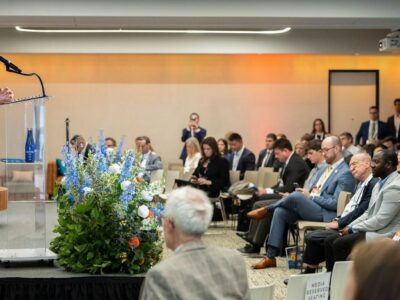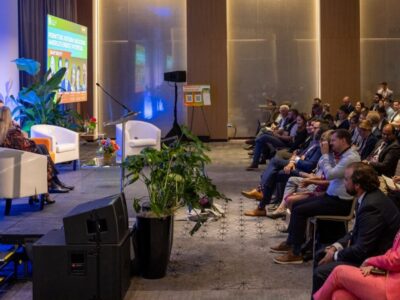
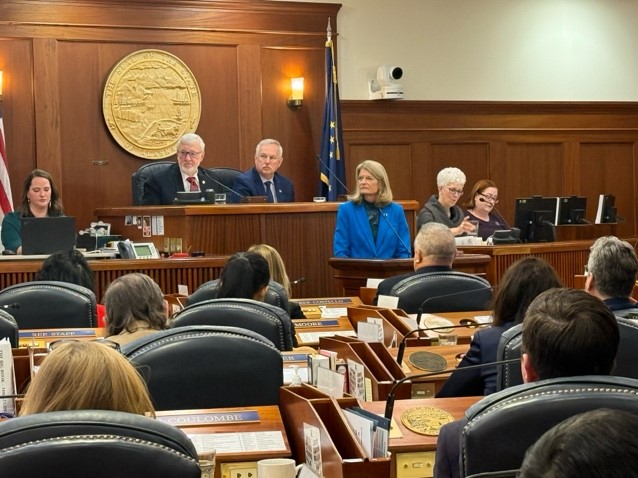
Senator Lisa Murkowski (R-AK) painted an optimistic picture for Alaska’s future in her annual address to the Alaska State Legislature.
In the speech, Sen. Murkowski reflected on all of the successes achieved in the past year: “Even in an election year, last year, we made progress for Alaska.” She pointed to the groundbreaking on the Kenai Bluff Stabilization project, funded by the Bipartisan Infrastructure Law, which will help prevent coastal erosion. She also highlighted the successful addition of $300 million to the U.S. Department of Commerce’s fishery disaster assistance account, previously noting that “the continued delays in the distribution of fishery disaster funding has been devastating for many in this vital industry, often forcing fishermen to change careers or even leave the state.”
Sen. Murkowski spent a significant portion of her speech focusing on the people whose work contributed to these past successes: “We’ve accomplished a lot, but it took hard work from the delegation, from you, from our teams, and from Alaskans across our state. Our people made the difference.”
As she highlighted the opportunities awaiting the state, she also emphasized the role that Alaskans will play going forward: “Every one of our opportunities depends on our people. People make it all happen. People allow us to be resilient. Resource development. Road construction. Fishing and tourism. Everything… We have incredible potential, but it will take all sorts of people, doing all sorts of things, to realize it.”
Among the opportunities awaiting the state, Sen. Murkowski emphasized, “We need to recapitalize an aging fleet. The President’s push for more domestic shipbuilding can be great for us, and I want it to reach Ketchikan, Seward, and more.” Companies building new vessels and offering repair, retrofit, and maintenance services include Vigor at the Ketchikan Shipyard and JAG Alaska at the Seward Shipyard.
Sen. Murkowski also noted the opportunity for a growing private sector: “We also have a chance to grow our private sector and reduce our dependence on the federal government. We need to embrace that, because it will benefit and could define our economy, our budget, and our quality of life for a generation or more.”
She also highlighted how energy and critical mineral projects are creating jobs and boosting the state’s economy, “We can put Alaska back on the global map for energy and resource production.” In particular, she noted that the state can expedite the permitting process for Graphite One. The site will be crucial in establishing a domestic supply chain of graphite materials for the production of large-capacity batteries used in electric vehicles, vehicles powered by hydrogen fuel cells, and energy storage systems. After the project received a $37.5 million grant from the Department of Defense, Sen. Murkowski reacted, “The Graphite One project is in a league of its own, in terms of the scope of the resource in the ground in Alaska and the vision the company has for manufacturing anode materials and recycling batteries in Washington state.”
Sen. Murkowski also highlighted some of the challenges facing Alaska. She drew particular attention to the uncertainty surrounding the federal funding freeze, with more than $1 billion in limbo. She specifically referenced a hydroelectric project that last year became one of five projects in the state to receive funding through the Energy Improvements in Rural or Remote Areas (ERA) program, with $26.9 million specifically allocated. “We worked for more than 20 years to get funding for Angoon’s Thayer Creek hydro project, and let me assure you, we are not about to let that go,” Sen. Murkowski said in her address. In response to last year’s funding announcement for these projects, she stated, “I see the opportunities we have to utilize more of our local resources, the hardships that high energy costs cause across our state, and pushed this innovative program as a way to tackle both…These investments will create jobs, reduce emissions, and increase the use of renewable resources while decreasing electricity bills.” The Thayer Creek project is expected to create 30 construction jobs.
“We need to grow our own, for every facet of life in Alaska, so we can grow as a state. We need to take care of our own, so that people can stay and build and enjoy their lives here,” Murkowski emphasized. “And that means we need to work together to knock down every barrier we find in housing, schooling, childcare, healthcare, infrastructure, the cost of living, the cost of energy, and everything else.”
This article was created on April 9, 2025 with the assistance of the generative artificial intelligence (AI) tool Claude 3.7 Sonnet, using the linked company websites, press releases, reports, or external media coverage as inputted source material. It was then reviewed, fact-checked, and edited by one or more team members to ensure factual accuracy and consistency with editorial standards before publication.
While we strive for precision, reliability, and quality, readers should be aware that AI-generated content may have limitations in contextual awareness and nuance and may not be completely unbiased, consistent, error-free, or up-to-date. We recommend using this content only for informational purposes, as well as independently verifying it or conducting further research to supplement it. If you notice any inaccuracies or have concerns about this content, please contact our research manager at greg@consensus-digital.com.