Salt Lake City, Utah, is pursuing an electric future. In November 2016, the Mayor and the City Council adopted a joint resolution, acknowledging that Salt Lake City was already feeling the disruptive effects of climate change and committing to climate goals that would “provide a range of benefits including improved air quality, enhanced public health, increased national and energy security, local green jobs, reduced reliance on finite resources, and myrian other positive outcomes.” A 100% renewable energy goal for 2032 would require the Salt Lake City Corporation to convert the community’s electricity supply and transition its municipal operations. However, a 2019 update to the joint resolution later moved this target date up to 2030. The Salt Lake City Corporation also committed to a 50% reduction in carbon emissions by 2030 and an 80% reduction by 2040, relative to a 2009 baseline. To document its progress over time, Salt Lake City is using a platform called Climate Positive SLC.
In 2018, the Salt Lake City Department of Sustainability partnered with Utah Clean Energy to create an Electrified Transportation Roadmap that offered strategies for local governments to advance electrified transportation solutions, ranging from offering charging station incentives to hosting Ride & Drive events in partnership with Live Electric.
The roadmap outlined the benefits of an EV transition, as does Salt Lake City’s webpage on electrified transportation. For example, a 60% “grid-to-wheels” conversion rate for EVs, which has risen to more than 75% in recent years, is more efficient than the 20% to 30% seen in gas-powered vehicles. EVs bring financial savings because they cost less for maintenance and eliminate exposure to petroleum price volatility. Plus, they promote energy independence by replacing imports of foreign oil with reliance on locally produced power. “Electricity is produced almost entirely within the state, and most communities (including Salt Lake City) get their electricity from Rocky Mountain Power,” the city wrote. Salt Lake City touts the benefits of ‘keeping it local,’ adding that “many EV models available to consumers are made in America.” Plus, electric vehicles are important for human health. According to the Utah Department of Environmental Quality, on-road mobile sources account for about 39% of the annual human-caused pollution in the Wasatch Front. The city elaborated, “Electric cars are the cleanest option for passenger vehicles-they don’t even have tailpipes!”
In 2020, Salt Lake City adopted an Electrified Transportation Resolution with a variety of goals, including committing to purchasing plug-in EVs for its internal fleet, including all-new sedans by 2023, all-new SUVs by 2025, and all-new pickup trucks by 2027, with all-new medium- and heavy-duty vehicles evaluated for electric options throughout the timeline. It also agreed to build out the charging infrastructure and policies that would encourage residents and businesses to buy EVs and to support the Utah Transit Authority (UTA) in transitioning to electric buses.
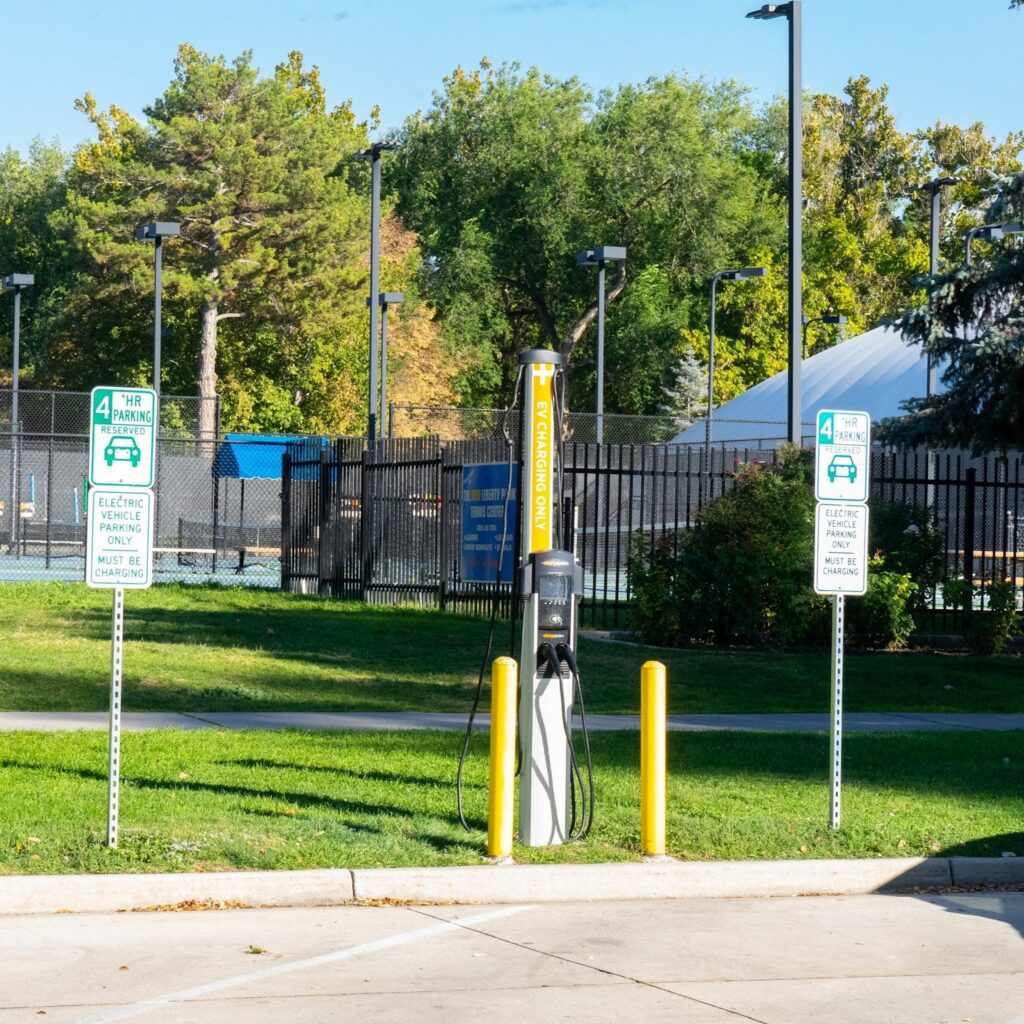
Photo Courtesy Salt Lake City Green
Since its policy launch, the city has been working to meet its goals. In 2022, Mayor Erin Mendenhall signed a petition-initiation request for the Sustainability Department to amend the zoning ordinance to require new multifamily construction projects to include at least 20% of on-site parking spaces for electric vehicles. Such EV-ready parking spaces “have electrical conduit and sufficient electrical capacity for the future use of a minimum 200-volt electric vehicle charging station,” but do not require those stations to be installed. The following year, the City Council voted to adopt this electric vehicle readiness update to its Off-Street Parking ordinance, thereby adding to a pre-existing language that already required one parking space dedicated to EVs for every twenty-five parking spaces at multi-family properties. “Providing residential charging infrastructure helps to increase electric vehicle adoption by removing charging barriers common in typical multifamily construction,” the city laid out the importance of the new language.
By the beginning of last year, the city had completed several other initiatives. It installed 24 charging ports near parks and libraries, where residents could charge their vehicles for free for the duration of the parking limit. By July 2024, there were 451 publicly available Level 2 charging ports and 55 publicly available DC fast charger ports in the city. Salt Lake City also launched the Green Vehicle Parking Permit Program, offering parking permits with the benefit of free 2-hour parking for vehicles – either fully electric or powered by hydrogen fuel cells – at all city meters for vehicles that meet the U.S. Environmental Protection Agency’s latest SmartWay Vehicle standards. The city has also been transitioning its fleet, with more than 400 clean-fuel vehicles, 60 of which were EVs. Plus, with 70 EVs, the airport had already shifted to have more than 40% of its fleet powered by alternative and clean fuels.
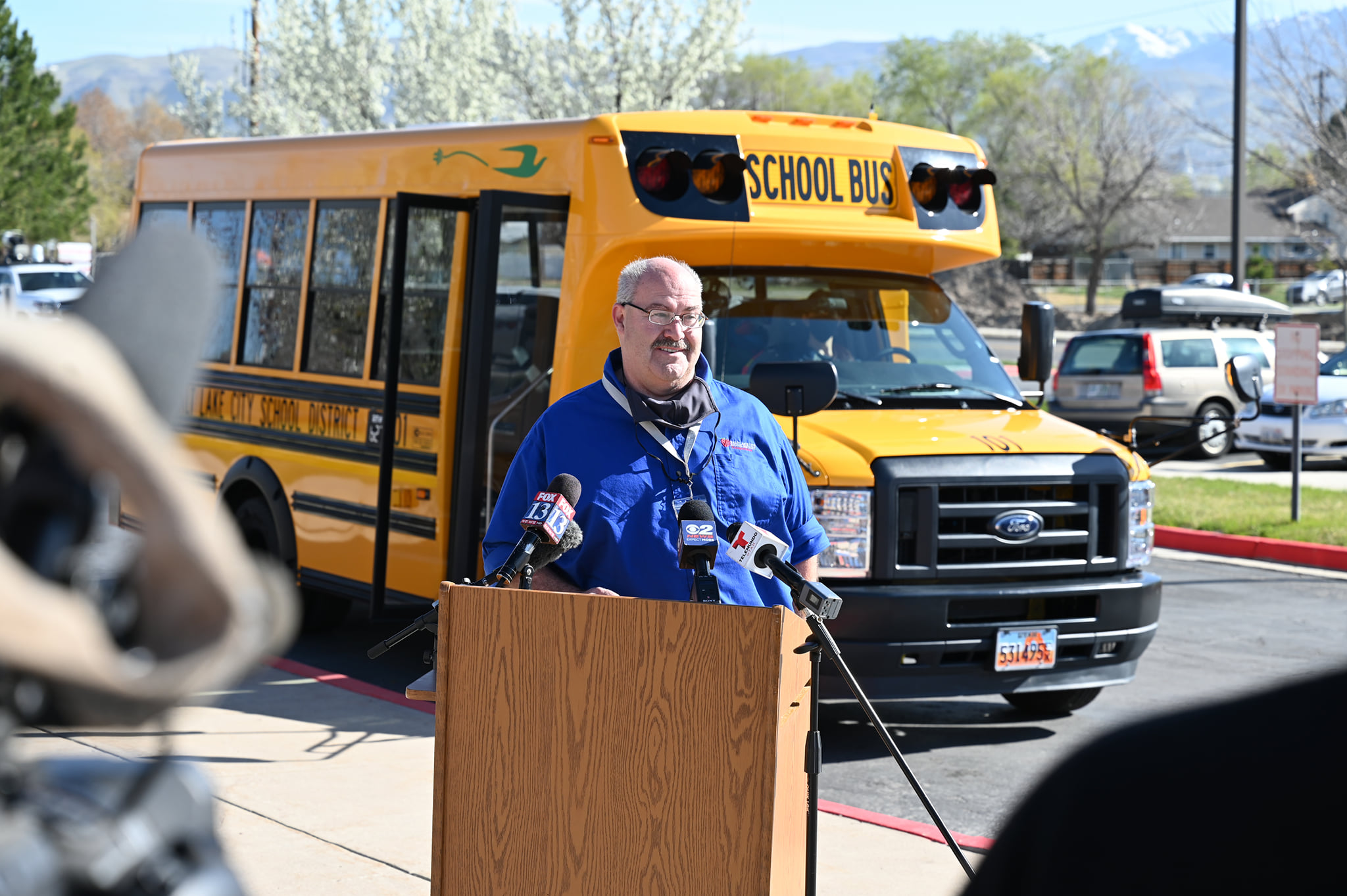
Showing additional community buy-in, the Salt Lake City School District joined the shift. By April 2025, the district owned and operated 12 electric school buses, including four Micro Bird Type A buses acquired in 2021 and four Blue Bird Type D buses acquired in August 2022 and November 2023. The district also installed twelve Nuvve chargers, powered by a solar array on the bus canopy. “It’s such new technology for the school bus industry. We’re gonna be the first to have one, even in Utah,” Ken Martinez, the school district’s transportation fleet manager, told the Deseret News at the time. The district listed reduced operating costs as a major benefit, with “substantial savings in fuel and maintenance expenses, with many routine maintenance needs reduced or eliminated entirely,” and with service lives of 18 to 20 years. It added that quieter operations contributed to driver satisfaction and improved student behavior. Plus, the bus routes focus on the Rose Park neighborhood, one of the most racially diverse neighborhoods, and also among the highest in air pollution. By 2022, the district had already saved 571 gallons of gas and eliminated 3.6 tons of emissions per year. The Utah Department of Environmental Quality estimates that electrifying all Wasatch Front school buses could eliminate 41,000 tons of pollutants.
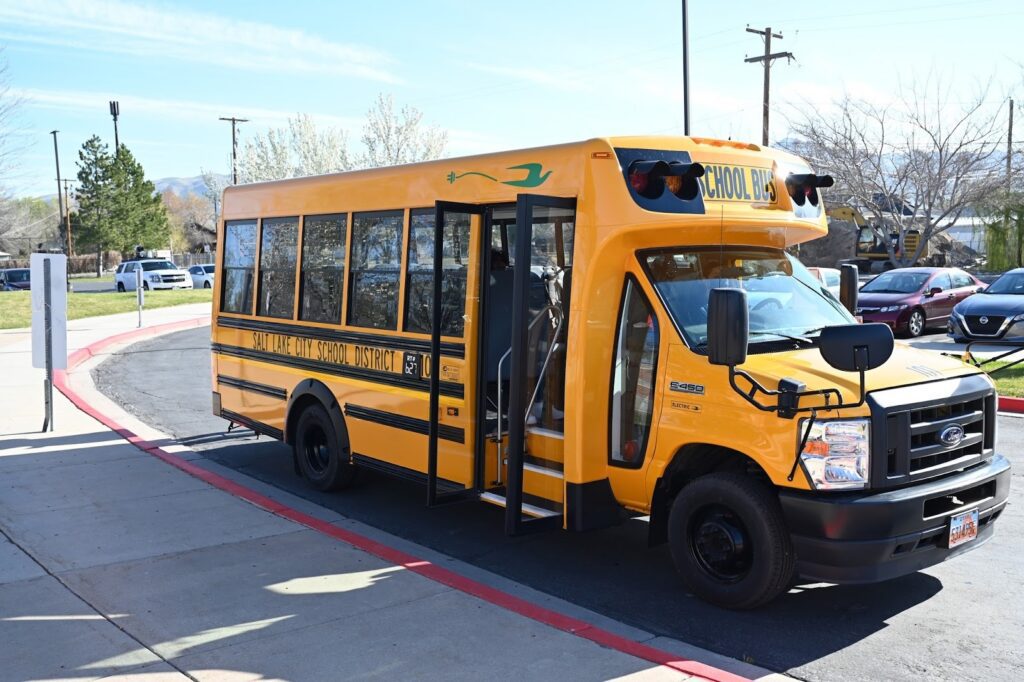
Photo Courtesy Salt Lake City School District
With the city ramping up its efforts, the residents also display an electric shift. EVs accounted for just 0.7% of registered light-duty vehicles in Salt Lake City in 2019, but rose to 2.6% by 2024. This corresponded to an increase from 2,012 to 7,413 battery-electric and plug-in-hybrid EVs. Similarly, EVs accounted for just 2% of new-vehicle sales in Salt Lake County in 2019, but rose to 8% by 2024, with 40% saying they would consider an EV for their next car. Similarly, EVs accounted for just 0.5% of used-vehicle sales in Salt Lake County in 2019, but rose to 2.4% by 2024.
Despite this progress, Salt Lake City still has work to do to meet its 2030 emissions-reduction goals. The city estimates that, at current rates, about 42,300 more locally registered vehicles will be electric by the end of the decade, but it needs to reach 116,200 light-duty EVs on the road. Increased adoption will require between 1,049 and 1,749 additional Level 2 charging ports and between 45 and 145 additional DC fast-charging ports to meet increased demand, along with many more single-family, multi-family, and private workplace charging ports.
Therefore, in January 2025, the city also completed a Community Electrified Transportation Study to inform the EV transition and meet the commitments of the 2020 joint resolution. By speaking with community and industry leaders, the city identified near-term and long-term opportunities to advance EV adoption. Some of the longer-term opportunities included offering rebates or vouchers to support the purchase or lease of EVs, launching an education campaign for auto dealers on local EV programs, requiring new light-pole installations to meet electrification requirements for EV charging at light poles, and creating zero-emissions zones for trucks. As Mayor Mendenhall wrote, “The culture is strong here in SLC—and it includes our youth. We care about our air. We care that the Great Salt Lake is dwindling. It feels good to drive a different kind of vehicle or use electric equipment that doesn’t impact what we breathe.”
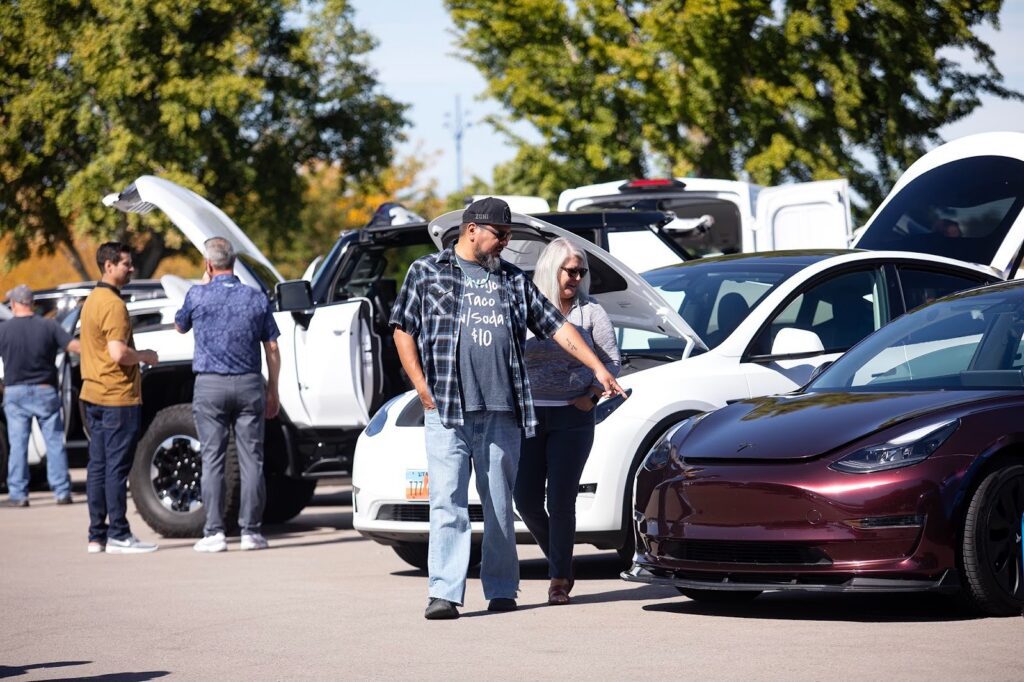
Photo Courtesy Salt Lake City Mayor Erin Mendenhall