
World War II is often considered the springboard of the postmodern era. The 1950s saw the emergence of two geopolitical superpowers, the United States and the Soviet Union. Europe was carved up into NATO allies vs. the Soviet Bloc. Asian nations were dealing with the repercussions of their war efforts and increased meddling by the U.S. and USSR. The 1950s stalled the progress electric vehicles (EVs) made. However, it wasn’t the end for them.
Postwar economies like Japan were scarce in resources, including oil. The country’s young automotive industry turned to electric power when it couldn’t afford gasoline. One example is the 1947 Tama, created by the Tachikawa Aircraft Company. It’s currently on display at the Nissan Museum.
The British ran a series of electric milk floats, vehicles designed specifically for milk deliveries, until the 1980s. Of course, these were not long-range EVs and had limited acceleration.
1950s
In the U.S., electric cars were almost entirely out of style. The keyword is almost because Henney Coachworks and the National Union Electric Company pursued a joint venture for a novel, modern electric car.
The Henney Kilowatt was released in 1959 in 36-volt and 72-volt versions. This car was modeled on the gas-powered Renault Dauphine and could reach top speeds of 60 mph in the 72-volt edition. The problem was that the Kilowatt was incredibly expensive. Production only lasted two years, with the final version rolling off the factory line in 1961.

Photo Courtesy DRoberson/Wikimedia
It’s important to note that during this EV “dark age,” the U.S. embraced fossil fuels as its main energy source. The interstate highway system was also being established, continuing the bicoastal connection of the Lower 48. Electric motors didn’t provide the range gas offered, especially with highways becoming thousands of miles long.
Then along came the American Motors Corporation (AMC) and Sonotone in 1959 with a joint venture. They wanted to produce a fully electric car with self-charging capabilities. You might be thinking, “Wait, today’s EVs don’t even have self-charging technology. How could they do this in 1959?” Well, see, they didn’t.
AMC made a name for itself with economical car manufacturing, while Sonotone developed nickel-cadmium batteries that were lighter than lead-acid versions and had rapid rechargeability. Research was done to see if they could build the concept, but no car was ever produced.
1960s
However, the AMC-Sonotone research venture got the conversation about electric cars started again. General Motors (GM) eventually decided to build a non-gasoline car but opted for conversion rather than a standalone EV. The company rolled out the Electrovair I in 1964, a converted Chevrolet Corvair sedan.
The Electrovair II followed in 1966, which was impressive for the time. It had silver-zinc batteries that gave the car 115 horsepower and could reach 80 mph, but it only had a range of 40–80 miles.
GM never followed through with the Electrovair II plans for mass-market production, probably because the cost of the car and the battery pack couldn’t compete with internal combustion engine (ICE) cars. The vehicle is on display at the GM Heritage Center.
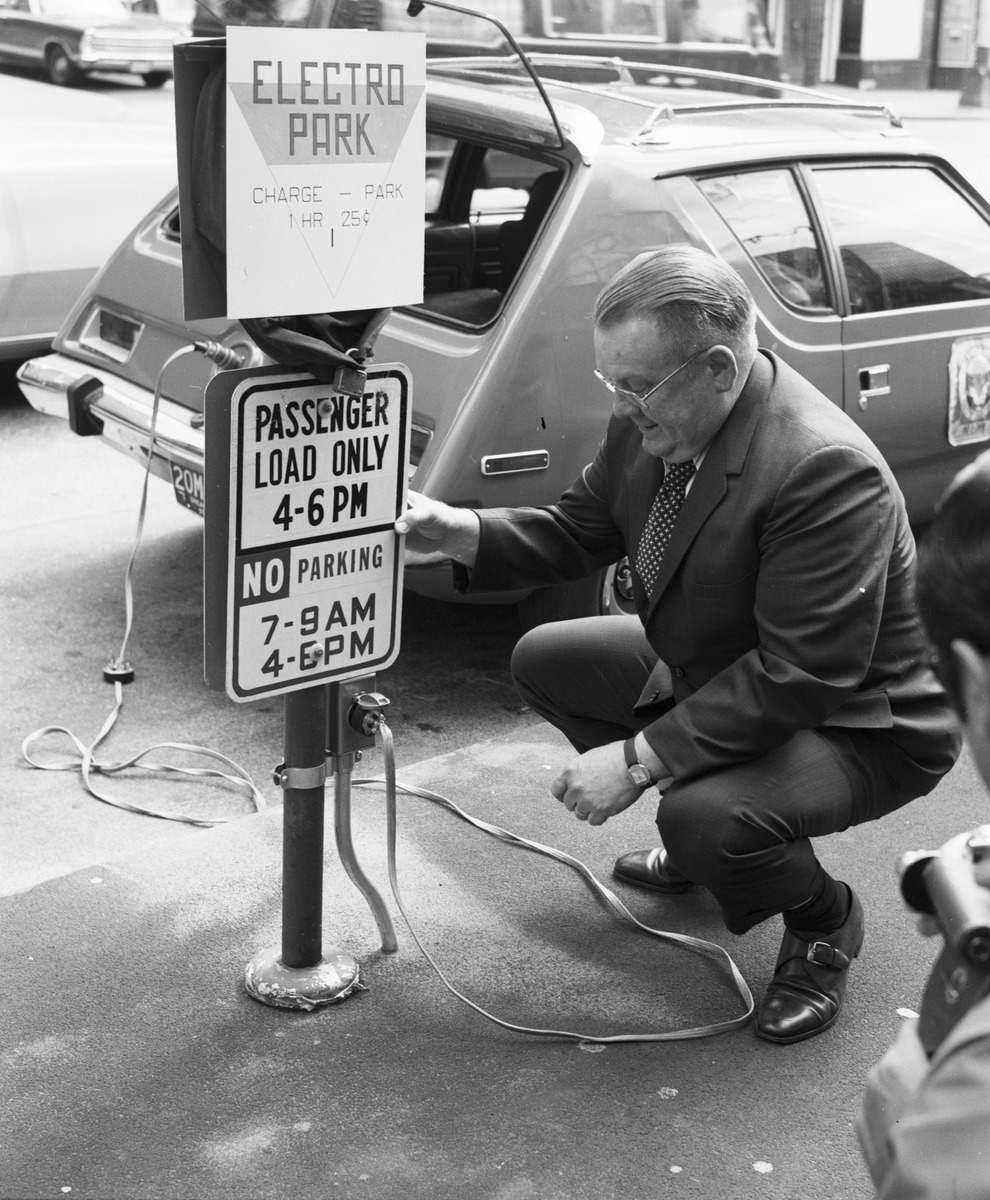
Other car companies tried to build an EV in the 60s. Scottish Aviation built the Scamp, a boxy two-seater, but it never went into production. Enfield Automotive created the 1973 Enfield 8000, which was successful to a degree, selling 112 units. A 1969 Rambler American station wagon was developed with electric power, and AMC even tried its hand at plug-in vehicles with the 1967 Amitron and the 1977 Electron. These cars were eccentric, and their exterior designs were bold, even for the 70s.
1970s And 80s
A few key events signaled a renewed interest in EVs. One was the Apollo 15 lunar mission in 1971. The moon rover was electric-powered, which earned praise among citizens. Before that, in 1965, Ralph Nader testified before the U.S. Senate, asserting General Electric (GE) was capable of manufacturing a 200-mile electric car that could reach 80 mph. GE eventually followed suit in 1967, unveiling the Delta experimental vehicle, but it was nothing that Nader suggested. Car and Driver called the Delta “repulsively ugly.”

Photo Courtesy NASA/Dave Scott
The 1960s, 70s, and 80s were also a time of energy crises. Gas prices began to rise as OPEC raised oil prices. The Iranian Revolution in 1979 caused a massive shortage. As shown above, EVs were considered potential replacements for ICE vehicles if the gas shortages continued. The auto companies went back to the drawing board with renewed intrigue in electric power among executives. Around this time, more information surfaced about pollution and global warming and the role cars played in it.
In 1976, GM came back with the Electrovette. It was what it sounded like: a converted electric Chevy Chevette.
There were other attempts by automakers throughout the 1970s OPEC embargo, but none ever got off the ground. The most successful was Sebring-Vanguard, with the triangular CitiCar selling more than 2,000 units, a record that held until 2013.
The Electrovette was ahead of the curve in some regard. GM executives noticed that gas prices were only going to increase after 1980, thus making a car that didn’t need gas more attractive to consumers, but that wasn’t enough to get the Electrovette mass-produced. It ended up being shelved by 1979.
The country’s reliance on foreign oil was a catalyst for legislative changes. Congress passed the Electric and Hybrid Vehicle Research, Development, and Demonstration Act in 1976 to incentivize the development of non-gasoline cars.

Photo Courtesy Wikimedia/Rick Bowen
1990s
The 1990s continued the EV revival with a few major legislative developments. The 1990 Clean Air Act Amendment was passed, establishing stricter emission requirements. The 1992 Energy Policy Act aimed to improve energy efficiency and increase clean energy use.
The passage of the California Air Resource Board’s (CARB) law on lower-emission, fuel-efficient vehicles in 1996 also got some automakers to invest in EV development. GM was the most successful at the time and launched the EV1 the same year. Unlike the Electrovair and Electrovette, the car was novel, used all the latest auto tech, and had lead-acid batteries. It was reasonably priced and had an induction charging system with direct-current charging and a highly efficient AC motor. It was a two-seater and launched when SUVs were skyrocketing in popularity.
People didn’t necessarily believe in the EV1.
About 800 were leased in Los Angeles, Phoenix, and Tucson, Arizona between 1996 and 2003 — they could only be leased, not owned. Production of the EV1 ceased in 1999.
There were other attempts in the 90s, though. Ford tried the Ranger EV, its first attempt at an electric pickup truck. Toyota had its RAV4 EV and launched the hybrid Prius in 1997 — its impact will be discussed in the next installment. Honda had an electric hatchback, and Nissan had the Altria EV, the first production car to use lithium-ion batteries. Almost all of these EVs were launched after the CARB ruling, which led to a Federal lawsuit by several dealerships.
The turn of the millennium was a time of massive upheaval. The Internet Age was still in its infancy. Y2K came and went without the forecasted chaos. EVs were still readily available, and the environmental crisis was worsening. As more information surfaced about the destructive nature of carbon emissions, personal transportation’s role in the problem became more well-known. We’ll see how the tides changed in Part 3.