When the Heron entered Casco Bay for the first time last July, the splashing wake and the laughing crew drowned out the motor. Willy Leathers, a founding partner and director of farm operations at Maine Ocean Farms, found himself listening for an engine that was already running. He described the silence to the Portland Press Herald as “really disconcerting,” before elaborating, “You’re taken aback that there’s no sound to the motor running when you’re clutching it in. … But it’s exactly the feeling we were hoping for of great performance on the boat.”
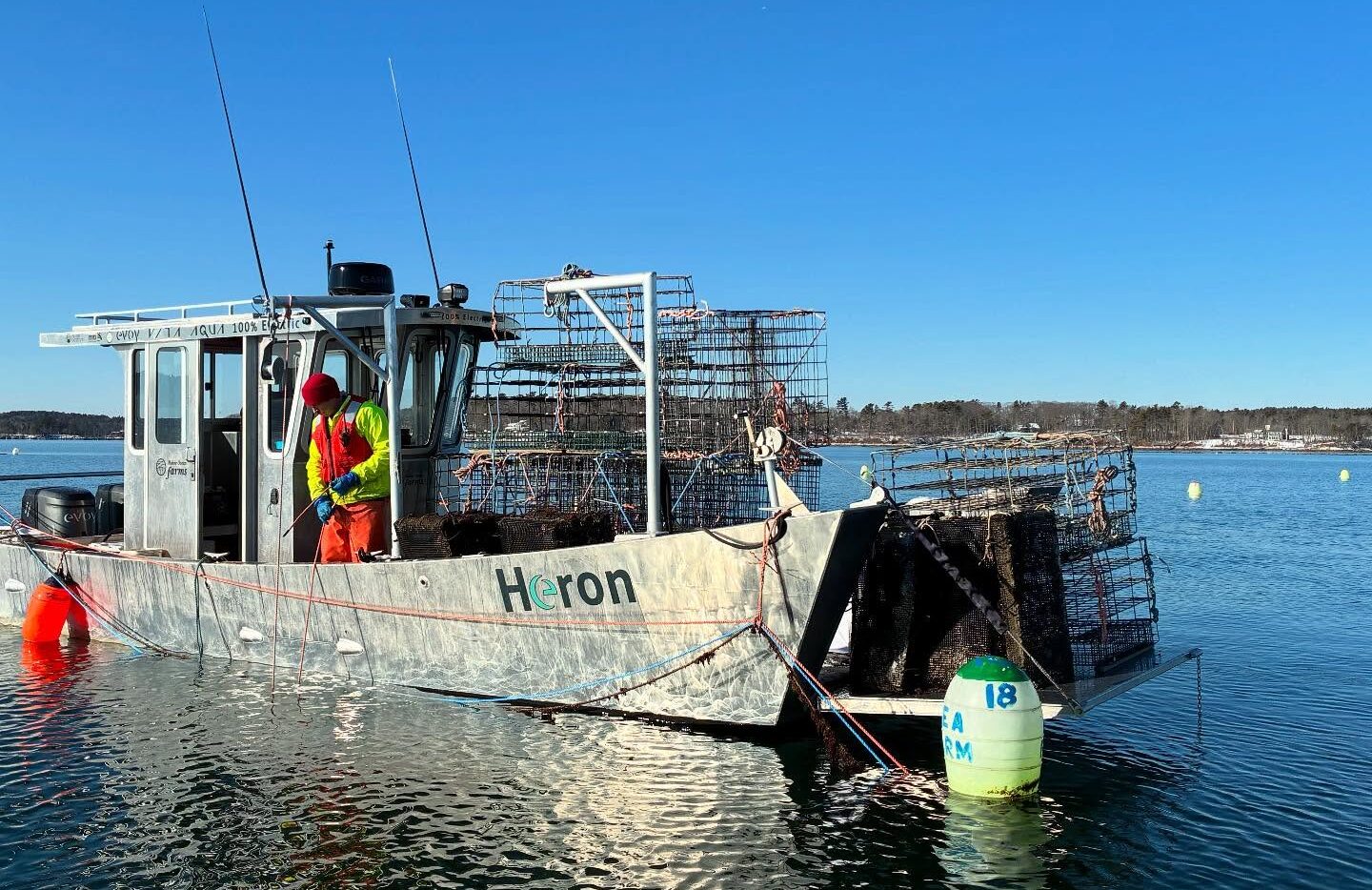
The Heron is an all-electric oyster workboat. “As far as I know, it’s the first fully electric aquaculture boat,” said Lia Morris, senior community development officer at the Island Institute, which helped develop and fund the vessel, indicating the boat is the first of its size in both Maine and the U.S. For Leathers, the quiet is not a gimmick. Maine Ocean Farms grows roughly three million oysters in dozens of floating cages on a 10-acre site in a cove ringed by houses. A workboat that idles all day without a growling motor or a haze of exhaust makes the farm an easier neighbor to live beside.
Although Maine’s aquaculture industry has a lower carbon footprint, pound for pound, than other animal proteins, oil-powered motors are its largest source of carbon emissions. An environmentally-friendly boat would complement Maine Ocean Farms’ work in resourcefully and responsibly growing oysters to “benefit the Maine waters that we love and the communities we live in.” For example, the farm also helped develop a compostable, biodegradable harvest bag to combat marine plastic pollution.
“We’re out there for eight hours a day, five days a week, so reducing noise and reducing on-site emissions is a goal of not only improving the workplace but also improving our potential impact on the environment around us, whether in an ecological sense or a community sense,” Leathers told The Daily Yonder.
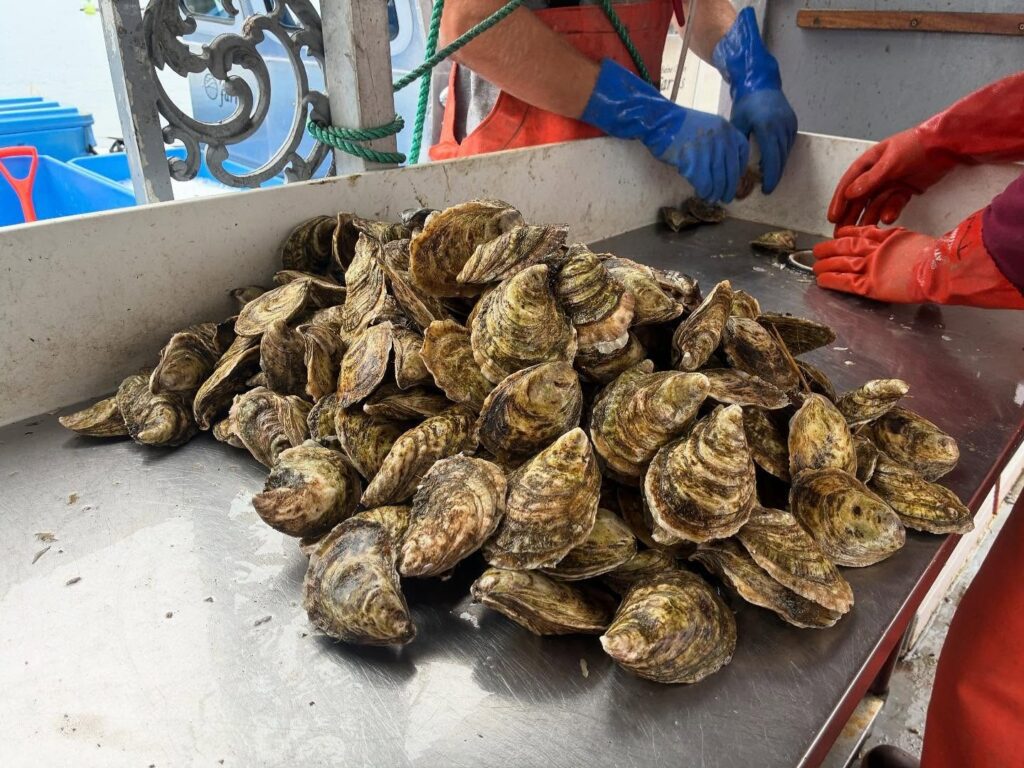
Photo Courtesy Maine Ocean Farms
Leathers also needed a boat that could haul more than 10,000 oysters at a time from the cages to the dock, carry a crew through a full harvest day, and keep running for decades in a punishing saltwater environment. When he approached Fogg’s Boatworks in North Yarmouth in September 2024, he arrived with a Word document spelling out exactly what he wanted. “We were going to design the boat we wanted, then start making concessions to its electrification,” he told Professional BoatBuilder.
Fogg’s was the right shop for that order. Dennis Fogg founded the yard in 2000 after years of building boats around Casco Bay. Now, his son Patrick runs the company, turning out welded aluminum workboats designed to last. Patrick took Leathers’ wish list and built a 28-foot landing craft with an enclosed pilothouse for winter work and an open deck for harvesting, cleaning, and sorting oysters. Two roughly 800-pound lithium-ion batteries sit low and centered beneath the pilothouse, feeding twin Evoy electric outboards rated at 120-plus horsepower each. Fully loaded with 4,000 pounds of ice and oysters, the boat has a range of 90 miles at 6 knots.
None of this was cheap, and the people behind it are candid about that. Electric vessels run 20% to 30% more than a comparable gas or diesel boat up front, Maine Morning Star reported, and the Heron cost about $425,000 to build. The long-run math is what makes the case: Nick Planson, who electrified a separate Casco Bay workboat, told the outlet he expects a four-to-five-year break-even period and a clear advantage over 10 years once reduced maintenance, equipment replacement, and fuel are factored in. To get over the upfront hurdle, the U.S. Department of Energy’s Office of Energy Efficiency and Renewable Energy included Maine Ocean Farms in a collaborative $500,000 grant, with roughly $289,000 of it covering the boat and its propulsion system. Other operators are using ‘marine green’ loans from Coastal Enterprises Inc., starting at $25,000, to make the switch possible without a federal grant.
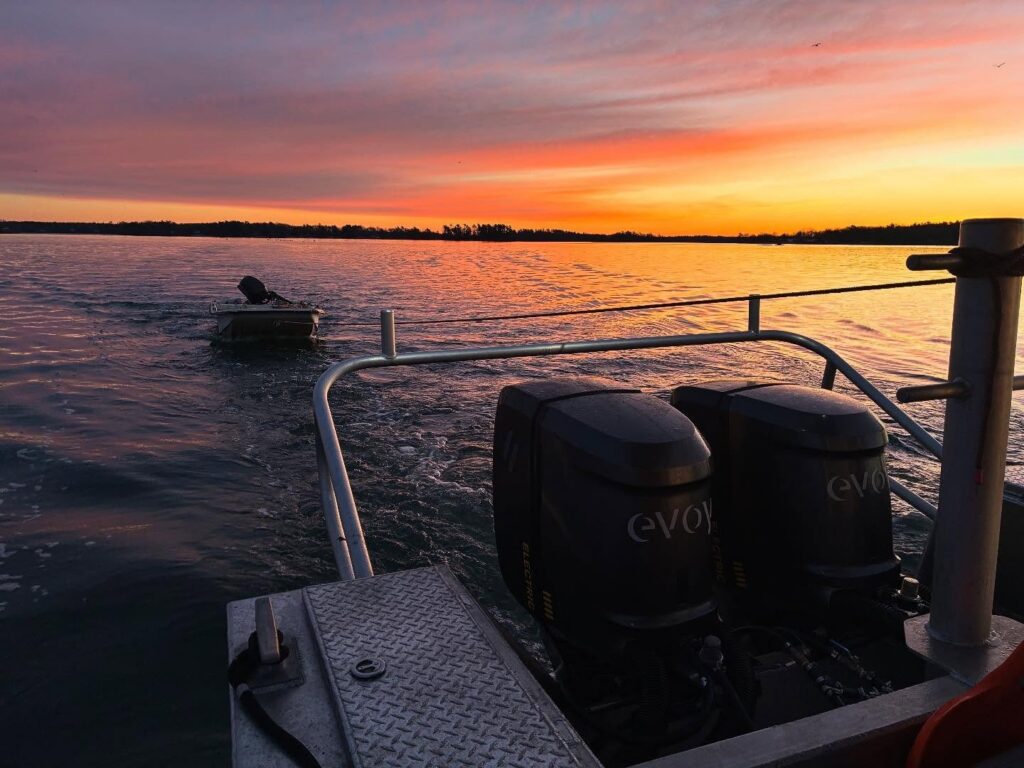
Photo Courtesy Maine Ocean Farms
The harder problem is where to plug in. Most days, Leathers runs a three-mile round trip from his slip on the Harraseeket River in South Freeport out to the farm on the bay. In November 2025, the project installed the first public marine fast charger in Portland’s harbor, a Level 3 unit on the Gulf of Maine Research Institute‘s wharf, built by Aqua superPower. Leathers said the Portland charger lets him run down from Freeport, deliver oysters, top off, and still make it home, opening up a route the boat could not complete before. A mere hour on the fast charger restores battery life to between 50% and 75%. “So it makes that round trip possible for us,” he told Maine Public. Lia Morris of the Island Institute calls charging a ‘chicken and egg’ problem: chargers sit idle until boats arrive, and electric boats are not made until chargers exist. “So this feels like the beginning of finding that solution is having some fast charging infrastructure that people can access.”
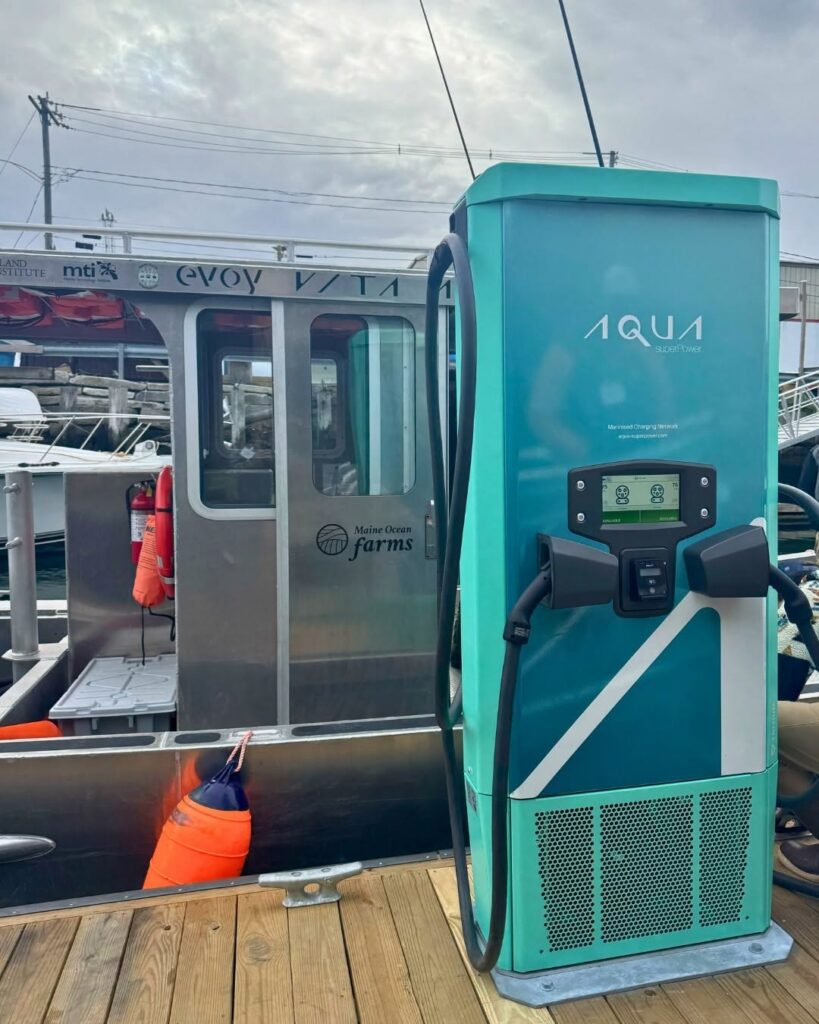
Photo Courtesy Island Institute
One question remains genuinely open. Cold weather shrinks battery range, and Leathers is deliberately running the Heron through Maine winters to find out by how much and to share the performance data with the Island Institute so other farmers can plan with real numbers.
“Maine Ocean Farms strives to continuously innovate our operations, embracing new technologies that can drive positive environmental change while supporting local economic growth. This project will demonstrate these technologies in action, providing data and real-time experience to other farmers and industry members,” Leathers explained to Aquaculture North America. “We expect it to serve as a model that can be replicated by other coastal operations, helping to build a more sustainable and resilient marine economy in Maine,” added Sara Mills-Knapp, director of sustainability at Maine Clean Communities. In its first three months alone, the boat logged more than 100 hours and over 1,000 nautical miles.
That data could travel far. Maine counts roughly 200 aquaculture farms, and oysters alone earned growers and harvesters $14.85 million in 2024, the state’s third most valuable fishery, according to the Maine Department of Marine Resources. Leathers sees the Heron as the first domino. “As a whole industry, I think it’s going to take proving that someone like us can do it,” he said, “and then the next person kind of snowballing after that.”