
Nebraska residents are rallying to preserve federal energy tax credits, which they say are vital for continued economic growth and job creation throughout the state, according to the Omaha World-Herald.
Solar United Neighbors Action recently joined local business owners and community leaders at a press conference in Omaha to highlight how these incentives have transformed Nebraska’s energy landscape while delivering tangible economic benefits.
“Solar is the fastest energy source to build, which we need to help meet the energy needs of new data centers and achieve American energy guidelines,” said Liz Veazey, director of state policy campaigns at Solar United Neighbors Action. She stated that more than 16,000 Nebraska residences benefited from these credits in 2023 alone, and she thanked Rep. Don Bacon (R-NE-02) for being one of twenty-one House Republicans to write a letter to the Chairman of the House Ways and Means Committee advocating for preservation of the credits.
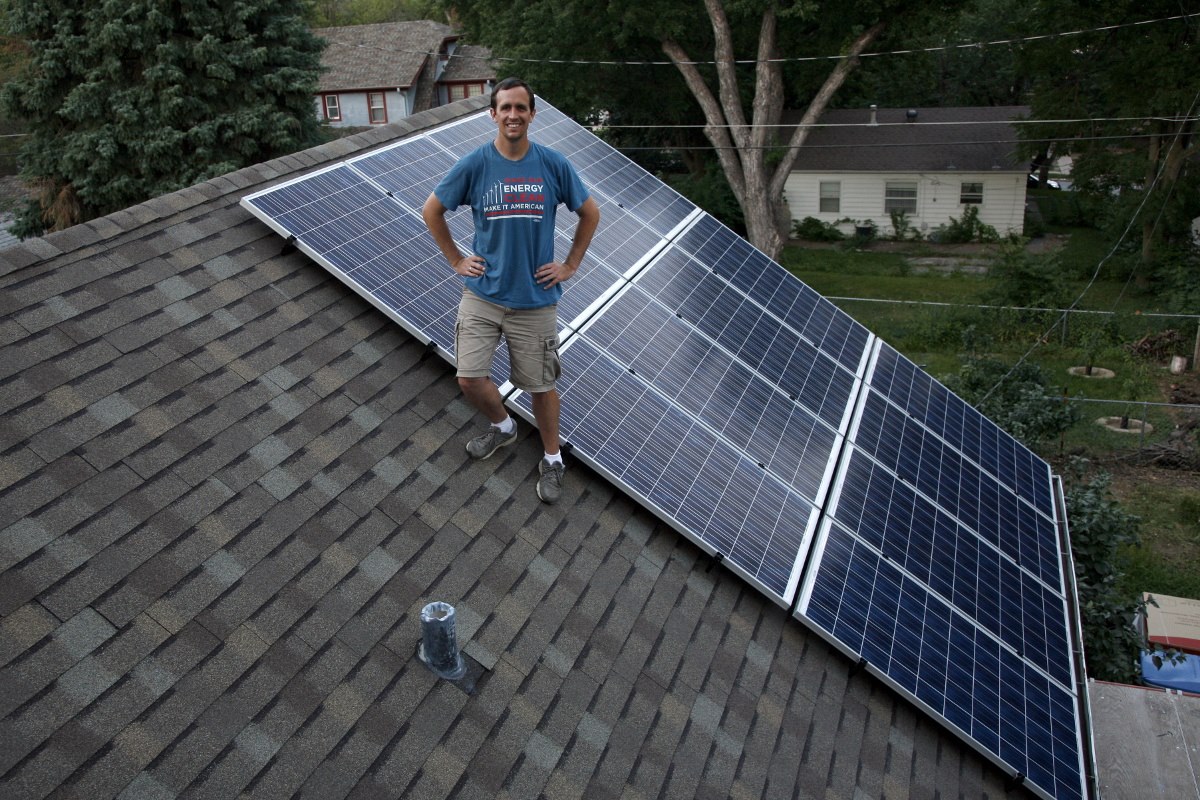
Rural homeowners, in particular, are benefiting from the energy credits. Alan Meyer from Saunders County called solar systems “especially valuable to people living in rural areas,” having found that his 5-kilowatt (kW) solar system reduced his grid consumption by approximately 32% and has saved him about 30% on his annual electricity bills since he installed it in 2014. He cut his grid consumption in half again when he installed a 12 kW system in 2022. \hen a blizzard cut his access to the grid this year, his solar panels proved especially valuable in keeping his refrigerator and freezer running. “Having solar installed on my home meant that the food in my fridge and freezer kept from spoiling during our recent blizzard when power was out for that full week,” he recalled.
Rep. Bacon has indicated that he is especially concerned about the impacts to Nebraska’s farm economy if the energy credits are rolled back. As he wrote in an email, “We should preserve tax credits for biofuels and for energy generation. Folks who have invested in IRA projects should be grandfathered in regardless.”
Graham Christensen, a fifth-generation farmer, said that solar panels power approximately 65% of the operations on his farm. “The tax credits put us in a place to be able to do that and make our business a little bit more competitive. And we’re always looking for those edges in Nebraska with the high property taxes,” Christensen noted.
Business owners are also seeing real financial benefits. Aaron Konen, CEO and co-owner of Wine, Beer and Spirits, reported that his monthly utility expenses have decreased between 50% and 80% from the addition of a 100-kilowatt solar system on the roof and LED lights and high-efficiency fans inside, thereby allowing the company to keep prices lower for customers. “It’s rare business when doing the right thing is also hands down the best financial move,” Konen reflected.
Federal clean energy support is also crucial for nonprofit organizations, such as the CUES School System in Omaha, which the Archdiocese of Omaha runs. Rev. Dave Korth, president of the system, explained that if direct payments authorized by federal legislation are eliminated, “we’re not sure how we’re going to be able to pay” for a recently installed 70 kW solar system, the savings from which it intends to funnel into education for disadvantaged students. “We went from being very excited about saving money on our electrical bills, so we could have more money to spend on the education of our nearly 600 children in the poorest neighborhoods in Omaha, to worrying about having to take money away from their education to pay for this project,” he stated.
Federal support for clean energy is also beneficial to the economy as a whole. According to Veazey, federal investments have supported the development of twenty new clean energy facilities in Nebraska, with five of them producing American-made products. This domestic production reduces vulnerability to international supply chain disruptions while creating quality jobs.
Last year, for example, the Grand Island Utilities Department announced that it was overseeing the construction of a $14.2 million, 9.9-megawatt solar farm in Grand Island, which is adding 21,600 panels and 900 inverters, making it the second-largest such project in the state. $4 million of the cost will be covered through the Inflation Reduction Act.
Jack Pratt, associate vice president of political engagement for Environmental Defense Fund Action, noted that the elimination of tax incentives could come at the expense of recent investments in the state. “There’s been a ton of data centers in Nebraska. Those do create a lot of jobs and a lot of investment, but they also consume a lot of energy.”. In the words of Veazy, “Nebraska really needs the federal solar investments to continue to grow our economy, attract new businesses, support good jobs, support American energy dominance, and keep energy bills from rising.”
This article was created on April 17, 2025 with the assistance of the generative artificial intelligence (AI) tool Claude 3.7 Sonnet, using the linked company websites, press releases, reports, or external media coverage as inputted source material. It was then reviewed, fact-checked, and edited by one or more team members to ensure factual accuracy and consistency with editorial standards before publication.
While we strive for precision, reliability, and quality, readers should be aware that AI-generated content may have limitations in contextual awareness and nuance and may not be completely unbiased, consistent, error-free, or up-to-date. We recommend using this content only for informational purposes, as well as independently verifying it or conducting further research to supplement it. If you notice any inaccuracies or have concerns about this content, please contact our research manager at greg@consensus-digital.com.