
Maine’s clean energy sector is experiencing remarkable growth, creating thousands of job opportunities for residents. According to the 2024 Maine Clean Energy Industry Report, commissioned by the Maine Governor’s Energy Office (GEO), the state’s clean energy workforce expanded to nearly 15,600 workers in 2023, equivalent to 2.4% of Maine’s total workforce. “The clean energy sector is playing an increasingly important role in Maine’s economy, contributing billions and providing a steady stream of good job opportunities for Maine people,” said Dan Burgess, director of the Governor’s Energy Office.
This clean energy employment growth outpaced employment in the state’s overall economy. With more than 500 new clean energy jobs, Maine’s clean energy workforce experienced a 3.6% growth rate between 2022 and 2023, compared to a 1.7% growth rate of employment in Maine’s overall workforce.
Since 2019, Maine has added over 900 clean energy jobs, reflecting a growth rate exceeding 6%. Over those five years, this growth has also outpaced the clean energy economies of the other states in New England, beating out Connecticut by 1.6%.
By sector, one-third of the added jobs were in renewable electric power generation, reflecting a growth rate in the state that was more than four times the national rate. Meanwhile, alternative transportation was the fastest-growing sector since 2019, with a growth rate of 30% over those five years.
Based on workforce numbers, the largest segment of Maine’s clean energy economy is the energy efficiency sector, employing 58% of clean energy workers and adding the most workers of all clean technology segments, with almost 360 new positions. More than 3,700, or about 40%, of these workers were employed in high-efficiency HVAC and renewable heating and cooling in 2023. Many of these positions focus on heat pump installation and maintenance.

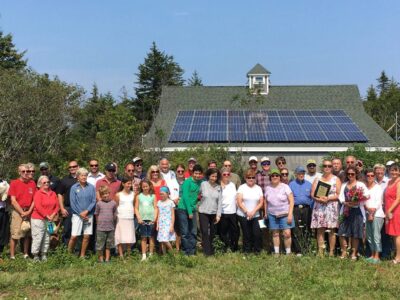
Photo Courtesy Maine Governor’s Energy Office
The report adds that the clean energy economy added almost $3 billion to Maine’s economy in 2023, equivalent to 3.2% of the gross state product (GSP) or a .5% increase from Maine’s GSP the previous year. Clean energy GSP grew by about half a billion dollars from 2022, or 20% year-over-year, while overall state GSP only grew 7.2%.
Since 2022, 84 businesses have joined the clean energy economy, with a growth rate of 3.4%. At the end of 2023, about 2,600 businesses, or 4.3% of all Maine establishments, were conducting clean energy activities.
Despite this impressive growth, Maine has only reached about half of its ambitious goal to expand the clean energy workforce to 30,000 positions by 2030, part of the state’s broader plan to achieve 100% clean retail electricity by 2040.
Workforce challenges persist. A Maine Energy Efficiency Contractor Needs Assessment, prepared by the Building Performance Alliance in 2024, highlighted that employee recruitment and retention were the most significant challenges for weatherization programs in 2022. The document provided suggestions for the GEO to offer more training, funding, and workforce development opportunities; to highlight and amplify existing business efforts and educational and employment opportunities; and to collaborate with more types of stakeholders.
To address these workforce gaps, the GEO has invested nearly $5 million in grants to support clean energy workforce development programs since 2022. Most recently, the office last summer announced $2 million in awards for six clean energy workforce training programs, including the Oxford Hills and Nezinscot Adult Education program with a focus on careers related to the installation, maintenance, and repair heat pump and solar panels in the district of State Representative Caldwell Jackson (R-Oxford).
In partnership with the Maine Departments of Labor and Economic and Community Development, the GEO also launched the Maine Clean Energy Jobs Network, an online platform connecting those seeking jobs in renewables with employers and training programs.
“With the recent commitments to investment in our state’s transportation infrastructure, climate resilience, clean energy and vertical building construction, these trainings and career opportunities will provide a solid foundation for the future of our workforce,” said Kelly Flagg, executive director of Associated General Contractors of Maine.
As Maine transitions to clean energy, these workforce development initiatives will be crucial to meeting the state’s ambitious climate and economic goals.
This article was created on April 9, 2025 with the assistance of the generative artificial intelligence (AI) tool Claude 3.7 Sonnet, using the linked company websites, press releases, reports, or external media coverage as inputted source material. It was then reviewed, fact-checked, and edited by one or more team members to ensure factual accuracy and consistency with editorial standards before publication.
While we strive for precision, reliability, and quality, readers should be aware that AI-generated content may have limitations in contextual awareness and nuance and may not be completely unbiased, consistent, error-free, or up-to-date. We recommend using this content only for informational purposes, as well as independently verifying it or conducting further research to supplement it. If you notice any inaccuracies or have concerns about this content, please contact our research manager at greg@consensus-digital.com.