The lesson that shaped Missy Greis’s company came from a third-grade classroom. Her daughter had been learning about Salt Lake City’s air, and she had opinions about the family car. “The school was giving them an education on air quality in Salt Lake City, and she was telling me I was driving the wrong car,” Greis recalled to Utah Business. A few years later, when she set out to open Publik Coffee Roasters, that conversation was still with her. “When I decided to open a coffee roastery, I knew I had to do something.”
Greis built the environmental answer into the business from the start. Publik opened in downtown Salt Lake City in 2014, and from day one, its roastery ran on the sun. The roof of the flagship carries 65 solar panels, installed by Creative Energies Solar. Those panels provide about 15 kilowatts of electricity, which, Greis told Utah Business, cover the roasting operation and provide additional power for the rest of the building. “That offsets 100 percent of our coffee roastery, plus a little more for the rest of the building’s operations,” she said.
The panels were only half of it. Roasting coffee is not an emissions-free process, and Greis knew it. So the roastery’s Diedrich IR-12 roaster, a machine built in Sandpoint, Idaho, was paired with a catalytic oxidizer that the company says filters out 96 percent of the particulates produced during roasting. The roaster itself runs on infrared heat rather than a natural-gas flame. “It doesn’t use natural gas,” Greis explained to Utah Business. “The drum is heated with this very specifically designed rolling mechanism that uses infrared heat. Again, it’s cleaner.” Publik is one of only two coffee businesses in Utah to have an afterburner, according to SLUG Mag.
For Greis, the point was local. Salt Lake City sits in a bowl ringed by mountains, and in winter, the cold air traps pollution against the valley floor. A coffee roaster venting smoke into that air was exactly the kind of small contribution she did not want to make. “I think what motivated our efforts in sustainability was the fact that we already reside in a big valley that has so many air quality issues,” she said. “Knowing that coffee roasting is not necessarily the cleanest business, it requires that you do something like our catalytic oxidizer. It filters out the particulates, so they’re not going out into the air.” Silvana Elguera, director of coffee and head roaster, agreed in an email to Daily Coffee News, “It’s important for us to consider the environmental impact that comes from roasting coffee in our community. We want to contribute to the health of the environment we operate in.”
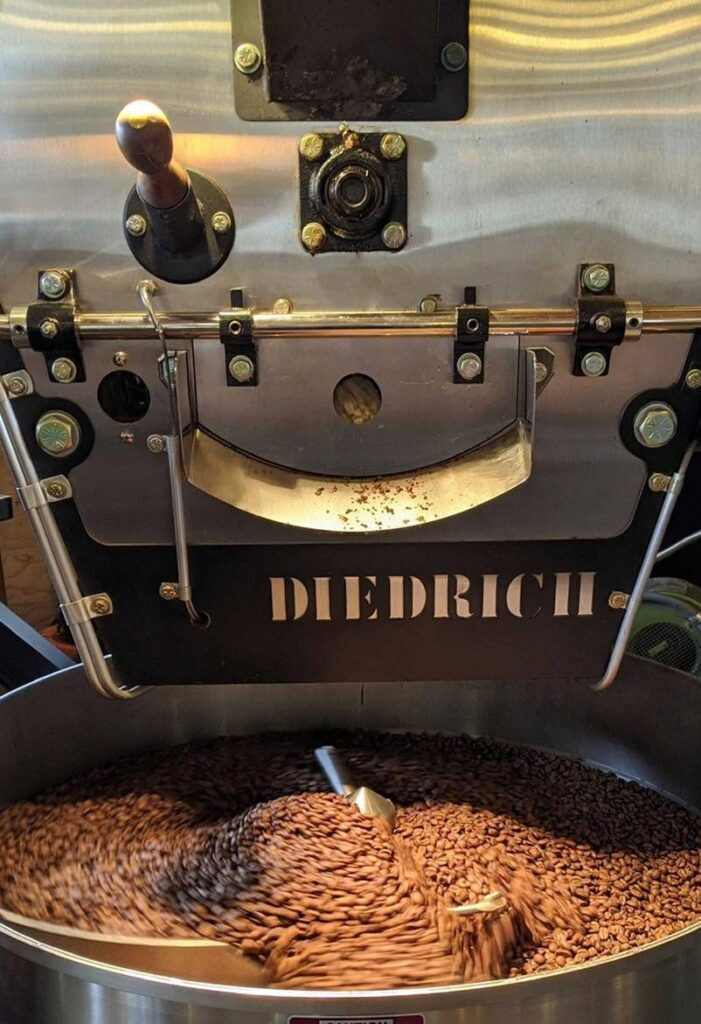
Photo Courtesy Publik. Coffee Roasters
Those features are the best-known, but they are not the only ways the business is saving money and protecting the environment. It also minimizes waste by roasting in small batches and maintains direct relationships with producers in its supply chain by paying a premium to help ensure they can cover costs and improve their quality of life. Later in the process, the company composts its grounds, filters, and food waste through the city’s curbside program, though Greis is quick to note the limits of what local infrastructure can handle, pointing to roughly 80,000 compostable hot cups a year that still have nowhere to go.
As the business remodeled its Publik Kitchen location in 2022, it aspired to add even more sustainability-focused features. “It’s the first time I’ve ever done new construction, and it’s been great when we’re doing things like building our electrical system from the ground up to say, ‘Let’s go with LED. Let’s put solar panels on the roof,” Greis said at the time. That roof is also a green roof with beehives to support local beekeepers and pollinator populations, even though Publik cannot sell honey.
None of it was cheap, and Greis does not pretend otherwise. The solar array and the oxidizer represented a real outlay for a small business, and Greis viewed those investments as essential. “It’s the cost of investing in your own infrastructure,” she told Daily Coffee News. “I think the best thing you can do is invest ahead of the game and do things that help.”
The same instinct shows up everywhere in the company, as Greis works with local architects to create spaces that are “light and up and bright and inspiring,” she told SLUG Mag, and that are uniquely Utahn. The flagship is a former printing-press warehouse that Salt Lake City firm Lloyd Architects renovated using reclaimed materials, including snow fencing salvaged from Wyoming, oil-field pipe, and metal doors pulled from an old downtown warehouse. The kitchen also sources ingredients locally: the bread comes from Red Bicycle Breadworks in Park City, the jam from Salt Lake’s Amour Spreads, and the milk from local dairy farm Rosehill Dairy. “We do it to support Utah’s local businesses, but there’s also the environmental footprint to consider,” Greis explained.
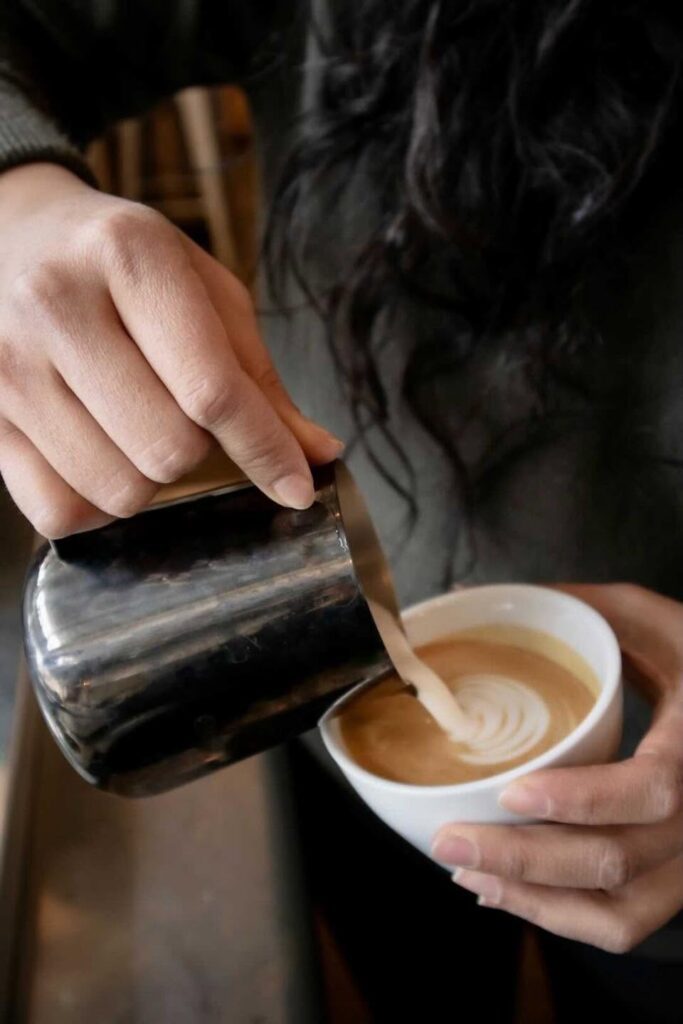
Photo Courtesy Publik. Coffee Roasters
“We’re just trying to build a culture that is conscientious about the work that we’re doing and the product that we’re providing,” Greis told Daily Coffee News. The coffee has kept pace with the conscience. Food & Wine named Publik the best coffee roaster in Utah, writing, “A little bit punk rock and a lot into sustainability, this should be the first stop for any serious coffee drinker in Salt Lake.” The roastery now supplies its four Salt Lake cafes and more than 30 wholesale accounts, including Whole Foods stores in Utah and Kansas.
The name fits the philosophy. “Publik” comes from the Dutch word for community, and the company’s tagline reads “planet over profit, community over corporate, quality over quantity.” More than a decade after the panels went up, Greis still measures the business by what it gives back to the surrounding city. “I feel good about what we’re doing for Salt Lake City,” she said. “Especially with our air quality.”