Matthias Kunerth was 22 years old and finishing a master’s degree when he drove three hours across southern Minnesota to sit in on a meeting about a self-driving tractor. He was the only person in the room representing his family’s farm. By his own account, the next-youngest person in the room was somewhere around 45, and most of the farmers around him were well into their sixties.
What held his attention was the distance between what the equipment those farmers already owned could do and what they were actually doing with it. “A lot of these guys don’t even know how to change their password for their iCloud account. There’s a big opportunity here to educate the general public and farmers about what that next generation of farming is really going to look like,” he said on the Taylor Moreland Podcast. On the drive home, he decided to start a YouTube channel to document life back on his family’s farm.
He returned to land near Brewster, in Nobles County, where the Kunerth family has deep roots. During a 2022 Board of Adjustment meeting for a new underground grain pit, his father, Mike, noted that the family has worked the property since 1886. That year, his great-great-grandfather Joachim arrived from Austria and was granted 160 acres under the Homestead Act of 1862. His great-grandfather bought a 1958 International Super M tractor that is still in working order.
Video Courtesy HiTech Farmer
Matthias isn’t the first Kunerth to trade a business degree for life on the family farm. His father studied business in the late 1980s precisely because the farm economy was so poor, but by the spring of 1990 he and his wife, Dawn, were running the operation Mike had been raised on, The Globe of Worthington reported. The couple later founded the Kunerth Seed Center and were chosen for the American Soybean Association’s leadership training program. “I call farmers eternally optimistic people,” Mike told the paper. “We learn through all our trials and tribulations; we pick ourselves up and continue on.”
Kunerth returned to the farm in 2021, and the YouTube channel became the explanation he had set out to provide. He raises corn and soybeans across roughly 2,500 acres with his parents, and publishes what that looks like under the name HiTech Farmer. His YouTube, Instagram, Facebook, and TikTok accounts have drawn more than 100,000 followers.
Financing a 2,500-acre operation, however, took money he did not have. At 25 years old, with his 2024 crop still sitting in the bin and the next season’s seed and fertilizer coming due, Kunerth sealed 16,000 bushels of corn across two bins under a commodity loan rather than sell into a soft fall market. The interest rate was only 5.25%, compared with the 6% to 8% he expected a commercial bank would charge, because he owns no large equipment to show on a balance sheet. Loans like this provide interim financing so a commodity can be stored after harvest and sold later when prices are higher, the U.S. Department of Agriculture’s Farm Service Agency confirms, using the grain itself as collateral.
Video Courtesy HiTech Farmer
The drone started as arithmetic too. His family was already paying a cooperative roughly $10 to $11 an acre to spray fungicide and insecticide, and the same video lays out the three credentials the work requires: a remote pilot certificate, a state commercial applicator’s license, and a federal certificate for aircraft over 55 pounds. He had flown drones professionally before, working during college for the St. Paul imaging firm Sentera, which John Deere acquired in May 2025. In his first season on his own, he covered about 7,000 acres, spent roughly $40,000 on the aircraft and $9,000 on a trailer, and made around $15,000.
The precision is where the work gets interesting. Before he sprays, Kunerth maps each field with a small camera drone flying near 400 feet, then builds the boundary in software, and then he flies with full real-time kinematic (RTK) satellite guidance. That lets him spray tight against power lines and telephone poles instead of leaving margins untreated. He puts the result in commercial terms rather than agronomic ones: “I can get a lot closer in your corners. I can get right next to the telephone wire. I’m basically spraying 100% of your field. I’m not just charging you for 100% of your field.”
Video Courtesy HiTech Farmer
The self-driving tractor from that first meeting did eventually reach the farm. The Kunerths served as beta testers for John Deere’s autonomous machine across several seasons, and Matthias told the Farm4Profit podcast that it moved to full production for 2026, which is why it is not in his fields this year. He has kept looking for the same leverage in cheaper places since. Rather than pay a company for a vegetation-index map, he feeds the images his drone captures of every second of flight into ChatGPT and asks what it notices, then reads back the spots where stand counts are low. He summarized that he conducts “all the field operations without needing to physically touch a steering wheel.”
None of that is pitched as environmental. It behaves that way anyway. “For you to come out here with a self-propelled sprayer, we would damage a lot of the soybeans by running that tire right along them and knocking off a lot of the pods,” Kunerth pointed out from the edge of his own field. Virginia Tech’s Virginia Cooperative Extension makes a similar case, pointing to lighter pressure on the soil, less fuel burned, battery power emitting no greenhouse gases, and the chance to apply less chemical by treating only what needs it.
Kunerth frames it as inheritance rather than innovation. Running through five generations of grain bins, machine sheds, and tractors, he says, “there’s been one thing that has remained constant on our farm, and that’s the care that we have towards the land.”
He is early to something that is no longer small. Spray drones treated 16.4 million American acres in 2025, a 58.7% jump over the previous year, the American Spray Drone Coalition found, and its survey also recorded the average price per acre falling by 38%, from $21 to $13. Kunerth charges $11 an acre and will not discount for volume. Cutting the price for a large account, he has explained, would not be fair to other growers: “‘Oh, if there’s a guy with 10,000 acres, are you going to lower your price?’ And I’m like, honestly, no. Cause that wouldn’t be fair to the farmer that signs up 200 acres.”
Kunerth thinks about his grandfather, who once had the money for three sections of land and didn’t buy them, and he doesn’t want to be the man at 81 driving past a place he could have owned. As he put it, the thing to do is “bet on yourself.”
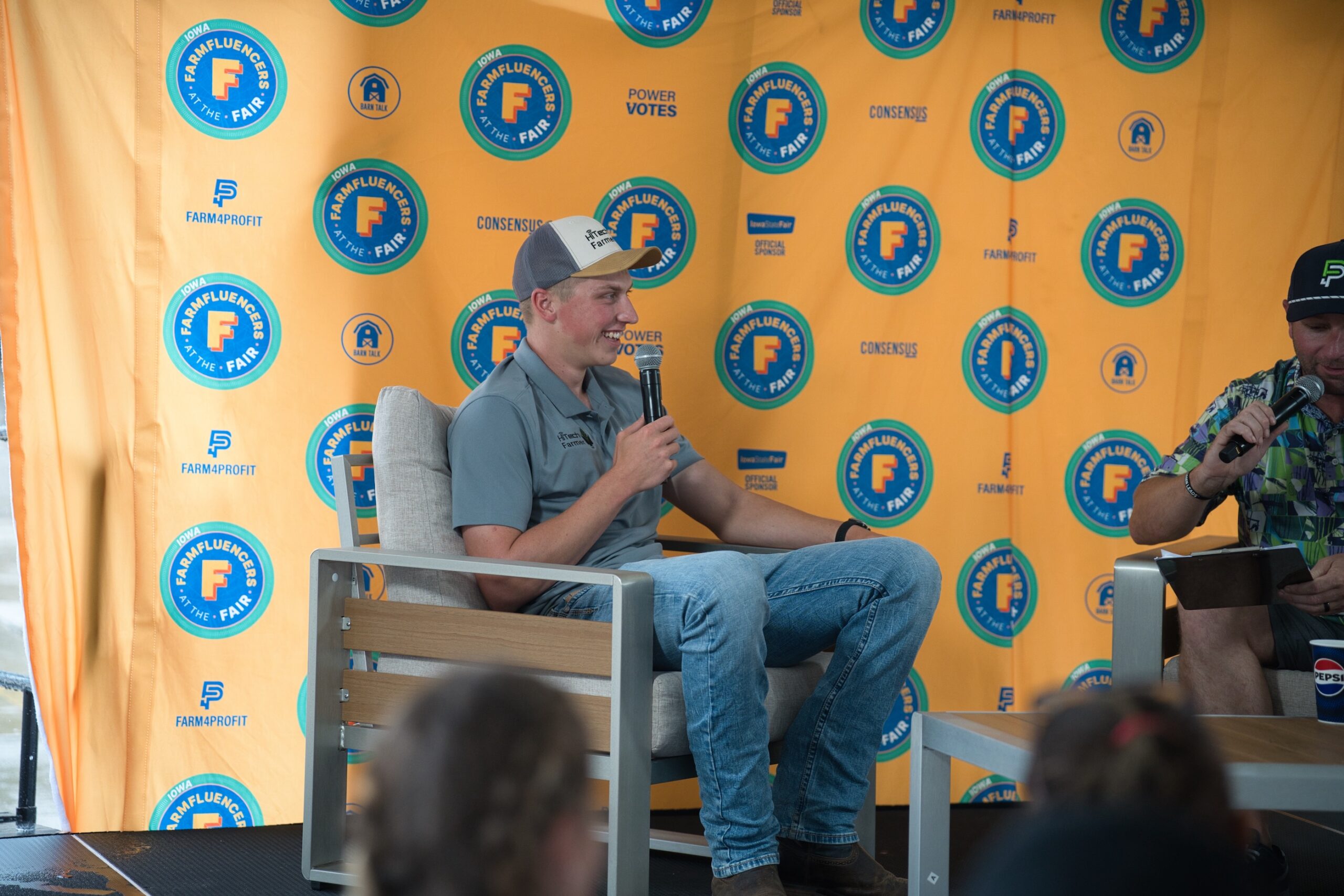
He was recently interviewed at the Iowa State Fair by Farm4Profit, one of the country’s most-listened-to agriculture podcasts, with more than 400,000 followers across platforms. Stay tuned for the Farm4Profit episode.