In 1978, Cabot Lyman originally intended to rent building space from the closing Morse Boatbuilding Company in Thomaston, Maine. Instead, he discovered that Roger Morse still had contracts with two customers to finish their boats. Seeing an opportunity, Lyman bought the land and buildings, took over both contracts, and opened Lyman-Morse Boatbuilding alongside a crew of eight employees.
Over the decades, Lyman-Morse has built more than 110 yachts, the company says, “each of them unique in its own way — and we love them all.” Cabot’s son, Drew Lyman, has run the company since 2014. Today, the yard builds far more than just boats. Drew Lyman described the marine industry as “notoriously up and down—you ramp up for a new, big, labor-intensive build and then next thing you know, everyone’s asking ‘what’s next?’” To counter those cyclical swings, the company created Lyman-Morse Technologies to apply its composite and custom manufacturing skills to other advanced industries. “It allows us to even out the revenue curve and the workload balance,” he said.
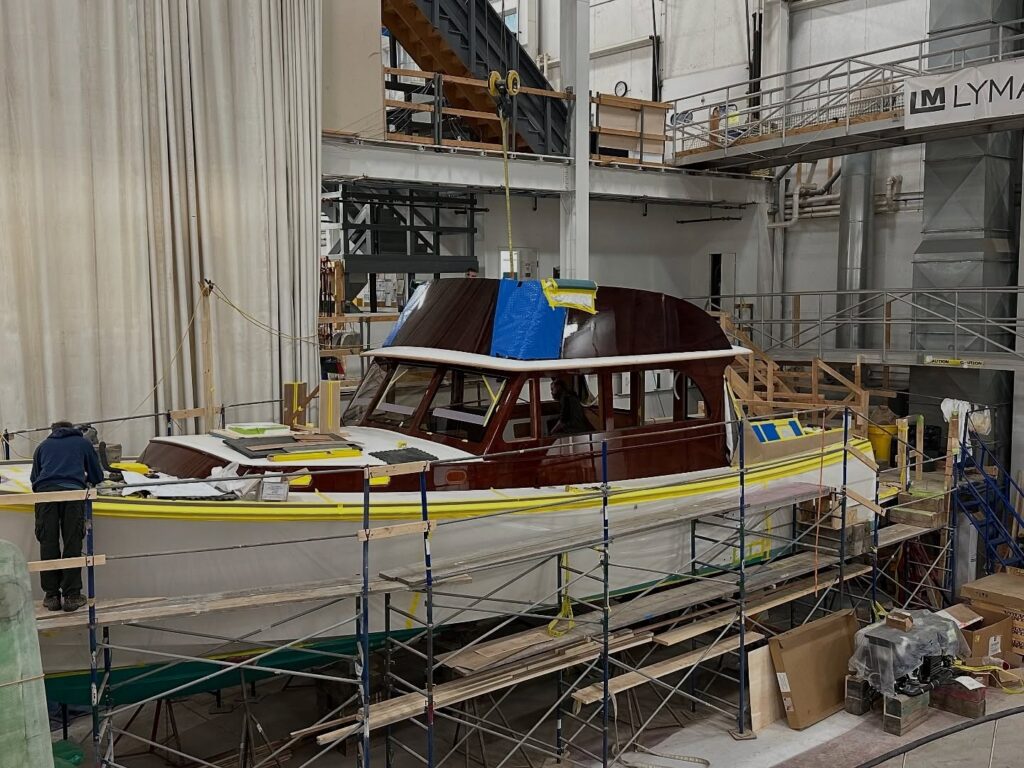
Photo Courtesy Lyman-Morse Boatbuilding
That division has produced a fiberglass-and-carbon-fiber canopy roughly 160 feet long for the Kendall Square subway entrance in Cambridge, Massachusetts. In September 2022, crews shipped the canopy’s two halves by barge from Thomaston to Boston and up the Charles River, then craned them into place overnight. “It was a great project for the company, not only from the scale of it—it covers an area close to 3,000 square feet—but also because it affirms everything that we do here in terms of craftsmanship and the ability of our teams to deliver spectacular pieces on time, and on budget,” said Samir Gupta, division manager at Lyman-Morse Technologies.
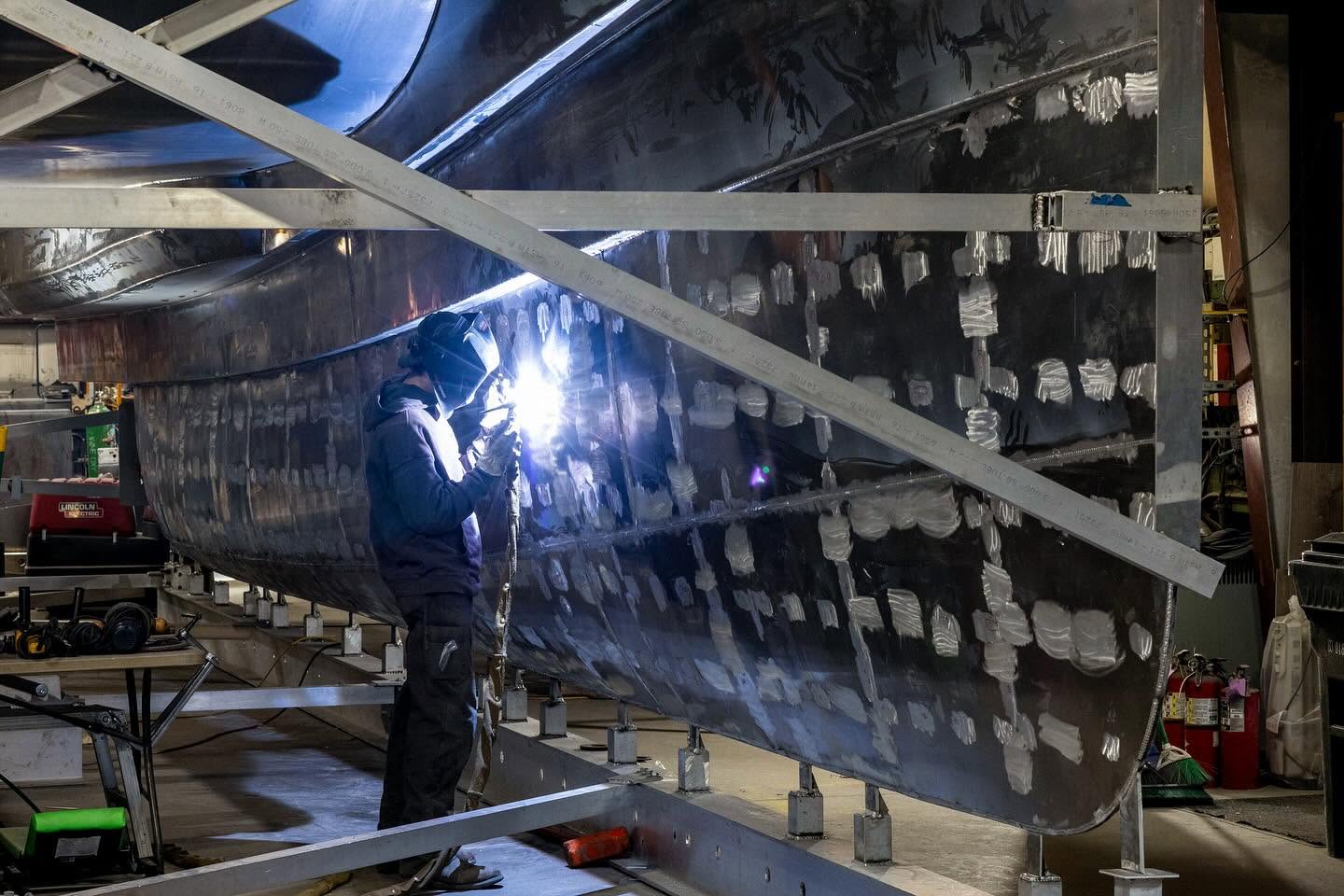
The company’s metal shop expanded similarly. LM Workboats, the company’s fabrication division, grew out of the need “to have custom, high-quality, durable, and beautiful hardware for extreme marine environments.” It now builds aluminum fire, patrol, utility, research, and recreational vessels, as well as water taxis. Past customers include the University of New Hampshire, which uses a 33-foot landing craft for aquaculture research; the U.S. Geological Survey in Woods Hole, Massachusetts; and a county fire department in South Carolina.
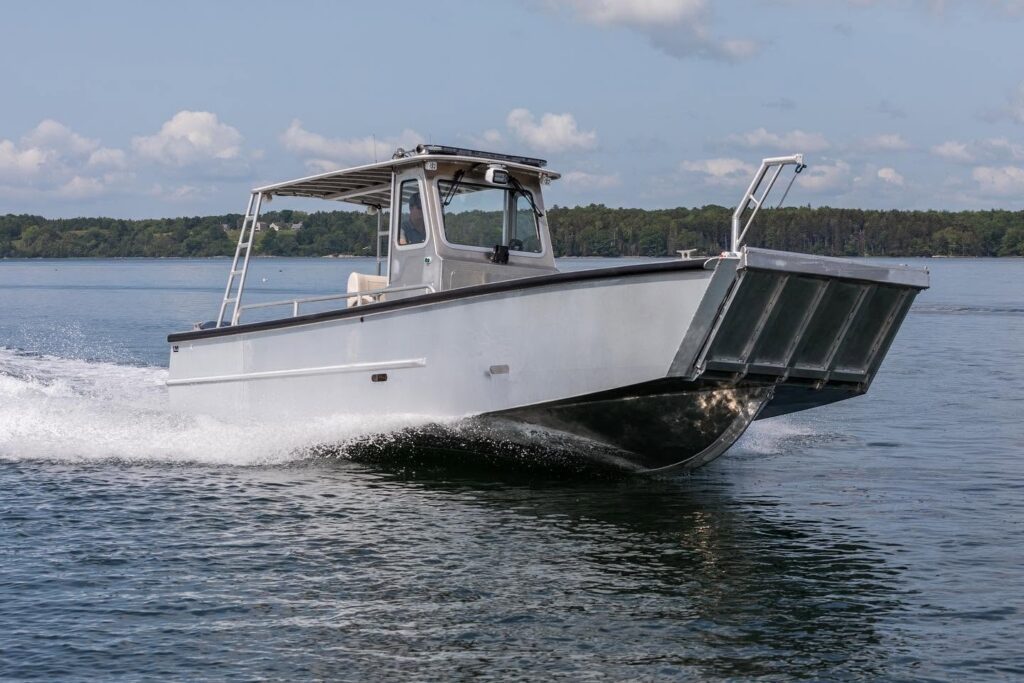
Photo Courtesy Lyman-Morse Workboats
In September 2026, LM Workboats announced a contract to build a 59-foot aluminum research vessel for the Maryland Department of Natural Resources. The boat will gather monitoring data year-round on the Chesapeake Bay to help the state protect and restore water quality and habitat. “This project reflects the growing demand for highly specialized aluminum workboats,” division manager Jonathan Egan said in a statement.
Several of the company’s shops collaborated on its most recent launch. On Aug. 3, 2026, Lyman-Morse launched Firefly, a 49-foot aluminum catamaran built for Upstream Alliance, a nonprofit that takes students and community members onto the water to connect them with nature and advance clean water, coastal resilience, and public access. Based in Camden, New Jersey, Firefly will carry 32 passengers as a “floating classroom” on the Delaware River. LM Workboats led the aluminum construction, and the main Thomaston boatyard handled final outfitting with its fabricators, electricians, mechanics, and systems technicians.
The boat is fully electric, running on two electric motors and a bank of lithium iron phosphate (LFP) batteries, with 24 solar panels on a canopy over the passengers. The panels cover about 12% of the boat’s daily power needs, Egan told Soundings Trade Only, with the remainder supplied at the dock. Upstream Alliance says it is “the first U.S. Coast Guard-approved passenger vessel powered by lithium iron phosphate batteries, marking a major step forward for carbon-neutral transportation on the water.” Upstream Alliance founder Don Baugh expects Firefly to begin classes in mid-October. “It’s a boat of the future,” he told NJ.com. “It’s a boat of hope.”
Lyman-Morse is also building three solar-assisted electric ferries for MeVa Transit, the public transit operator for Massachusetts’ Merrimack Valley. The 33-foot catamarans, funded by a $4.2 million federal grant, will carry commuters and day-trippers between Haverhill, Amesbury, and Newburyport, reviving recreational Merrimack River ferries after nearly a century. Egan reflected, “We’re combining precision marine engineering with sustainable technology to deliver efficient, accessible, and environmentally responsible vessels that honor the Merrimack River’s maritime history while shaping its future.” MeVa administrator Noah Berger told Haverhill radio station WHAV that Lyman-Morse beat four other bidders in a process that weighed specifications, not only price.
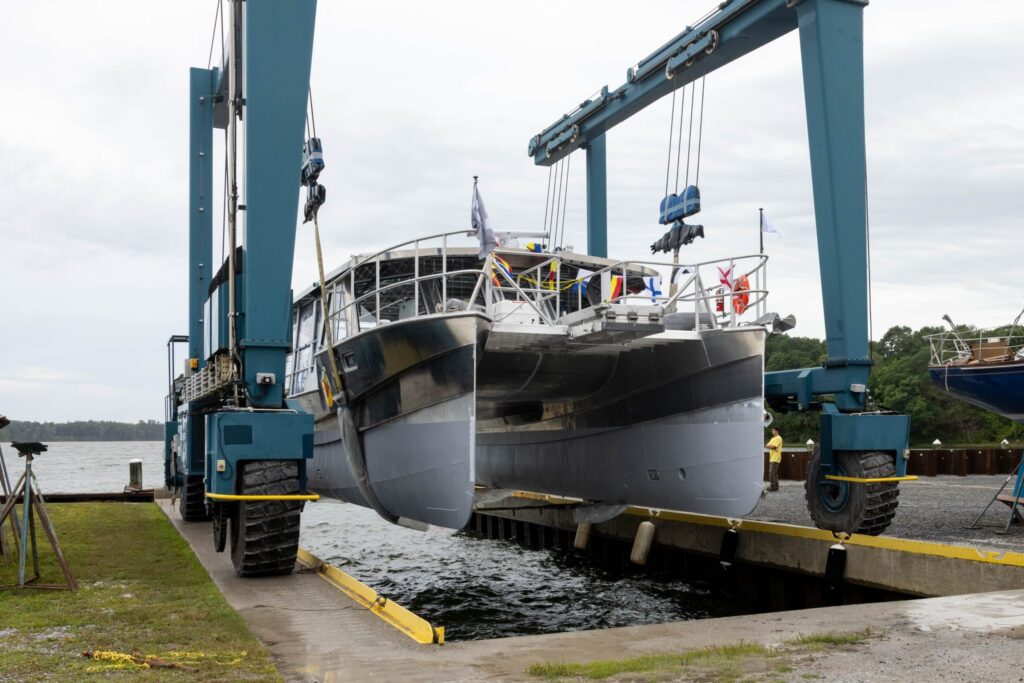
Photo Courtesy Lyman-Morse
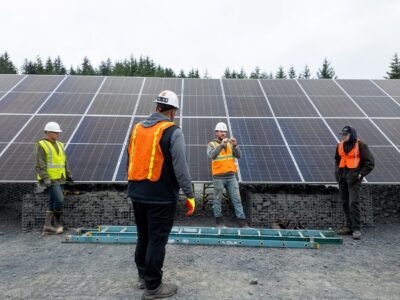
To support this expanding workload, the company announced in May 2026 that it had begun building a 15,000-square-foot Advanced Composites Center on its Elltee Circle campus in Thomaston. The Maine Technology Institute (MTI) awarded $1,985,502 toward the $4 million project. MTI says the building will add 25 well-paid jobs and help train workers through a company program called LM360, increasing company revenue by 50% within five years and strengthening Maine’s supply-chain resilience. With a 150-kilowatt solar installation, Gupta said, “this new building allows us to take on larger, more complex projects with greater efficiency.”
The company’s own history credits its success to local talent: “Maine has turned out to be, perhaps, the finest place in the country to find exceptional and dedicated people to work with.” Those workers belong to a state ocean economy that accounts for more than 90,000 jobs and close to $6.8 billion in yearly economic activity, according to the Maine Department of Economic and Community Development.
Nearly 50 years after his father took over two unfinished contracts, Drew Lyman describes the new building in terms of what comes next. “This project is about building capability for the long-term,” he said. “We’re creating a facility that not only supports our current work but positions us for the next generation of manufacturing challenges.”
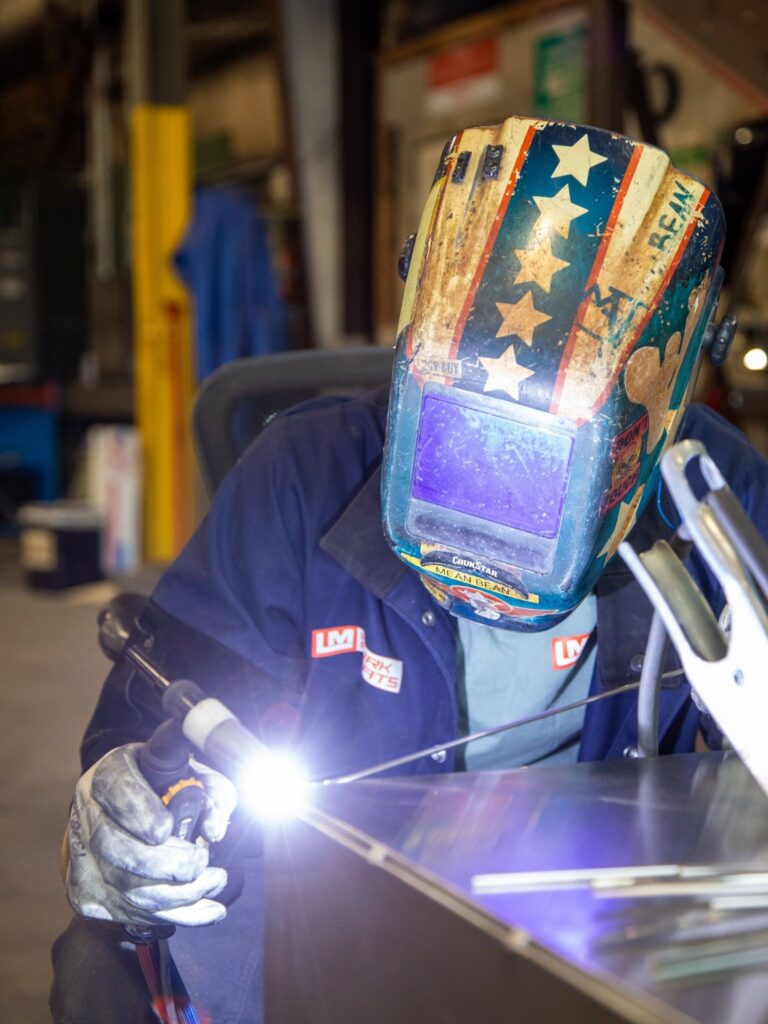
Photo Courtesy Lyman-Morse Workboats