
The Eastern Band of Cherokee Indians (EBCI) is charging ahead with clean energy investments that promise both environmental and economic benefits for North Carolina. In September 2024, the U.S. Environmental Protection Agency (EPA) awarded the Tribe $4.99 million from the Climate Pollution Reduction Grant program, which is funded through the Inflation Reduction Act (IRA). This substantial investment will electrify transportation and integrate clean energy throughout Cherokee, North Carolina, creating jobs while positioning the Tribe as a leader in the state’s energy transition.
This investment will not be EBCI’s first clean energy initiative. In 2021, the Tribal Council committed to a cleaner future by publishing a resolution to establish reasonable goals for the deployment of electric vehicles and electric charging stations. The resolution proclaims, “the Cherokee outlook for future generations is to plan for seven generations in advance to ensure our progeny and descendants are able to enjoy the same level of opportunities in the future, or greater, and that the environment in which we occupy will be as fruitful then as it is now.”
In 2022, with funding from the North Carolina Department of Environmental Quality’s Volkswagen Mitigation Plan, and with help from Katie Tiger, EBCI Air Quality Program supervisor, and Donnie Owle, Cherokee Boys Club service manager, EBCI became the first North Carolinian group and one of the first American Tribes to buy an electric school bus. The benefits were immediate, with $400 in monthly energy costs dwarfed by the $700 to $900 that it had cost to fuel each diesel bus. Collaboration with Duke Energy resulted in four additional buses, as well as charging and infrastructure support, in exchange for participating in a vehicle-to-grid (V2G) technology pilot.
With the most recent funding, EBCI will purchase 15 additional electric school buses and one Class 8 heavy-duty electric truck, thereby fully electrifying its fleet. The truck will transport trash across the 103 miles to Homer, Georgia, six days a week, resulting in $17,000 in health benefits per year for the surrounding communities back home. “Federal funding has really been key,” said Katie Tiger. “Being able to get 15 additional school buses to make our fleet 100% electric is an amazing accomplishment.” Donnie Owle highlighted the immediate economic benefits: “Our diesel buses were costing us about $800 a month. Now, with electric and the charging, we’re paying about $400 probably in a year’s time. They’ve saved us probably $50,000 to $60,000.” These savings enable more resources to be allocated toward education and community services, rather than fuel and maintenance costs.
These clean energy investments represent major economic development opportunities. In addition to enhancing “energy affordability and equity by providing access to clean, affordable energy options,” the funding will also create immediate construction jobs and long-term maintenance and operations positions for multiple related projects:
- A 400 kilowatt (kW), off-grid solar microgrid and an 80 kW diesel energy storage system for the Cherokee Boys Club bus depot, supplying power to eight fast charging stations
- Installation of solar power on Tribal buildings, including:
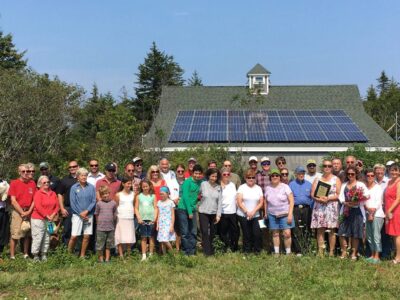
- A 52 kW solar array on the Tribal Council House Complex
- A 121 kW solar array on the New Kituwah Academy rooftop
- Installation of 20 publicly accessible Level 2 EV charging stations across the town of Cherokee
Kelly Gloger, co-founder of the Critical Services Microgrid Group, added that the buses could act as mobile microgrids, especially during the summer when they are not in use by schoolchildren. “Those buses, obviously being on wheels and having big batteries, could go in an emergency situation like we just had with Hurricane Helene and could move to community centers or fire stations and provide power instantaneously because they are like big generators,” he explained.
Ultimately, these investments will help the Tribe meet the goals laid out in its 2021 resolution and the Priority Climate Action Plan that it submitted to the EPA last year, and ultimately “initiate transformative progress towards achieving energy resilience, sustainability, and economic development.” Such action is more important now than ever before, with 8 out of 10 surveyed Tribal community members agreeing that Cherokee, North Carolina, is currently experiencing the effects of climate change, with the top threats being wildfires, extreme heat, and flooding.
Perry M. Shell, Tribal Council Representative for EBCI, explained the deeper significance: “We live in the most beautiful place on earth right here in the Great Smoky Mountains, our traditional homeland…. Maintaining that beauty and maintaining this culture and where we’re at and taking care of it is a sacred obligation of our people.”
This article was created on April 9, 2025 with the assistance of the generative artificial intelligence (AI) tool Claude 3.7 Sonnet, using the linked company websites, press releases, reports, or external media coverage as inputted source material. It was then reviewed, fact-checked, and edited by one or more team members to ensure factual accuracy and consistency with editorial standards before publication.
While we strive for precision, reliability, and quality, readers should be aware that AI-generated content may have limitations in contextual awareness and nuance and may not be completely unbiased, consistent, error-free, or up-to-date. We recommend using this content only for informational purposes, as well as independently verifying it or conducting further research to supplement it. If you notice any inaccuracies or have concerns about this content, please contact our research manager at greg@consensus-digital.com.