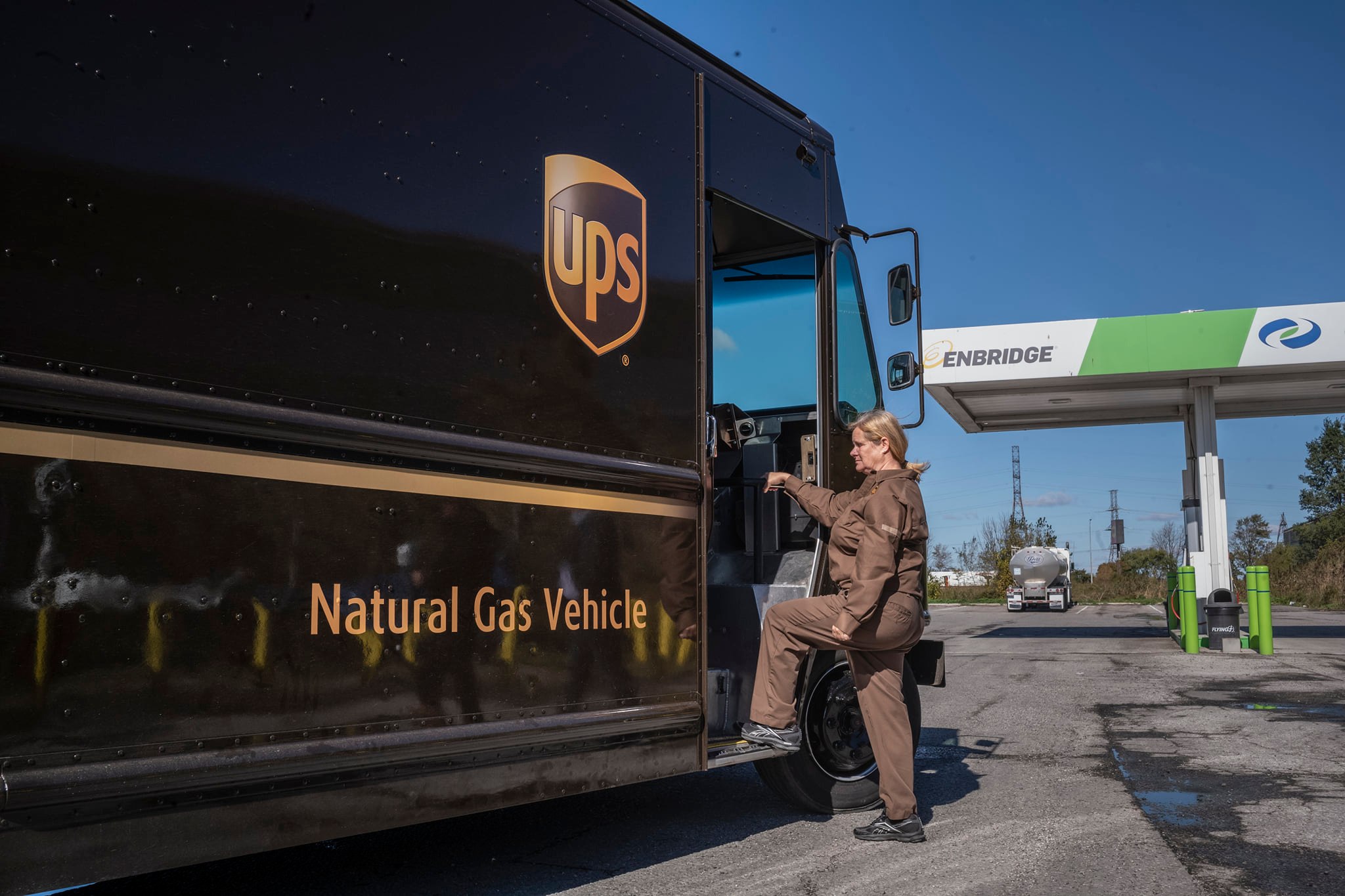
With more than 460,000 employees across more than 200 countries, UPS delivers 20.8 million packages and documents every day. To do so, the company has had to innovate. In 2019, the company announced that it would buy 170 million gallon equivalents of renewable natural gas (RNG) from Clean Energy Fuels Corp. through 2026, marking “the largest commitment for use of RNG to date by any company in the United States.”
UPS estimated that switching from diesel fuel to RNG would enable UPS vehicles across 12 states to reduce carbon emissions by 1.074 million metric tons over the course of the agreement. The impact is equivalent to planting 17 million trees or recycling 374,000 tons of waste rather than landfilling. Essentially, RNG is a clean fuel made from methane, a gas that traps 25 times more heat in the atmosphere than carbon dioxide, which is captured from organic waste in agricultural operations and landfills. Mike Whitlatch, vice president of global energy and procurement, elaborated, “RNG yields up to a 90% reduction in lifecycle greenhouse gas emissions when compared to conventional diesel.”
Mike Casteel, former UPS director of fleet procurement, said, “The world has a trash problem. And the world has an emissions problem. Renewable natural gas, produced naturally from bio sources such as landfills and dairy farms, turns trash into fuel. It’s a winning solution that will help UPS to reach our ambitious sustainability goals,” said Casteel. Adopting RNG was part of UPS’s goals to make low-carbon or alternative fuels account for 40% of total ground fuel purchases and reduce the absolute greenhouse gas emissions of its ground fleet by 12% by 2025.
Around the same time, the company announced it would spend $450 million on over 6,000 natural gas-powered trucks between 2020 and 2022, capable of running on either RNG or conventional natural gas (CNG). Casteel added that “RNG is supported by existing national infrastructure used to transport natural gas.”
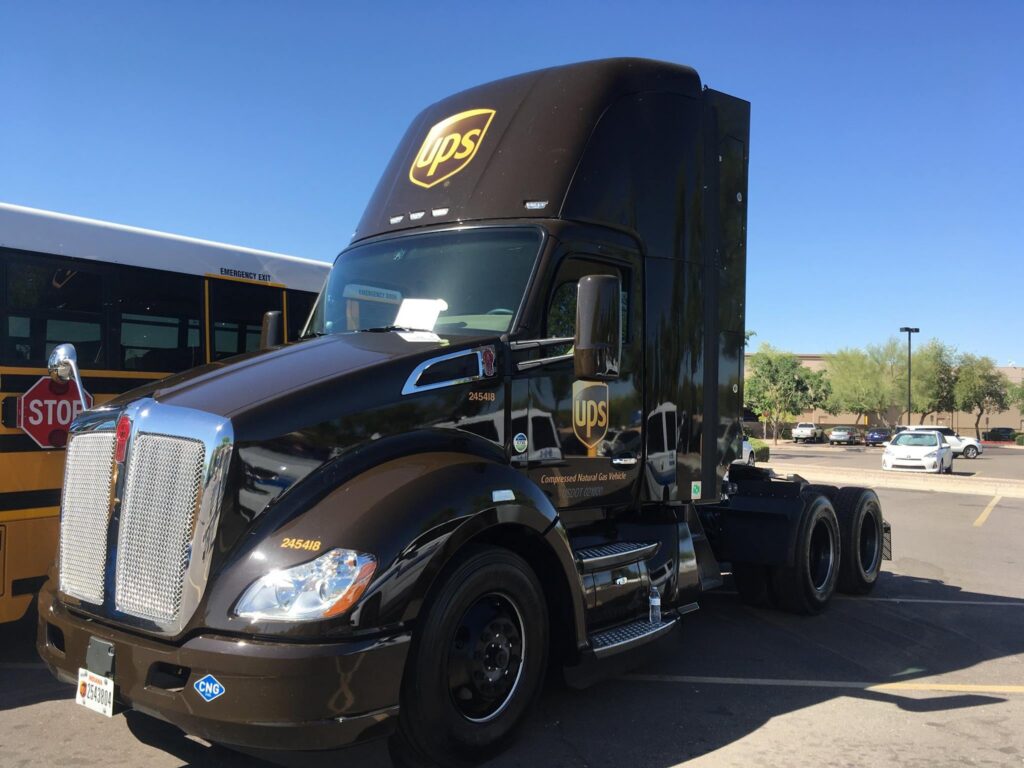
Photo Courtesy CNG Services of Arizona
Using RNG also makes sense from a cost standpoint. Casteel added to Supply Chain Dive, “We can put a large number of trucks here that burn this fuel, and we can recover the incremental cost of those assets over a reasonable period of time through fuel savings because natural gas costs less than diesel fuel… Our environmental goals also need to be economically sustainable, so this is one of those cases where they both come together very well.”
In 2020, UPS announced that it would also buy 80 million gallons of equivalent RNG from Kinetrex Energy, now part of Kinder Morgan, and TruStar Energy, now part of Opal Fuels, over the next seven years. These agreements further expand its impact, bringing its total commitment to 250 million gallons of equivalent RNG, making it the largest adopter in the transportation industry.
The move to RNG was not new, however. Between 2009 and 2019, the company invested over $1 billion in alternative-fuel and advanced-technology vehicles and fueling stations. Between 2014 and 2022, the company purchased 155 million gallons of equivalent RNG. It used more than 169 million gallons of alternative fuel in 2023 alone and purchased 214 million gallons in 2025. Using alternative fuels last year helped the company avoid about 1.4 million metric tons of carbon emissions. Currently, UPS has 19,000 alternative-fuel and advanced-technology vehicles that drive more than one million ‘green miles’ daily, and employees have driven more than 5 billion miles on alternative fuel since 2000.
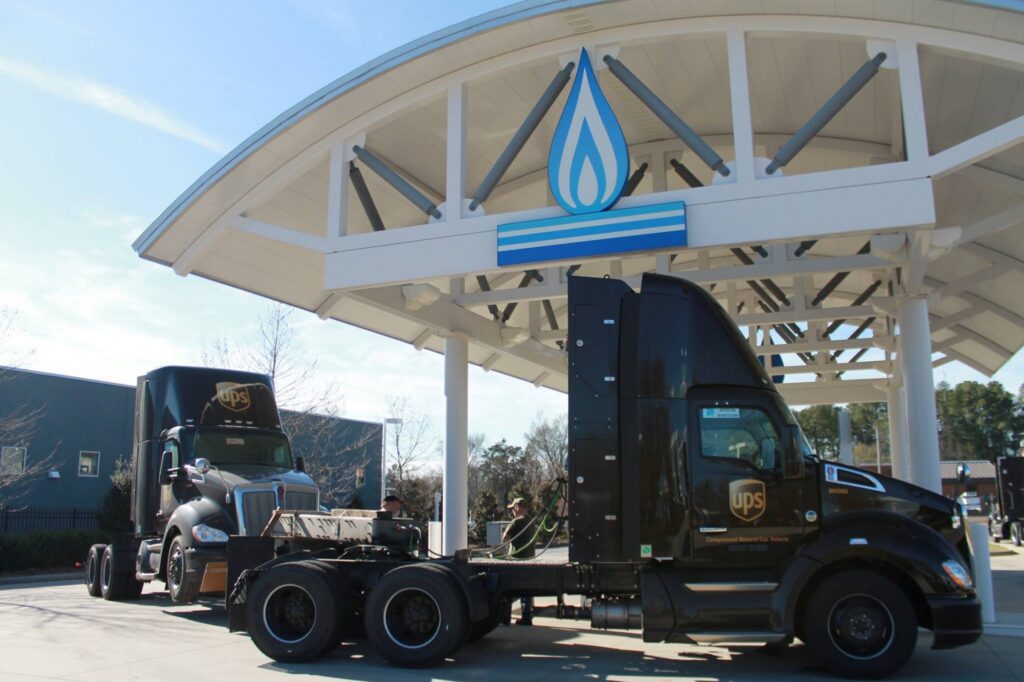
Photo Courtesy York County Natural Gas Authority
UPS’s use of RNG is perhaps most visible in Salt Lake City, Utah, the company’s fourth-largest regional hub in the country. UPS chose natural gas for its Salt Lake City fleet due to air quality concerns about emissions being trapped in the valley created by the Wasatch Mountains. In the state, 240 UPS drivers are on the road each day, and around 1,000 trailers enter and exit the Salt Lake facility. While the rollout has been gradual, more than 50% of the regular fleet and 92% of the package fleet were running on CNG by last August, with each fleet averaging about 65% daily.
Although the company already maintains 600 fueling stations, 200 of which are tractor-trailer-friendly, the main factor preventing them from reaching 100% right now is the need to expand with CNG supplier partners in locations where fueling stations have not yet been built. “That’s coming, with our partners, expanding those networks,” said division manager Nathan Branch. “Within the next few years, we will have that opportunity to be 100% renewable natural gas here in Utah.” Mike Backus, UPS Director of Fleet Maintenance for the Desert Mountain District, added, “With each new generation of CNG tractors, we’ve been able to expand our operations and increase efficiency.”
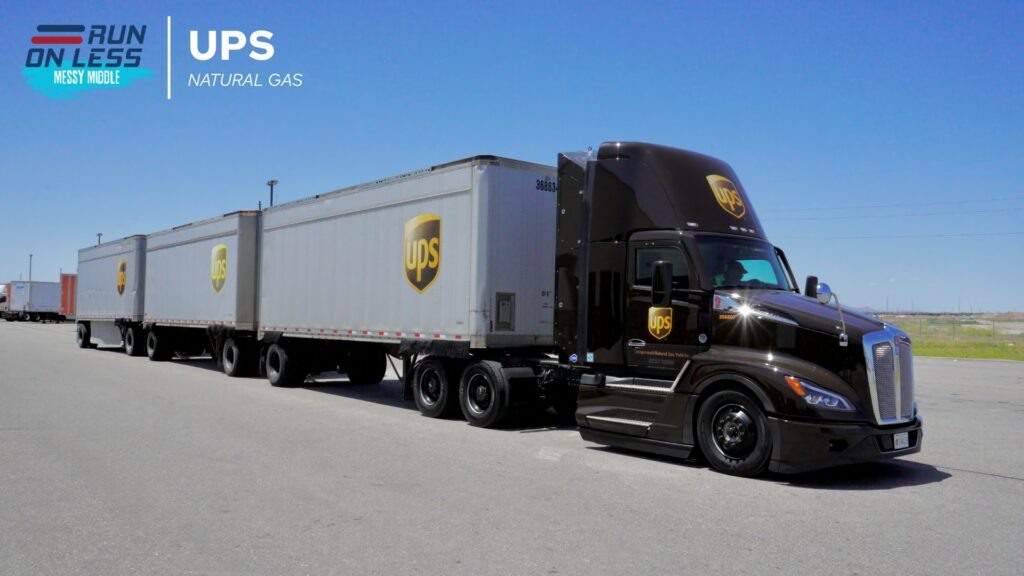
Photo Courtesy NACFE – North American Council for Freight Efficiency
The choice to use CNG vehicles was also informed by reliability concerns across a broad swath of territory. “One advantage of the CNG trucks is their reliability in all climates,” said Backus. “Whether in the freezing temperatures of Salt Lake City or the extreme heat of Phoenix, they start easily and run consistently without temperature-related issues — something we can’t always say for our diesel units.”
Drivers have also benefited from smoother driving with less noise and quicker fueling, which creates a more comfortable and efficient work environment. “I’ve been very happy with this truck. I heard that they do just as well as the diesels, and they do,” said driver Gene Horne, who starts driving every day at 2:15 a.m., about a Kenworth Truck T680 day cab tractor. “It’s much quieter being in a CNG than a diesel, it makes a lot less noise… [and] they’ve got a really soft suspension, soft drive.” The T680 has offered natural gas as a powertrain option for more than a decade, and UPS was one of the first to receive a Cummins X15N engine in a Kenworth T680 chassis in 2024. Horne added, “It probably takes about 10 minutes max to take a tank that’s 90% empty to fill that thing up.”
As Chief Sustainability Officer Scott Childress said, “While electrification will play a big role in decarbonizing our fleet, RNG is today’s solution.”