
Mike Healy first saw Skagway, Alaska, in 1999, when he and a friend dropped their East Coast road-trip plans at the last minute to visit a friend there. “Though we were only in Skagway for a couple of weeks, this little town left a lasting impression on me,” he told What’s Up Yukon in 2019.
The South Dakota native moved to Skagway in 2003 and opened a coffee and smoothie shop with friends. While driving tours up and down the mountain pass outside town every day, he always passed a flatbed trailer holding stainless steel brewing equipment from an earlier version of Skagway Brewing that had operated until 2002. “Around that time, a friend gave me a home brewing kit, and I was fascinated by the process. Things just all of a sudden clicked,” he explained.
In 2007, Healy and his father formed a company, bought the equipment and the name, and opened Skagway Brewing Company. The name has even older origins: The company traces it to the Gold Rush, when its first brewer, German immigrant Hermann Barthel, came north from San Francisco to serve prospectors bound for the Klondike.
Skagway is not an easy place to supply a restaurant. The town’s only grocery store relies on weekly barges, and the number of people in town ranges from about 900 residents in winter to more than 10,000 on some summer days due to tourism, according to Alaska Public Media. In 2025 alone, the Municipality of Skagway counted 1,357,498 cruise passengers. Nearly two decades after opening, Skagway Brewing Company has built its business around a practical idea: In a town where so much arrives by boat, the best supplies are often the ones already on hand.
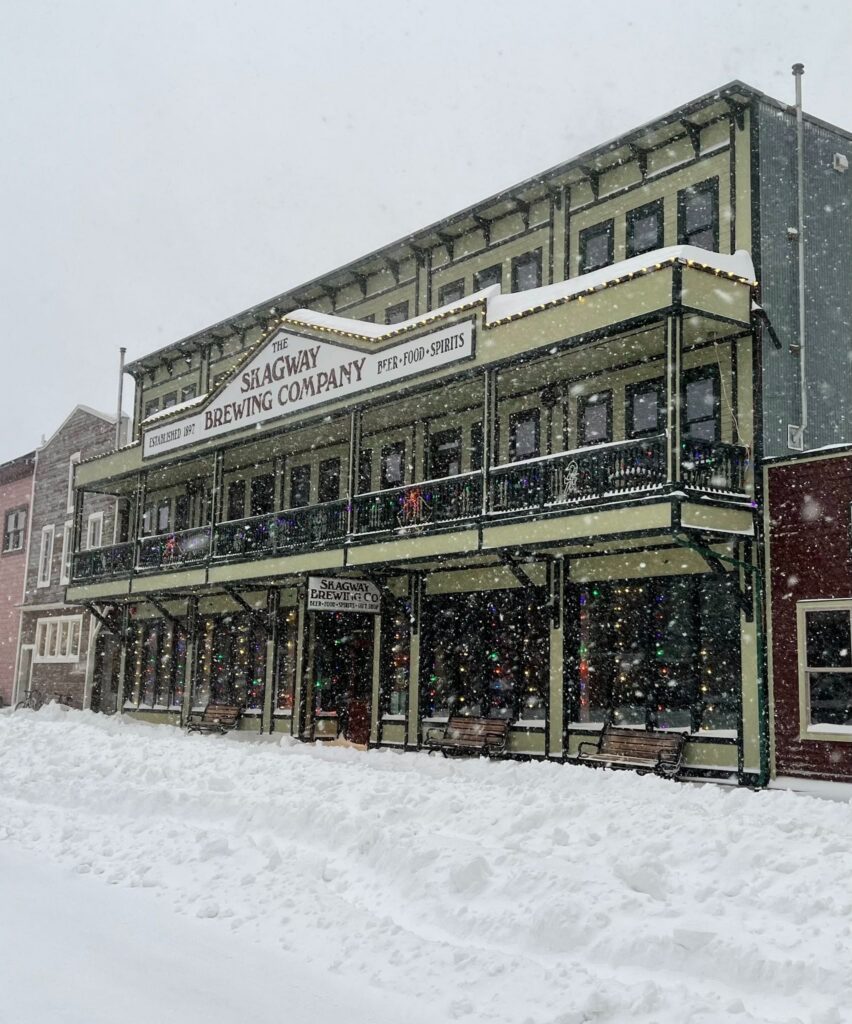
Photo Courtesy Skagway Brewing
That idea starts with the brewery’s flagship Spruce Tip Blonde Ale. The company says the beer uses local Sitka spruce tips, hand-picked in the spring and vacuum-sealed and flash-frozen so it can brew the ale year-round. “This is our flagship ale, the beer that built Skagway Brewing Company,” Healy said.
Picking enough tips requires help. After the team foraged tips for its first batch in spring 2007, the brewery began accepting spruce tips from locals as payment, BBC Travel reported in 2019. Until 2016, a pound of tips earned $4 or a pint of beer. After Healy concluded that state liquor law did not allow payment in beer, the brewery switched in 2017 to paying $5 a pound in cash.
Former head brewer Trevor Clifford called the payments the “spruce tree dividend.” He said the spring harvest helps seasonal workers who often reach town short on cash after paying their way north. “So people are excited to get some money off the trees,” Clifford told BBC Travel. In 2021, Healy told Alaska Magazine, “We hand-pick hundreds of pounds of spruce tips every spring and early summer.”

Photo Courtesy Skagway Brewing
By 2018, the original brewpub could not keep up with demand, and the following year, the company moved into a new three-story building that can serve up to 400 guests and increased its brewing capacity by 400%. The brewery occupies the first floor, the restaurant the second, and a farm the third. The company says it brews its beer with steam from biodiesel made from its own used fryer oil. Fans move heat from the farm’s grow lights to warm nearby offices, and the bar tops are made from reclaimed lumber.
The aeroponic farm grew out of a shipping problem. “We got to the point where we had to fly herbs up because we couldn’t rely on the seven-day barge to get them here before they would spoil,” Healy told CBC News in 2020. He told Wine Enthusiast, “We were throwing away 10–30% of all of our greens and herbs because they spoil by the time they got to us.” Farm manager John Michael Mead described the same frustration to Civil Eats. “Lettuce is the hardest to get up here, because of how delicate it is, to harvest it, ship it,” he said. “It shows up bad or partially bad, and we spend hours picking through it.”
Today, the farm, known as the Raven’s Nest, grows 250 pounds of lettuce a week, enough to meet the restaurant’s entire demand. The farm supplied 100% of the restaurant’s greens in its first year, producing more than 100 pounds of lettuce a week that summer. Locals noticed. “We’ve had a lot of feedback from the locals that they’re now going out [just] to eat a salad. No one did that before,” Healy told CBC News.
It runs partly on brewing leftovers. For years, the brewery vented its carbon dioxide (CO2) onto the street, which bothered Healy; now, a tube carries the gas from the fermenter up to the plants to speed their growth. Leftover yeast from the brewhouse helps, too: Mead said the team uses it in homemade microbial compost teas, so the farm buys less fertilizer.

Photo Courtesy Skagway Brewing
Healy and Mead are candid about the costs. Mead estimates that growing lettuce in-house costs about 10% more than buying and shipping it in. However, he pointed out what that figure misses: the fuel burned moving lettuce from Arizona fields to Seattle and north by sea, and the business lost when a delivery shows up spoiled, even if the vendor refunds it. “In places that have a lot of sun and easy access to roads and freeways, it doesn’t make a lot of sense,” Mead said. “But in Alaska, it’s dumb not to. The costs of not having what we need are too high.”
Healy had hoped the farm would feed the whole town through the winter. “Part of the original plan was to be able to fully supply our community in the winter. And unfortunately, the cost of electricity just keeps going up,” he told Civil Eats. For now, extra winter greens go to the school, the senior center, and the local market, donated or sold at cost. Healy has not given up on the winter plan. “It is my hope that after this season, when we start looking at all the numbers again, we’re going to say, ‘OK, we’re back in it,'” he told Civil Eats in August.
The brewery’s ties to its neighbors show up on tap, too. In October 2025, it released a West Coast IPA called Local’s Only, brewed “in honor of our locals and neighbors.” Healy told Wine Enthusiast that hometown loyalty runs deep: “Alaskans have a lot of pride. You can probably find fairly similar beer even cheaper at the liquor store, but locals prefer the fresh beer made in their own town.”