The U.S. Department of Agriculture (USDA) announced that it will release previously obligated funding for rural energy programs despite initial uncertainty surrounding the funds. Programs including the Empowering Rural America (New ERA) program, Rural Energy For America Program (REAP), and Powering Affordable Clean Energy (PACE) program are set to proceed with their mission of helping farmers, ranchers, and small businesses, thereby supporting “their essential role in building a stronger, more energy secure America.”
“We’re ensuring these investments support U.S. energy production while putting America’s farmers, ranchers, and rural businesses first,” U.S. Secretary of Agriculture Brooke Rollins said.
These funds will support rural electric cooperatives, such as Grand Junction-headquartered Grand Valley Rural Power Lines, Inc. (Grand Valley Power), which the USDA selected in December to move forward in the grant process. With an award of $13 million over 15 years, New ERA Program CEO Tom Walch explained, “The purpose of the grant is to allow us to buy renewable energy from a solar generating facility over in Delta County, the Garnet Mesa solar facility. We will be getting 65,000 megawatt hours from the Garnet Mesa facility beginning in June of 2028.”
The company expects this deal to provide power for almost 6,600 homes annually, resulting in over $700,000 in annual cost savings for Grand Valley Power members, and create jobs on Colorado’s Western Slope. Walch added, “The New ERA investment provides our rural members the opportunity to support the unique integration of renewable-energy development and Western Colorado values. The increased resiliency and production of clean energy will provide benefits for generations.”
Rita Sanders, spokesperson for Grand Valley Power, expressed optimism about the recent funding announcement: “Our project is one that benefits our members and our members are rural, so we are optimistic. It is also local, a local energy source that will provide resiliency and increased reliability for our members.”
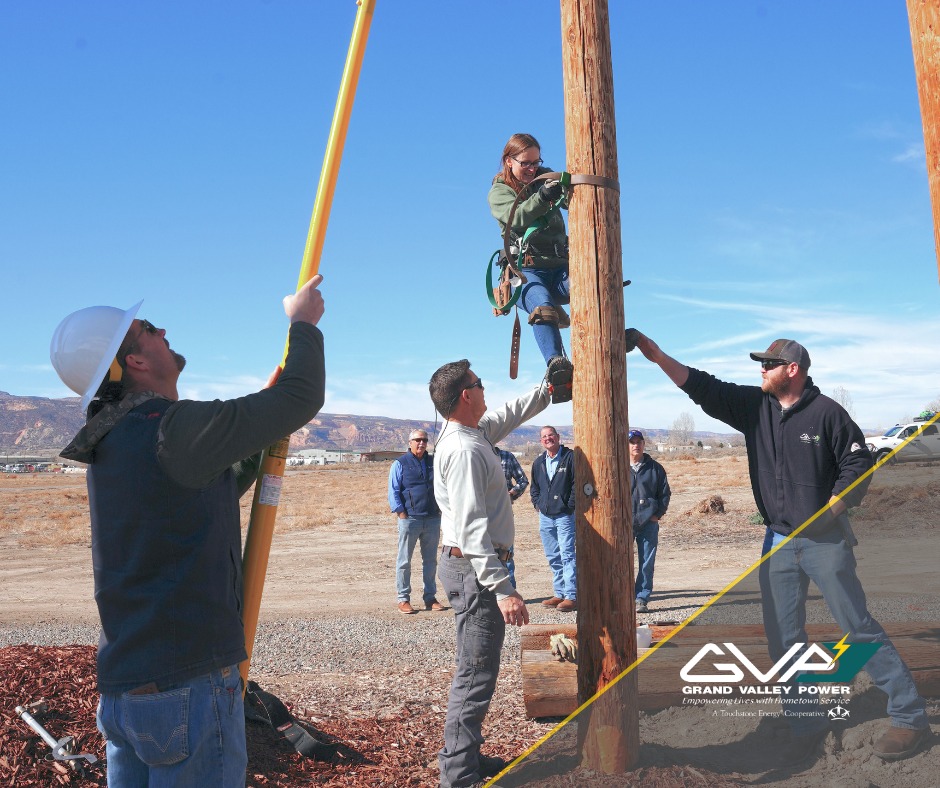
Photo Courtesy Grand Valley Power
Westminster-based wholesale power provider Tri-State Generation and Transmission Association (Tri-State), meanwhile, was selected by the USDA in October to receive $2.5 billion from the New ERA program in the form of grants and low-cost loans as it advances its production of clean energy for the 40 utilities to which it provides electricity across the rural West, including Colorado, Nebraska, New Mexico and Wyoming.
Tri-State’s award will support financing for 1,280 megawatts (MW) of solar, wind and hybrid storage projects, as well as over 100 MW of stand-alone energy storage projects. It will also facilitate the retirement of 1,100 MW of coal-fired energy generation, which the company says “lessens the financial burden of stranded assets for Tri-State members.” These infrastructure announcements will create over 2,000 total jobs while reducing carbon emissions by 5.8 million tons per year. The company also expects the projects supported by New ERA funding to help lower wholesale electricity rates for cooperative members by 10% by 2034, amounting to $430 million in rural consumer benefits over the next decade.
“Together with Tri-State and with the support from USDA, our members will have an increasingly clean power supply that remains reliable and affordable, and that aligns with our cooperative board’s strategic plans and initiatives,” said Gary Kelly, CEO of Buena Vista-based Sangre de Cristo Electric Association.
Tri-State is also committed to investing in the communities where these projects are placed. As CEO Duane Highley commented at the announcement, “This is a momentous day for Tri-State, for our members, and for the future of rural electric cooperatives. Most importantly, this is all about our rural communities, who are the beneficiaries, and how we can accomplish an accelerated energy transition that ensures reliability, in an affordable manner, that finally allows rural America to own and directly see the benefits.”

Photo Courtesy Tri-State G&T
Highley also thanked Rep. Jeff Hurd (R-CO-03), Rep. Gabe Evans (R-CO-08), and Rep. Lauren Boebert (R-CO-04) “for weighing in with USDA and the Administration, and for showing their support for our application, our member systems and our rural communities.”
Representatives Evans and Hurd have emphasized their commitment to ensuring that rural communities receive the resources they need to strengthen their energy independence, while creating jobs and keeping costs low for consumers.
Rep. Hurd ran on the platform of being “open to competitively priced renewable energy and low-carbon resources. He will engage any company interested in bringing power plants, safe technologies, and well-paying jobs to southern and western Colorado.” He has long supported small businesses, recently telling Colorado Matters that he ran for office because “I wanted to create opportunities that families could stay and live and thrive in rural Colorado.”
Rep. Evans, meanwhile, recently advocated for clean energy, stating, “Truly, the 8th Congressional District is an all-of-the-above energy powerhouse to the tune of well over $30 billion worth of energy, and so being able to advocate for our economy, for good policies across the nation from that position on the energy and commerce committee is going to be a way that we deliver on those campaign promises of making things affordable, making sure folks can get good jobs, making sure that we’re protecting and empowering our American economy and American workers.” In early April, Rep. Evans introduced legislation aimed at helping farmers and ranchers achieve a more equitable payment structure with the U.S. Department of Agriculture. “The Conservation Reserve Enhancement Program Improvement (CREP) Act gives Colorado’s hardworking farmers and ranchers a path forward, allowing them the flexibility to voluntarily cut back on water use while keeping our working lands productive. This bill is a smart, bipartisan step toward protecting Colorado’s water and ensuring our agricultural communities remain sustainable for generations to come,” he explained.
This article was created on April 17, 2025 with the assistance of the generative artificial intelligence (AI) tool Claude 3.7 Sonnet, using the linked company websites, press releases, reports, or external media coverage as inputted source material. It was then reviewed, fact-checked, and edited by one or more team members to ensure factual accuracy and consistency with editorial standards before publication.
While we strive for precision, reliability, and quality, readers should be aware that AI-generated content may have limitations in contextual awareness and nuance and may not be completely unbiased, consistent, error-free, or up-to-date. We recommend using this content only for informational purposes, as well as independently verifying it or conducting further research to supplement it. If you notice any inaccuracies or have concerns about this content, please contact our research manager at greg@consensus-digital.com.