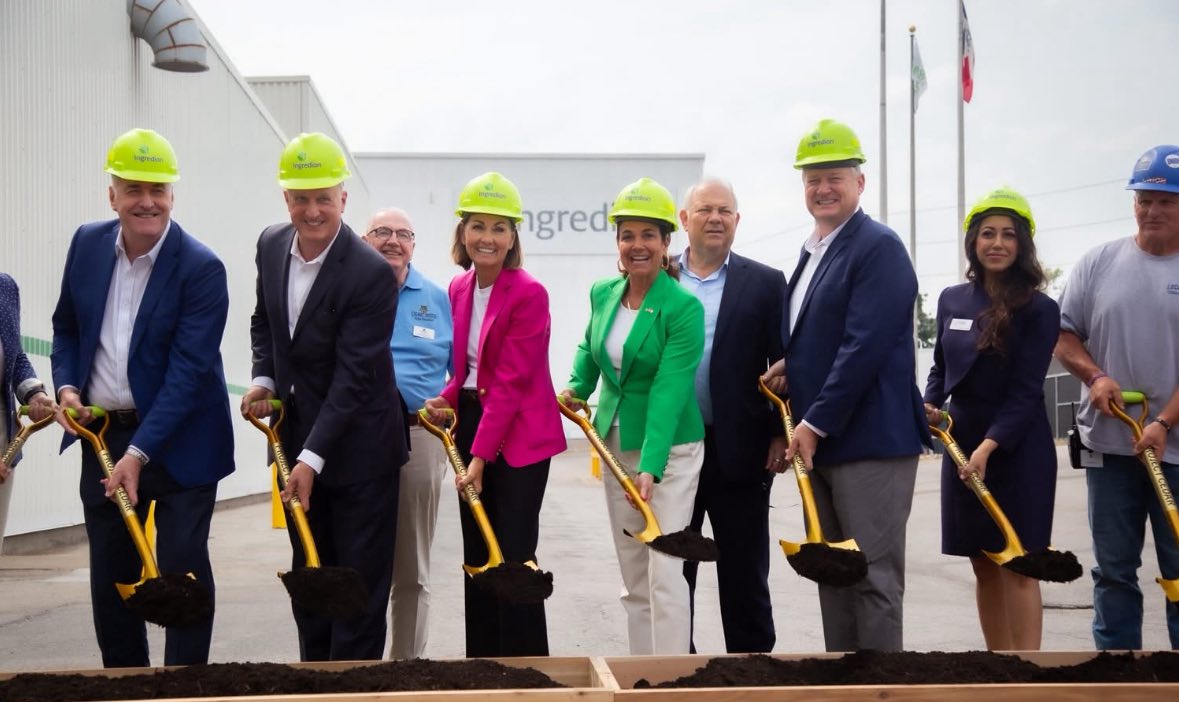
Ingredion is an ingredients solutions company, turning plant-based materials like grains, fruits, and vegetables into inputs for industries spanning food, beverages, brewing, animal nutrition, and industrial markets. Its manufacturing centers span across the U.S., including two in Iowa. Early last year, the company announced a $50 million investment to expand and modernize one of those facilities in Cedar Rapids, enhancing its production of industrial starches for the paper and packaging industries. The expansion includes a new starch flash dryer and three new buildings, expanding operations by 10,000 square feet and increasing capacity by up to 50 percent. Ingredion broke ground on the facility in August.
The economic impact of these types of investments for states like Iowa cannot be overstated. The Cedar Rapids City Council offered financial incentives to Ingredion and supported tax benefits for the project through the Iowa Economic Development Authority’s High-Quality Jobs Program. The expansion created four new jobs, in addition to the approximately 100 employees already working there, and will generate $5.1 million in taxes over the next ten years. In a comment on LinkedIn, Mark Grenko, a human resources manager at the Cedar Rapids site, reacted, “Our employees are the heart of this operation, and this modernization effort will not only help secure jobs but also provide opportunities for growth and development as we ramp up production of innovative, sustainable industrial starches.”
Meanwhile, Cedar Rapids Mayor Tiffany O’Donnell reflected, “Cedar Rapids continues to build a favorable development landscape, encouraging companies like Ingredion to reinvest and grow here. This agreement reflects years of City Council policymaking that has created ideal conditions for businesses to establish deep roots, create quality jobs, and strengthen our regional economy.”
This facility’s wet corn milling operations have been “supporting the livelihoods of many, many Iowa farmers” since the 1890s, according to Eric Seip, senior vice president of global operations and chief supply chain officer at Ingredion. At the groundbreaking ceremony, Iowa Governor Kim Reynolds highlighted that Ingredion processes 45,000 bushels of corn daily, but “with this investment, we have the opportunity to take that up to 65,000 bushels a day. And it’s 100% sourced from right here in our great state.”
At the groundbreaking ceremony, Mayor O’Donnell praised the company’s commitment to the region, noting its resilience through a 2008 flood and a 2020 derecho: “Your willingness to continue through good and challenging times says a lot about our community and a lot about you. So I thank you all for your partnership and those all-important relationships.” In fact, the facility has been rebuilt and bounced back numerous times throughout its history, most notably after a 1914 fire that decimated the building. Roxie Simon, former director of plant operations, discussed this longevity with The Gazette: ‘I think it’s the leadership and the vision of those who’ve run the facility to say, ‘OK, we’re going to evolve with changing markets and we’re going to make something that’s going to make money,’ but then you’ve got to have a strong, resilient, team-oriented workforce to make it happen too.”
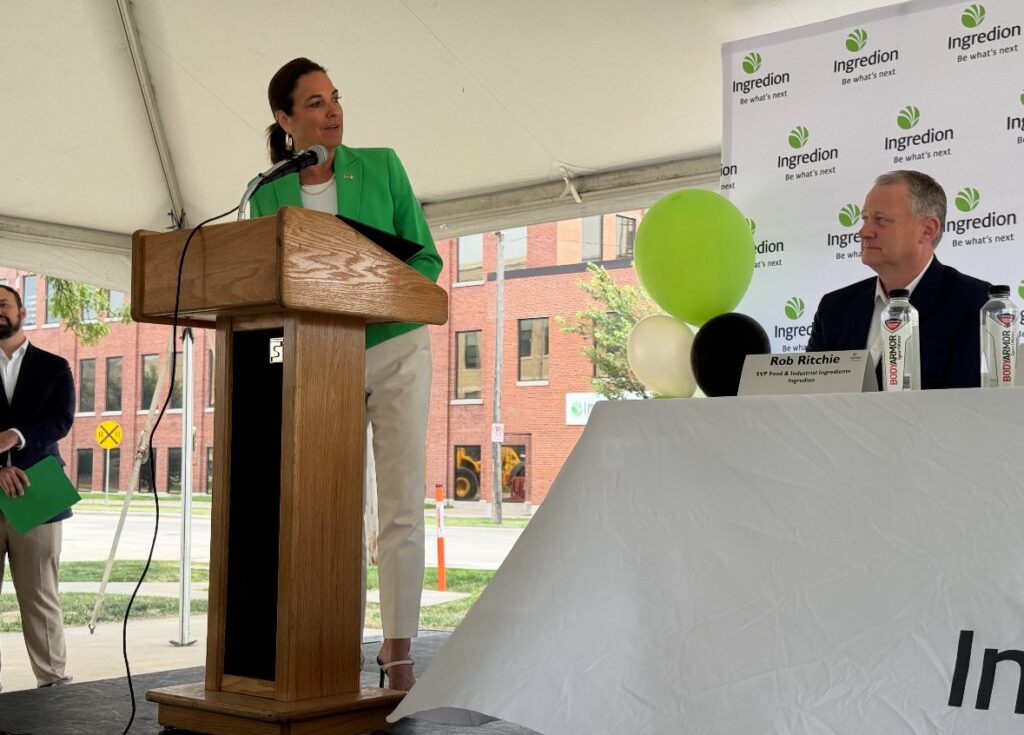
Photo Courtesy Mayor Tiffany O’Donnell
The facility also represents what Siep called “an exciting chapter in the broader renaissance of manufacturing that’s coming back into America.” He expanded on this “renaissance” in an interview with the Corridor Business Journal, “I’ve grown up in manufacturing plants. I’ve spent my career in manufacturing. I’m very happy that as a country, we’re starting to look at bringing manufacturing jobs back into our plant. This is part of that renaissance, and our chapter with that begins here today in Cedar Rapids.”
Photo Courtesy Ingredion
The new plant will also contribute to the circularity of the paper and packaging industries. As Rob Ritchie, senior vice president of food and industrial ingredients for the U.S., Canada, and Latin America, outlined in the press release, “Demand is growing for functional solutions that deliver against more stringent requirements for strength, biodegradability and recyclability across both containerboard and papermaking. Ingredion is committed to supporting these industries as they adapt and innovate to meet a variety of changing consumer and environmental requirements, such as the need for stronger natural polymer-based food packaging.” He explained to the Corridor Business Journal about the benefits of using plant science and chemistry to incorporate corn starch in all different types of packaging: “At Ingredion, we are making the next generation of corn starch followers that can help shift away from plastics and petroleum to stronger, greener and more sustainable boxes right here in Cedar Rapids.”
Ingredion leads in paper and packaging sustainability, not only for its operations in Iowa but as a model for other companies. Its use of plant-derived starch, which it described as “one of nature’s sustainable polymers,” offers numerous advantages over synthetic or fossil-fuel-based polymers, including a lack of harmful forever chemicals or microplastics. For example, plant-based coatings like the FILMKOTE™ barrier starch can be used in foodservice packaging, such as burger wraps or french fry bags, that require oil- and grease-resistance. At the time of the product’s release, Scott Hyland, then-project leader of coating applications, described, “By replacing fluorochemicals with our new barrier starch, manufacturers will now be able to offer packaging with the desired level of oil and grease resistance, more sustainably.” Jake Finkelstein, a senior marketing analyst, noted that demand for Per- and Polyfluoroalkyl Substances (PFAS) replacements “starts at the consumer level.” However, it is being reinforced at higher levels, with states increasingly updating their food packaging laws to phase out or ban PFAS due to concerns about consumers’ health.
Outside the food industry, the use of starch in paper packaging not only yields stronger, lighter products but also enables easier separation of inputs, enhancing recycling efforts. For example, some of Ingredion’s additives enable the tissue industry to use recycled pulp sources without compromising quality, thereby improving environmental friendliness and reducing costs. Meanwhile, the company’s board solutions offer reduced drying times, resulting in energy saved and, again, cut costs.

Photo Courtesy Ingredion
Behind these plant-based ingredients is an ingrained commitment to regenerative agriculture, including crop rotation and cover cropping to improve soil health. Ingredion works with the Sustainable Agriculture Initiative Platform to conduct farm sustainability assessments (FSAs) for its agriculture suppliers. Some of the questions labeled ‘Essential’ in the evaluation, with which suppliers must comply, include no deforestation on the farm since 2015. Notably, 85% of the company’s Tier 1 crops – corn, tapioca, potato, stevia, and peas or pulses – and 100% of its Waxy corn and stevia were sustainably sourced in 2024, according to its sustainability report. “FSA Silver for 100% of our stevia leaf supply means we are fostering the best farming practices on the field and adding resiliency to make communities better. Our audit program ensures we are helping to elevate farmer livelihoods by prioritizing human rights, fostering sound farm management practices and optimizing herbicide and pesticide usage, resulting in increased yield per hectare,” reflected Kurt Callaghan, director of the global product portfolio for sugar reduction.
Ingredion’s internal operations increasingly reflect its dedication to the planet as well. For example, it installed filtered water and ice machines at its Westchester, Illinois headquarters, eliminating the need for plastic water bottles and saving 150 kilograms of plastic. At its plant in North Kansas City, changes to manufacturing and wastewater processes reduced the amount of solid waste sent to landfill by 75% compared to 2019.
Iowa, however, is at the forefront of the wave of sustainable innovation. As Mayor O’Donnell thanked Ingredion at the groundbreaking ceremony, “Cedar Rapids is all about doing things better, more efficiently, more sustainably, and you are on the same page with that.”