Spencer Hilbert paid $8,500 for a 1966 John Deere 4020, hooked it to an $800 disc he found five miles down the road, and drove the pair back to a 50-acre parcel in central Iowa he had bought at auction. Then he did the thing almost nobody in farming does. He told everyone exactly what it all cost.
Spencer and his older brother, Grant, run Hilbert Farms, a first-generation operation that Grant estimated at about 440 acres in November 2025. The two brothers own their ground separately and share machinery, most of it Grant’s, as he described it on Iowa PBS. Neither grew up on a farm, but they visited their grandparents and uncles who farmed near Algona—a two-hour drive from their home in the Des Moines suburb of Ankeny—during every gap in the schedule: spring break, summer, and holidays. “Even as a little kid, it was my dream to farm. Everyone else had athletes or celebrities as their heroes, but my idols were farmers,” Grant described to AgWeb.
Bridging the gap between wanting to farm and actually owning land is the central challenge for first-generation producers. According to the U.S. Department of Agriculture’s Economic Research Service, 27 percent of self-farmed land in 2014 was acquired through inheritance or gift, with another 18 percent purchased from relatives. The 2022 Census of Agriculture found that the average American farm producer is 58.1 years old. “I was like, OK, well somehow at some point, I want to be able to farm, whether that’s when I’m 50, 60, 70 or like 40 or 30 years old, something like that,” Grant shared with Agweek. Asked at the fair what worries him most about agriculture right now, Spencer went straight to the same barrier: “Upfront cost to get started, land cost. From our perspective, it just kind of is what it is. You understand what’s going on, and then just work.”
Grant’s way around it started in a bedroom in 2014, when the 15-year-old and a friend launched a YouTube channel called The Squad, posting footage of themselves playing whatever was popular. The viewers who showed up cared about one title, Farming Simulator, so Grant gave them more of it. AgWeb charted the grind that followed: he entered Iowa State University in 2016 with 30,000 subscribers, committed to roughly a video a day for four years. “After class I’d come home, maybe go to the gym and then YouTube all night. I did that for four years straight, and it started taking off,” Grant told the Iowa Soybean Association. He passed 100,000 subscribers freshman year, 300,000 as a sophomore, 600,000 as a junior, and a million on the day he graduated in 2020.
Video Courtesy The Squad
What the game did not do was teach him to farm, a point Grant makes himself. “Everybody always asks the question, is it the same? Like did you learn anything from farming simulator the game?” he told Agweek. “And as cool as it would be to say ‘Yes I learned a ton,’ it really doesn’t teach you too much.” He credited Ag PhD and the Hefty brothers for the actual education. The channel bought the ground. The rest had to be learned in the field.
He bought his first farm in November 2020, 120 acres in Mahaska County, and added ground in Poweshiek County the following spring, for a total of 250 acres of tillable land and 40 acres of lumber. He later sold two tracts and bought 125 acres in Story County, closer to home. Iowa farmland averaged $11,549 an acre in the 2025 Iowa State University Land Value Survey. He was direct with The Gazette about the financing, telling the paper: “I am borrowing a lot of money to buy these farms. I use a lot of leverage. I would say 60 percent (of the down payment) was from videos and 40 percent from investments.”
Asked on Iowa PBS whether outside income was necessary, Grant did not hedge. “It’s almost impossible to start farming without outside income,” he said, “and outside income just makes it so much easier to get started farming.” He put it more plainly at the Iowa State Fair. “It was all outside income,” he said. “It wasn’t that I grow record crops or anything like that.”
Video Courtesy Grant Hilbert
Spencer followed in his brother’s footsteps. He bought his own 50 acres in 2023. “I planted my first crop, it’s in my name, kind of doing the full thing,” he told Agweek. Then he walked through the entire ledger on camera: a $396,000 purchase price, 42.5 tillable acres in year one, 90 percent of it financed at 4 percent, a 212-bushel corn average, and a cash flow that came out to a loss of roughly $16,800, just under $400 an acre. He also posted the footage of the day he rolled the 4020 into a road ditch, rollover bar up, as a warning to anyone watching.
Losses like that are not rare. The same Iowa State survey found that about half of Iowa farmers lost income in 2025, Farm Progress reported. What is rare is saying it so out loud.
Video Courtesy Spencer Hilbert
However, the next season on the same ground, he put 30 acres into soybeans, cleared $98 an acre, and was still cash-flow negative once the principal payment came out. He has since bought a second farm, 53 acres at $10,000 an acre with roughly 70 percent of it borrowed, cleared $192 an acre on soybeans there, and reported the same split: a profit on paper, a shortfall in cash. Profitable and short of money are not the same thing, and he separates them every year.
“I talk about exactly what I paid for the land and what the loan looks like,” Spencer told the Iowa Stater. “I own the land and want to be as transparent as possible. Am I making or losing money?” Viewers regularly tell the brothers that their own families have never shared what they paid for ground or what inputs cost. Grant thinks the freedom comes with being transparent from the beginning. “It’s easier to document all the failures and successes when it’s just you,” he said on Iowa PBS. Spencer’s ledger video had reached about eight million views by October 2025, he said on the Barn Talk podcast.
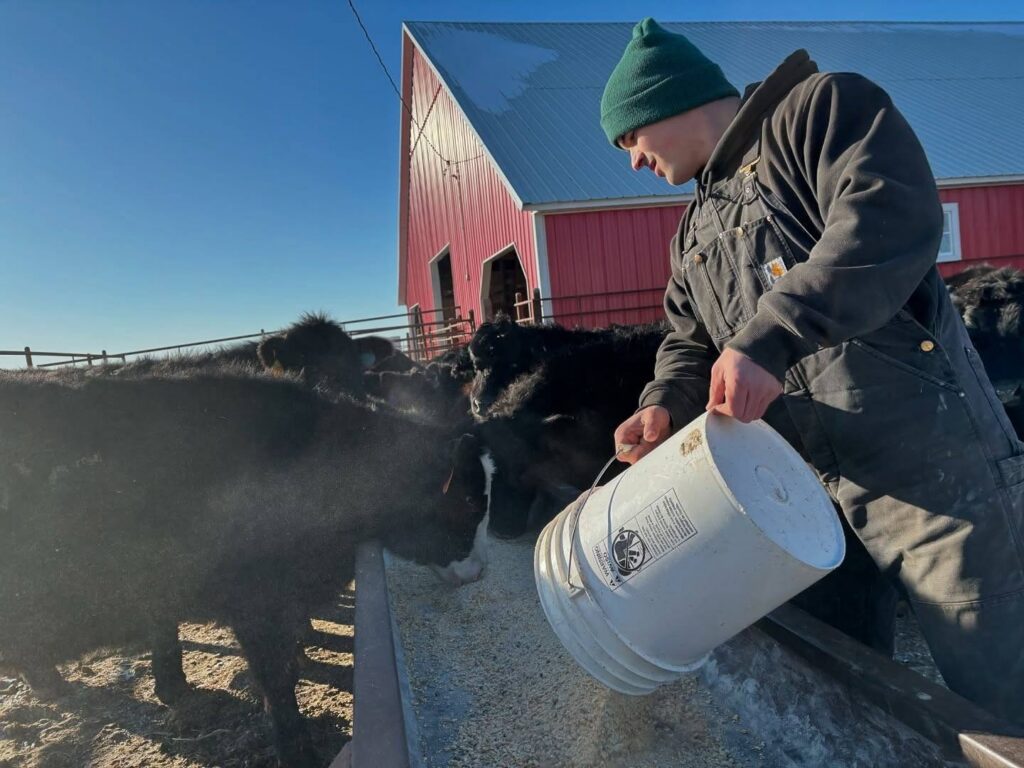
Photo Courtesy Spencer Hilbert
The failures have been instructive. Grant bought a farm with strong soil ratings that had never been artificially drained and watched it produce roughly 130 bushels of corn in 2022. That fall, he pattern-tiled it on 30-foot spacing. The next crop was a different animal. “It was probably the best moment I’ve ever had farming,” he said, and the reason was plain enough. “That just felt really good being able to fix a farm and get it producing decently.” The lesson stuck. “When I go buy a piece of farm, number one question is what’s the drainage situation look like,” he told Barn Talk.
Off the farm, Grant started a software company, SquadBuilt, in 2020, aiming at a simulation game called American Farming, focused on “American farmsteads, American towns, U.S. based brands, cow-calf operations, farrow to finish, and so many more hallmarks of Midwest agriculture.” He told Agweek why: the game he had built his audience on is set in Europe, and he wanted an American one. He spent three years on American Farming, licensing a roster of domestic implement brands and hiring, as he put it, eight artists and developers to build something he could not code himself. “Not to toot our own horn, but these guys know what a Midwest farm looks like,” he told Agweek. A sequel, American Farming 2, is scheduled to launch next week, on August 24, and the company has said it will be free to play.
The channels turned out to be the reason any of it worked. “You can have the best product in the world, but if nobody knows about it, they’re never going to buy it,” Spencer told Barn Talk. “Building our audiences over the past 10 years has been a huge kind of getting something started.”
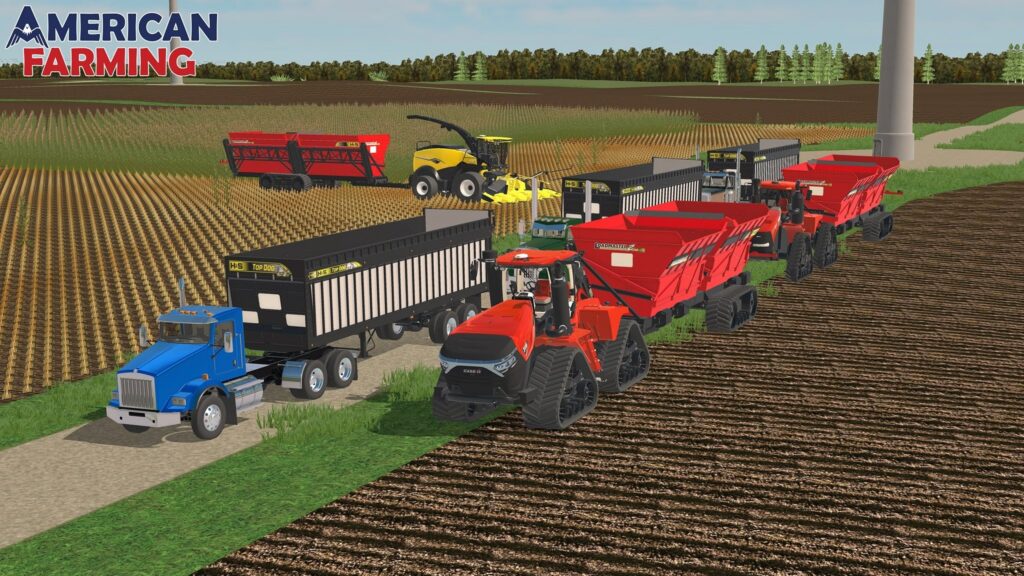
Photo Courtesy American Farming
Grant hopes he won’t be the only one using this strategy for long. “Whether a kid or a teenager or anybody wants to literally copy my strategy of literally just starting a YouTube channel and playing Farming Simulator, that’s all I did,” he told Agweek. “Hopefully I am kind of getting the message out there that it’s possible.” Through the brothers’ individual YouTube channels, highlighting activities on their farms, they are creating the opportunity to do just that. As Grant summarized, “The public’s appetite is for all things farming and the hunger is just starting to grow.”
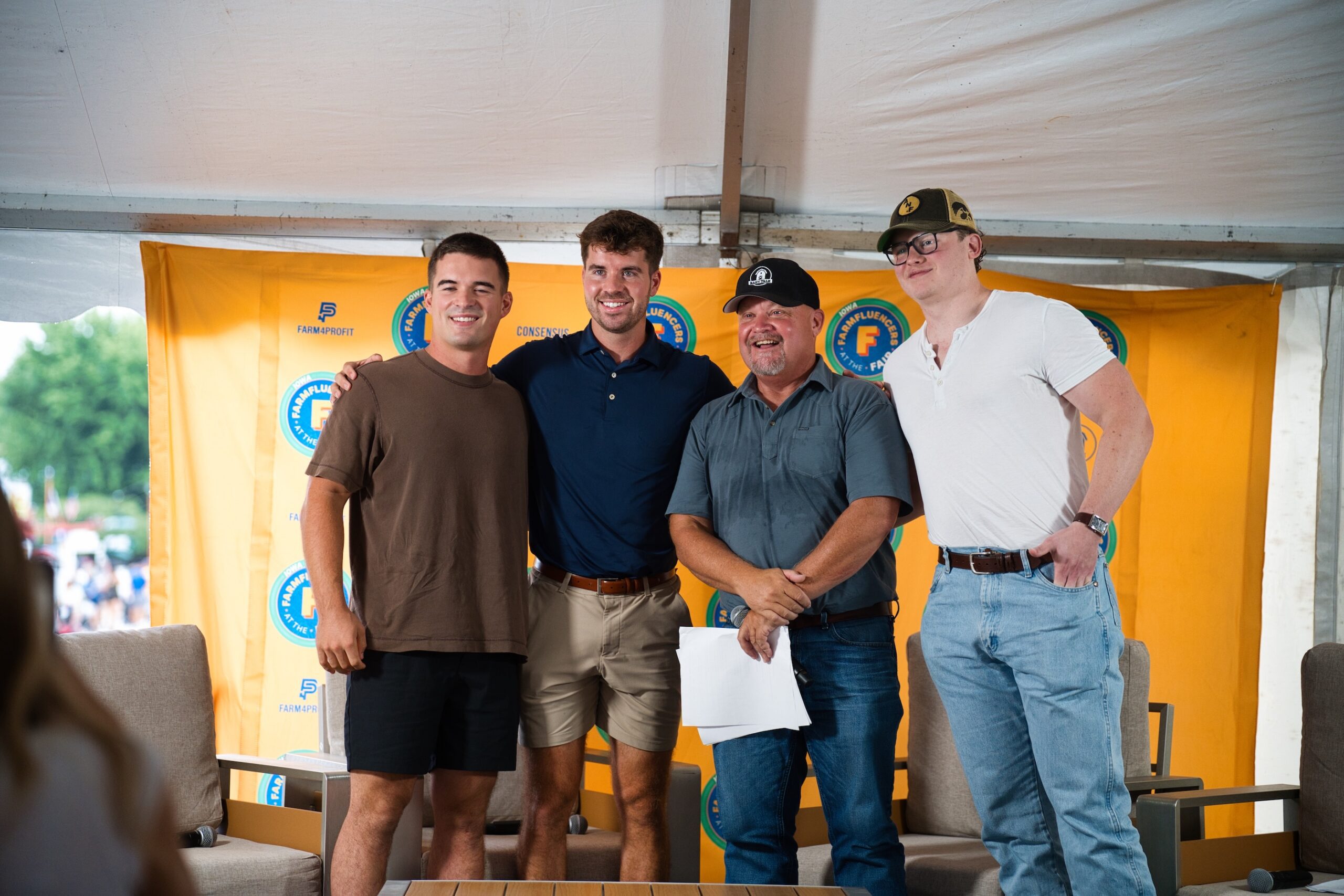
Grant and Spencer were recently interviewed at the Iowa State Fair by Barn Talk, one of the country’s most-listened-to agriculture podcasts, with 274 million views to date. Asked there about new technology and what it means for people starting out, Spencer gave the answer that has carried them both this far. “We have very optimistic mindsets,” he said, “and in history, whoever has the most optimistic mindset and works the hardest, kind of wins and goes forward.”
Stay tuned for the Barn Talk episode.