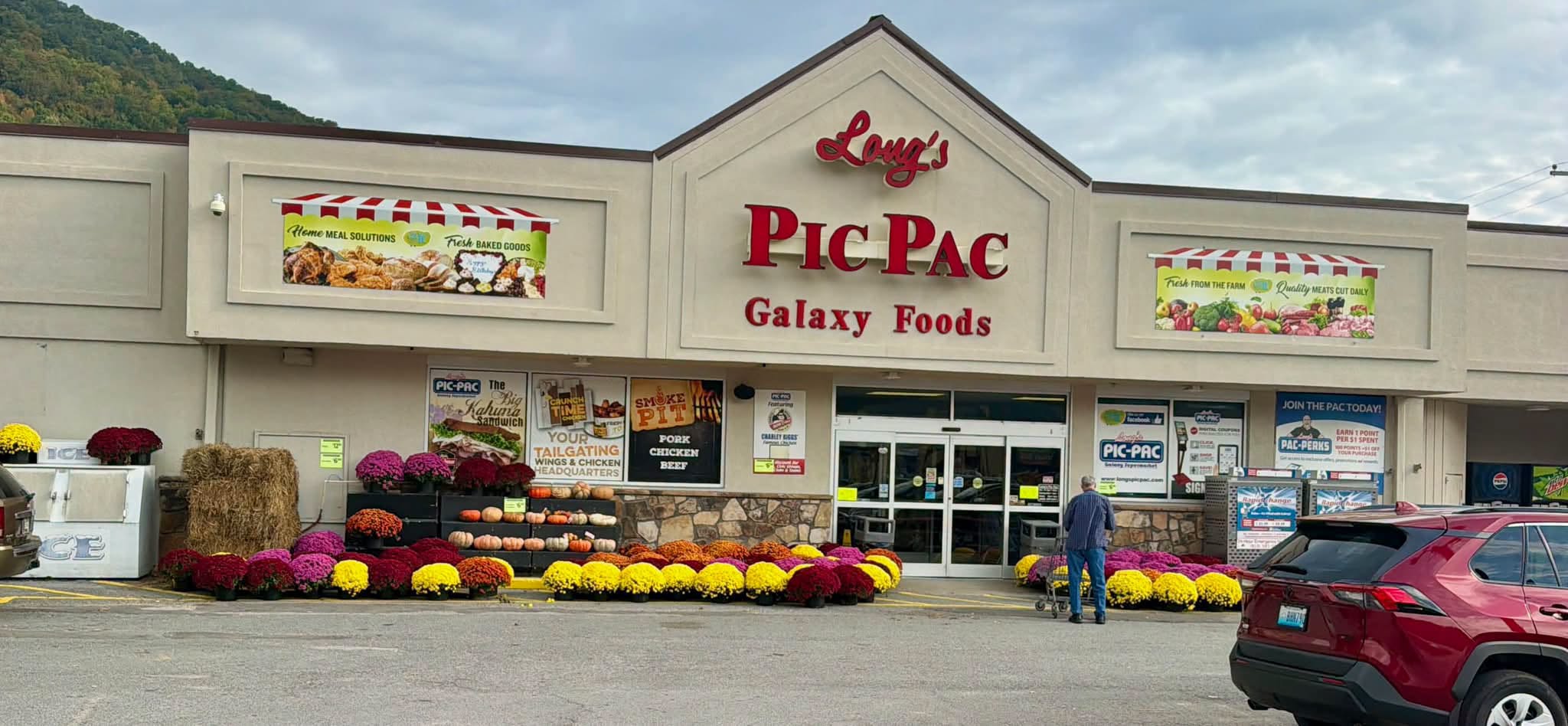
In 1964, Arthur “Ray” Long opened a grocery in Pineville, Kentucky, with a $3,500 loan. An appliance store owner who knew Ray from watching him play football co-signed it. Six decades later, Ray’s son, Mike Long, runs Long’s Pic Pac as general manager in a town of about 1,630 people. “There’s only one cell tower,” Long said of Pineville. “You can run around the whole town in about three miles.”
Today, one of the biggest threats to the store’s bottom line sits on its electric bill. Grocery stores run on a low 2.2% profit margin, and at Pic Pac, annual power bills can reach $78,000, each month accumulating roughly $2,600 for the power charge and $3,900 for the “demand charge”. Long’s answer to these steep bills was to pair a rooftop solar array with a battery built to shave that charge down.
A demand charge is not based on how much electricity a business uses over a month. Instead, Clean Energy Group explains that it reflects the highest level of power the business pulls during a billing period. For a grocery, those spikes come from refrigeration, deli ovens, and fryers. Long laid out the math for the Mountain Association, a Berea-based nonprofit, in 2020: “In the summer we’ll run, say, $6,500 a month – half of that is the actual rate and half of that is a multiplier done for the demand charge – so in a given month anytime that there’s a high spike in demand, it multiplies for that month.”
At Pic Pac, the new battery is built to blunt the spikes Long described. Solar Energy Solutions installed the array on the grocery’s roof, and USDA describes it as a 143.1-kilowatt, roof-mounted system. Resource Rural reported that the store’s battery, with over 60 kilowatt-hours, lets it bank solar energy, “vastly reducing the peak demand charges that make up more than half the store’s monthly power bill.” The system’s controls come from New Sun Road, whose technology uses battery storage to reduce power spikes “so that your site does not move up to the next rate tier, which would increase the power costs for the whole month.” Long thinks Pic Pac might be the first grocery store in Kentucky to use solar and battery storage this way, he told Resource Rural.
USDA’s Rural Energy for America Program (REAP) awarded the store a $148,320 grant for the solar system, according to a February 2024 USDA release. The grant covered 40% of the project. Long projected at least $15,000 a year in savings and expects the project to pay for itself in four years. The same USDA release listed a second REAP grant of $365,656 to replace the store’s 25-year-old refrigerated and frozen display cases, walk-in freezer, and refrigerated food preparation rooms, which it projected to save the business 59,483 kilowatt hours of energy per year, equating to $2,284 in savings.
In March 2025, the Bell County Chamber of Commerce joined Mike Long, employees and vendors for a ribbon-cutting and grand reopening celebrating the store’s new solar panels and new freezers. “We try to support the community that supports us, we’ve got low prices so come on down,” Mike told the Middlesboro News.

Photo Courtesy Long’s Pic Pac
In addition to installing a solar array with a durable battery, Long has taken other steps to decrease his energy costs. A $58,253 grant from the U.S. Department of Agriculture (USDA) in 2018 went toward LED lighting, plus door-front produce coolers and new freezers with motion-activated lights, which USDA said would cut the store’s monthly energy costs by 10% to 15%. By 2020, the Mountain Association reported that Long was saving more than $23,500 a year on energy.
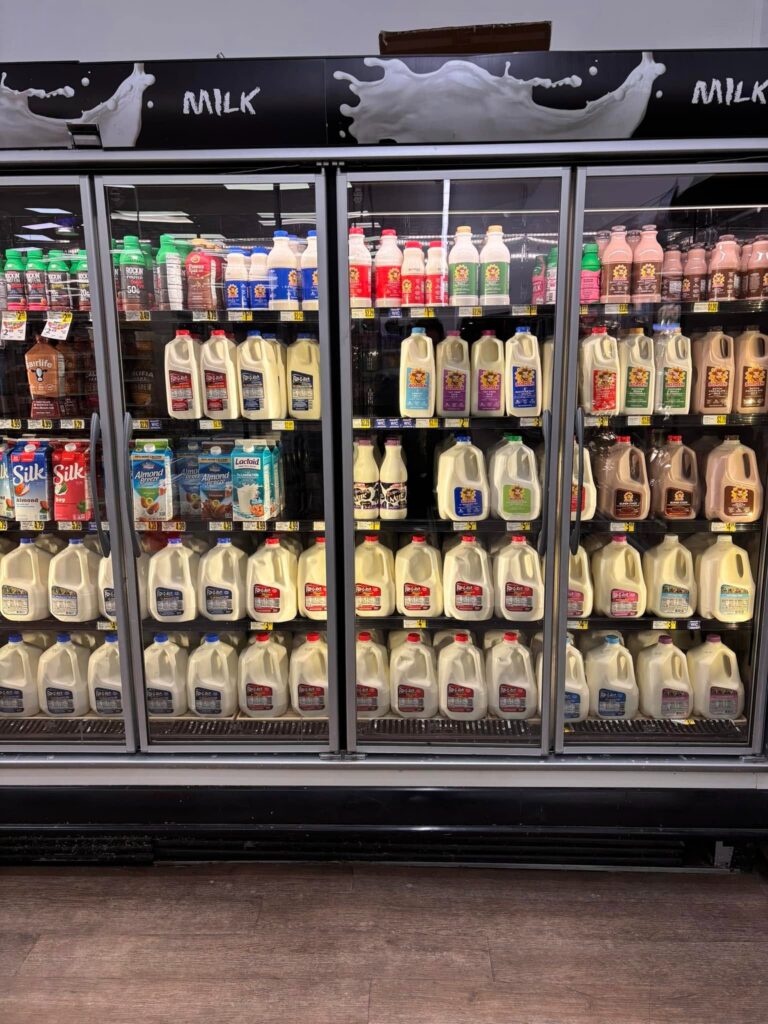
Photo Courtesy Long’s Pic Pac
The family has also seen how installing solar can help lower their bills. Long’s 1 & Up Pro Hardware, which was across the parking lot and was owned by Ray’s wife, Sandy, added a 39-kilowatt solar system, which was also installed by Lexington-based Solar Energy Solutions. The Mountain Association said that the system would “generate about 60 percent of the hardware store’s annual electric use, saving them around $5,800 a year.” The hardware store’s bills from September through November 2019 averaged $875 a month, and for the same months in 2020, with solar, they averaged $77.

Photo Courtesy Mountain Association
At a 2.2% profit margin, $15,000 a year matters. Pic Pac competes with larger stores within a 15-minute drive from a sales floor of only 11,500 square feet, and Long points to what sets it apart. “None of the chains have solar,” he said. “We’ve got more green, newer stuff than any of them.” He said the savings could go toward staffing the perishable departments and offsetting delivery costs. “Tight margins are one of the reasons why many rural places have seen full service stores struggle to keep their doors open,” he told Resource Rural. The store employs about 60 people in a town where the median household income was $27,159 in 2022.
The math is not getting easier. Long has described his billing from Kentucky Utilities (KU) to the Mountain Association, and KU moved its Power Service rate for larger commercial customers to what the Mountain Association calls “a complicated three-tier time-of-use rate” in a rate case decided in 2026. Under KU’s current tariff, that rate charges up to $11.91 per kilovolt-ampere for a customer’s biggest draw during weekday peak hours. “Many Power Service ratepayers are places like schools and grocery stores,” Carrie Ray, the Mountain Association’s director of energy programs, pointed out. Josh Bills, the group’s senior energy analyst, put it more bluntly in a May 2026 op-ed in the Kentucky Lantern: “One bad year or one season of sky-high demand charges and a rural store can vanish.”
Jed Weinberg, who manages a grocery store in Martin, told the Mountain Association that seeing Long add solar to his metal roof inspired the solar projects at stores in Frenchburg and Martin, both completed in spring 2025. “The solar savings [after paying off the systems] will eventually go back into funding equipment when it breaks down, maintenance and improvement projects, you name it,” he told the Mountain Association.
Long’s path is harder to follow today. On March 31, 2026, USDA announced it would pause new REAP grant awards while it rewrote the program’s rules. A final rule published in the Federal Register on October 1, 2026, requires projects to be built and operating before an owner applies, and requires applicants to cover at least 75% of the project cost.
For Long, the battery is the latest chapter in a long habit. “This store was built in 1989, and we try to continually revamp it,” he told the Mountain Association in 2020. The battery on the roof is the newest part of that revamp.