Dustin Moffitt joined Barilla’s pasta plant in Ames, Iowa, as a production operator in 2002. The Iowa native then worked his way through jobs as a processing technologist, mill manager, and production manager before becoming plant director. “I’ve literally grown up with this plant,” Moffitt told the Ames Regional Economic Alliance. “What’s made Barilla special to me is the opportunity to keep learning, keep improving, and work with people who genuinely care about what they do. The team here in Ames is world-class.”
The plant has grown up, too. Barilla, a family-owned Italian food company whose story began with a small shop in Parma in 1877, opened the Ames plant in 1998 as its first U.S. factory. Today, Ames is the only Barilla location in the United States that mills wheat and makes pasta under one roof. The 125-acre site employs roughly 260 people, processes more than 700 tons of wheat a day, and turns out about 1.2 million boxes of pasta a day. “We’re taking raw wheat grown across the Midwest and transforming it into a product that reaches dinner tables all over the country,” Moffitt said. “That’s something our team takes a lot of pride in.” Larry Curtis, mayor of Ames at the time the city was chosen, told the Iowa State Daily, “Jobs are jobs. And anytime a business with nice-paying jobs with good benefits comes to town, I think it will greatly help the economy.”
When Barilla went looking for its first American site in the 1990s, Ames beat out locations including Newton and Franklin County. The Iowa State Daily pointed to proximity to Interstate 35, Union Pacific rail lines, and the nearby Iowa State University as significant benefits. “The plant will need to bring wheat germ and other rail products to the factory through Union Pacific railroads,” explained then-Mayor Larry Curtis. At the same time, Mark Reinig, then-director of planning and housing communities, noted that Barilla was “pleased with the proximity of Iowa State, which can provide a multitude of food technology,” adding that because Iowa exempted machinery and equipment from taxes, $100 million of Barilla’s investment would not be taxed.
Then-executive director Edwin L. Artzt explained that the plant would “provide consumers with authentic Italian Barilla pasta at lower prices, as we pass along savings in transportation costs and important duties.”
Two decades later, then-CEO Claudio Colzani looked back on the decision in a 2019 company release: “Over 20 years ago, we were drawn to the unparalleled work ethic of Iowans, the agricultural know-how of Iowa State University and the proximity to favorable rail access as well as the critical regional supply of wheat.”
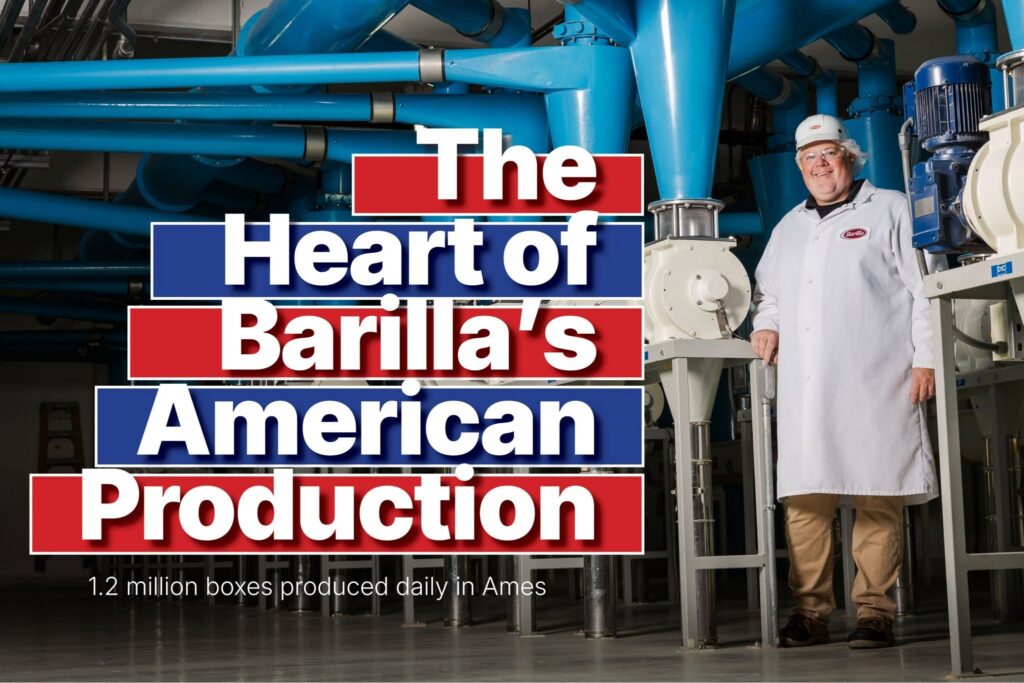
Photo Courtesy Ames Regional Economic Alliance
Barilla has kept investing. A $26.5 million expansion in 2015 added two gluten-free production lines, new packaging equipment, and 23 new jobs. Then-plant manager Larry Covington described the setup as a “plant within a plant” that prevents cross-contamination. When the company announced the expansion, officials said the gluten-free pasta made in Ames would ship to Canada, Brazil, Mexico, and Australia, as well as across the United States.
The biggest step came in 2019. A $65 million project added a rail-yard expansion, two processing and packaging lines, and six wheat silos, giving Ames eight production lines and the capacity to make 200,000 metric tons of dry pasta a year. Officials said the project made Ames the third-largest Barilla Group plant, the Tribune reported, and Iowa companies carried most of the load: more than 32 in-state vendors handled 90% of the building and utility work, worth about $19 million. The Iowa Economic Development Authority backed the projects in 2017 with $1.2 million in tax credits and a $375,000 forgivable loan.
The expansion also created openings for 41 new jobs, which then-mayor John Haila described as “outstanding jobs,” adding that Barilla’s commitment to safety and its investment in people “just strengthens our workforce.” Dan Culhane, president and CEO of the Ames Regional Economic Alliance, said, “Partnerships like ours with Barilla demonstrate the long-term benefits of investing in this region. Their growth has ripple effects throughout the community—from agriculture to logistics to workforce training.”
“We now have the opportunity to continue to grow and push volumes into the marketplace for our customers that we wouldn’t have had in the past,” Covington told the Tribune. “It’s a huge opportunity to us.” Iowa Governor Kim Reynolds added, “Barilla is a great example of one of those innovative companies that are really playing a big role in our economy.”
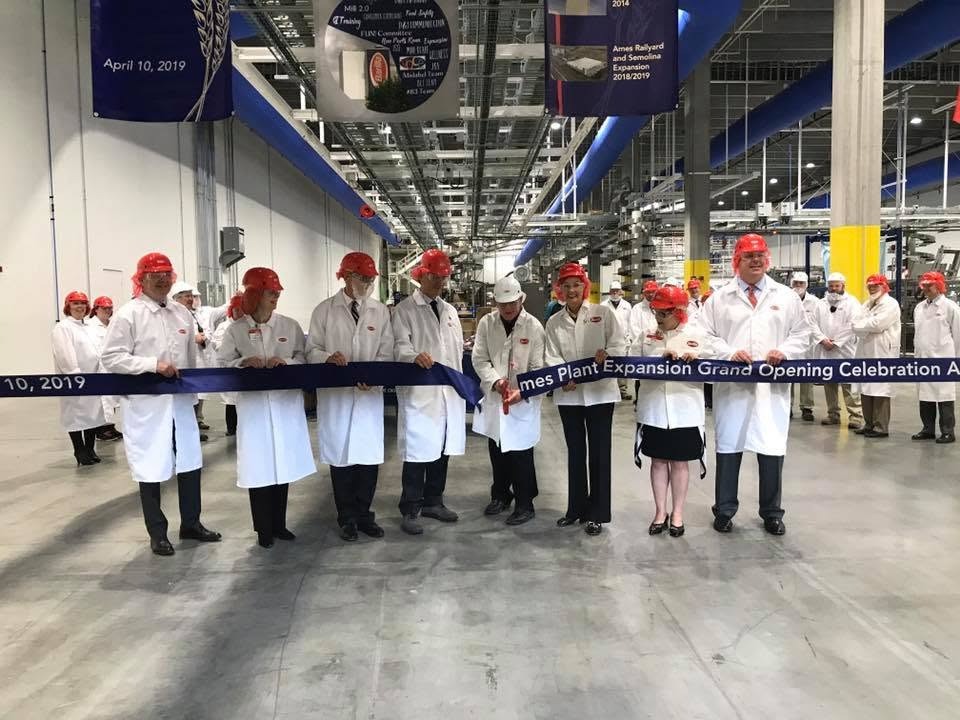
Photo Courtesy Governor Kim Reynolds
The investment has not stopped. Barilla Group’s capital spending rose to €280 million in 2025 from €250 million, including upgrades at the Ames plant, Just Food reported.
Plant leaders have paired that growth with careful use of resources. According to the Tribune, Covington said the 2019 rail, mill and silo project allows the company to reduce its carbon footprint. “We have one planet. When it’s gone, it’s gone. We need to do our part and be good corporate citizens in taking care of that,” he explained. The company also set a goal of reaching zero waste at the plant by the close of 2020 and worked with Iowa State University to found the Iowa Sustainable Business Forum. The forum’s work now continues under the university’s Center for Industrial Research and Service.
Across the company, each Barilla production site also sets annual targets to reduce water use and tracks them monthly on a global scorecard.
Moffitt describes that work as ongoing. “Our work doesn’t stop when the pasta leaves the line,” he said. “We’re constantly looking ahead—how we can be more efficient, how we can give back, and how we can ensure that what we do here continues to have a positive impact on both our people and our planet.” Notably, over 25 years, Barilla has donated more than 400,000 pounds of pasta and sauce to the Food Bank of Iowa.
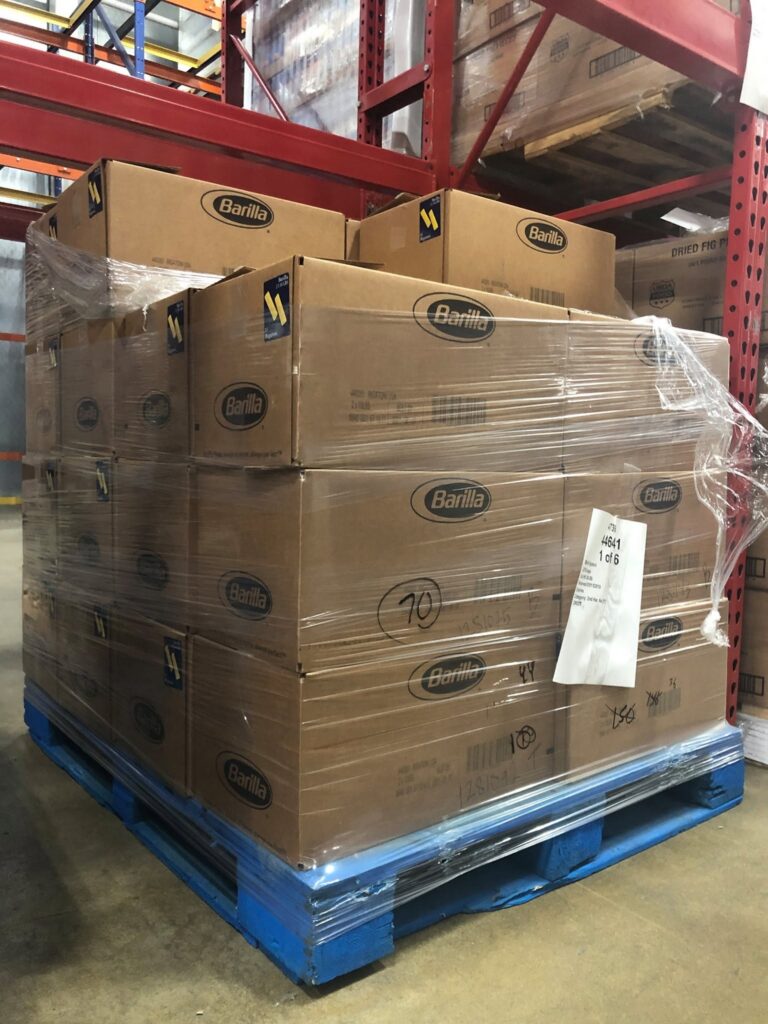
Photo Courtesy Food Bank of Iowa
Colzani closed the announcement ceremony by looking ahead. “We came to Iowa 21 years ago, the company has survived for the last 141 years, and we want to stay another century at least in Iowa,” he said.
For Moffitt, that pride shows up in the grocery aisle. “When you see a box of Barilla pasta on the shelf,” he said, “there’s a good chance it came from right here in Ames.”