According to a new report from the American Clean Power Association (ACP), the U.S. witnessed a surge in clean energy progress in 2024. Nearly 49 gigawatts (GW) of new renewable capacity, representing solar, wind, and energy storage, was added to the grid. That marks a 33% increase from 2023, whose additional 37 GW set a record at the time. These additions bring the cumulative clean power installed up to over 313 GW, enough to power 75 million American homes with domestically produced energy. The pace of these installations is speeding up: the U.S. installed its first 200 GW of clean energy over four decades, and now 100 GW has been installed over the course of a mere three years. Remarkably, 93% of the total 52 GW capacity that came online last year was renewable, far higher than the average of only 75% for the five years spanning 2019 through 2023.
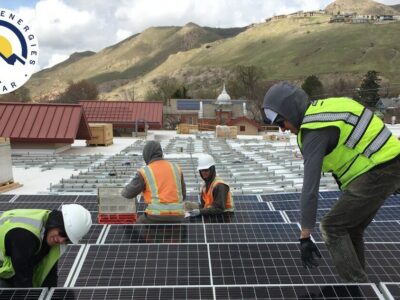
The year sticks out for several other reasons. Over 33 GW of solar was added throughout 2024, which is almost 12 GW more than in 2023, breaking an annual record. 2024’s additions bring the total cumulative installed solar capacity to nearly 130 GW. The increasing pace of solar deployments is evident in that more than 70% of the country’s utility-scale solar went online in the past five years, including eleven states that added over 1 GW of utility-scale solar last year.
The highlights of 2024 continue with energy storage. Over 11 GW was added last year, marking the first year of double-digit installations and bringing the total installed to approximately 29 GW. Over the past five years, energy storage installations have also grown by 93% and now account for 96% of the total domestic energy storage.
Of the entire year, the fourth quarter, in particular, shines. It was the second-biggest quarter on record for renewable energy installations, with 18,865 MW of utility-scale solar, wind, and energy storage capacity deployed, accounting for 39% of 2024’s additions. It was also the best quarter on record for utility-scale solar installations, with nearly 14 GW added. That is over double the 6 GW installed in the third quarter.
The impacts of this clean energy revolution are felt all over the country. By the end of last year, all 50 states, the District of Columbia, and Puerto Rico had at least one renewable project in operation, with forty-eight states deploying at least one project in 2024. Over the year, twelve states added 1 GW or more of renewable capacity each, while four states – Texas, California, Illinois, and Florida – added over 1 GW of renewable capacity in the fourth quarter alone. Florida and Illinois’ 2024 deployments pushed those states over the threshold to have more than 10 GW of operational clean power, for a total of six states at that level, while Michigan, Nevada, New York, and Georgia’s 2024 deployments pushed them over the threshold to have more than 5 GW, for a total of seventeen states at that level. By the end of 2024, forty states had at least 1 GW of installed capacity.
At the district level, by the end of 2024, 86% of congressional districts had at least one renewable project. A majority of these districts receiving the clean energy benefits of these projects are Republican-held. They received 77% of the clean power projects added in 2024, and by the end of the year, 79% of the total operational clean energy capacity could be found in red districts. Additionally, the red states of Kentucky, Louisiana, and Mississippi saw the highest year-over-year increase in operational clean power capacity, at more than 200% each. Kentucky was by far the leader, with 400% growth year-over-year.
A significant number of new manufacturing facilities joined the new generation projects. In 2024, 46 new primary component manufacturing projects went into operation, spanning utility-scale solar, wind, and storage supply chains. They represent $22 billion in investment injected into local economies. “Two landmark laws aimed at reshoring manufacturing and securing the United States’ energy future cascaded market signal waves, resulting in an exponential growth in domestic manufacturing,” the report states, referring to the Bipartisan Infrastructure Law and Inflation Reduction Act.
As a result, ACP reports that 190 commercial projects were online in the U.S. by the end of last year. Their geographic reach is broad: the new facilities alone span 20 states, and 85% were in Republican-voting states. One of the highlights included crystalline solar cells being manufactured domestically at a commercial scale for the first time in more than ten years. The resulting employment opportunities are a major win for local communities, featuring “significant efforts made to utilize and retrain talent within communities where this manufacturing is occurring. This effort supports providing employment opportunities where adjacent industry may have been shuttered in prior years.”
More such facilities are also on their way. Companies announced 79 projects promising new or expanded production of primary component manufacturing, and 59 projects were under construction at the end of the year. The clean energy projects pipeline now amounts to more than 175 GW to come nationwide.
This article was created on March 13, 2025 with the assistance of the generative artificial intelligence (AI) tool Claude 3.7 Sonnet, using the linked company websites, press releases, reports, or external media coverage as inputted source material. It was then reviewed, fact-checked, and edited by one or more team members to ensure factual accuracy and consistency with editorial standards before publication.
While we strive for precision, reliability, and quality, readers should be aware that AI-generated content may have limitations in contextual awareness and nuance and may not be completely unbiased, consistent, error-free, or up-to-date. We recommend using this content only for informational purposes, as well as independently verifying it or conducting further research to supplement it. If you notice any inaccuracies or have concerns about this content, please contact our research manager at greg@consensus-digital.com.