
“From the Gulf Coast to the waters off Virginia, offshore energy is powering our economy and strengthening national security… Right now, companies want to invest across a range of technologies: oil and gas, wind, carbon capture, hydrogen, nuclear, geothermal and deep-sea mining. These projects represent billions in private investment, hundreds of thousands of jobs and the next generation of U.S. energy leadership,” reflected Rep. Jen Kiggans (R-VA-02) and National Ocean Industries Association (NOIA) President Erik Milito in an op-ed published in The Hill. “But if we want this momentum to last through future administrations, we must fix our broken permitting system.”
In the opinion piece, the authors reflected on the country’s potential for energy leadership. Offshore energy development is spurring domestic investment along the nation’s coasts, which Rep. Kiggans and Milito label “a story of industrial revitalization.” They highlight shipbuilding as an industry that has particularly benefited from this trend. As of the end of last year, the Oceantic Network totalled $1.8 billion in American shipbuilding contracts to support the offshore wind industry, creating more than 3,000 jobs for workers such as steelworkers and welders. Rep. Kiggans and Milito noted that more than 35 vessels have already been built, and 23 more have been announced or are currently under construction.
A significant amount of investment is also flowing into America’s ports along the East and Gulf coasts. Of the $12 billion in announced investments into America’s offshore wind industry, the American Clean Power Association (ACP) calculated nearly $3 billion to be allocated for ports. The Virginia Port Authority alone spent $223 million to upgrade the Portsmouth Marine Terminal with the help of a $20 million grant from the U.S. Department of Transportation. These upgrades enable Dominion Energy to transport equipment and infrastructure to its 176-turbine Coastal Virginia Offshore Wind project, located approximately 27 miles offshore.
“These aren’t theoretical investments,” explain Rep. Kiggans and Milito. “They are real, made-in-America projects rebuilding our industrial base, reinforcing supply chains and strengthening maritime capabilities.”

Photo Courtesy The Port of Virginia
Meanwhile, Wood Mackenzie estimates that deepwater oil producers in the Gulf will add 300,000 barrels per day this year and an additional 250,000 barrels next year. This uptick will swell production to more than 2 million barrels daily, a 40% increase since 2020. The National Ocean Industries Association (NOIA) reported in 2023 that the carbon intensity of production in the Gulf is 46% lower than the global average outside the U.S. and Canada, making it more environmentally friendly than other producing countries, such as Russia, China, Brazil, Iran, Iraq, and Nigeria.
“That is precisely the kind of domestic production that both sides of the aisle should support,” Rep. Kiggans and Milito said. “Offshore energy is not a zero-sum game; it’s additive. We need all forms of energy. Oil and gas projects in the Gulf can produce for decades, while offshore wind will continue to ramp up and build a reliable supply for other coastal areas.”
All of these forms of offshore energy will play a crucial role in addressing growing energy demand, which the authors attribute to a combination of population growth and the artificial intelligence (AI) revolution. The International Energy Agency expects data centers to be responsible for nearly half of the growth in energy demand in the U.S. by 2030. By that time, they will consume more electricity than all energy-intensive manufacturing sectors combined. Virginia’s Loudon County, also known as “Data Centre Alley,” is just one region that will require as much secure and scalable power as possible, with 200 completed facilities spanning 49 million square feet. “We must move quickly to ensure Americans have the power to meet surging electric demand,” Rep. Kiggans and Milito wrote.
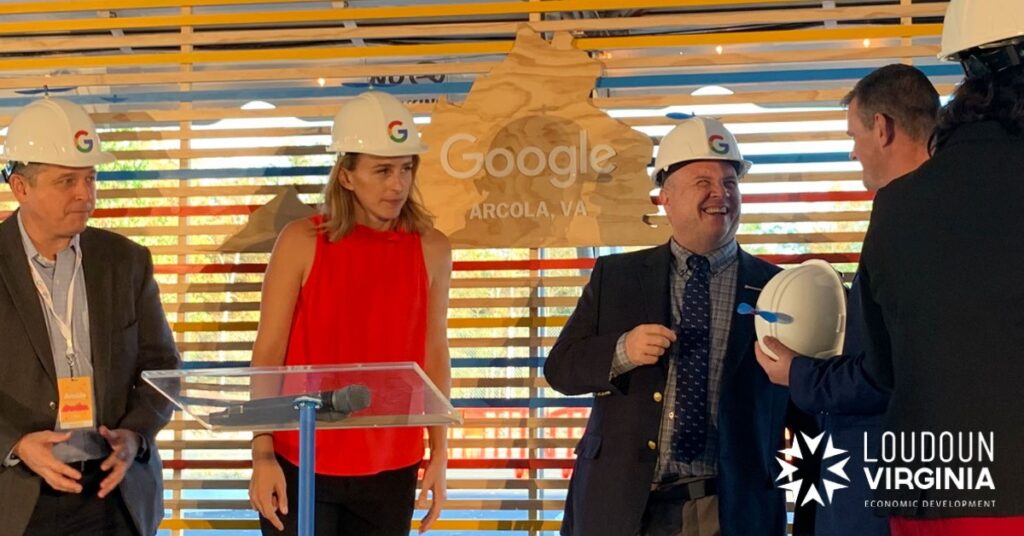
Photo Courtesy Loudoun Economic Development
At the same time, Rep. Kiggans and Milito highlighted the various factors that contribute to long project development timelines and delays. For example, they explained that the deepwater oil projects in the Gulf can take at least a decade to plan and require billions of dollars of investment. “But both time and money depend on regulatory certainty. When that slips, so can production and investment in the U.S.,” they added.
They also acknowledged that although the intentions behind the National Environmental Policy Act (NEPA) were admirable, it now results in years-long delays stemming from administrative reviews and litigation: “The bottom line: projects stall, costs rise, investment dries up and America loses ground.”
The authors concluded that “we need bipartisan, durable and foundational permitting reform that protects U.S. energy leadership, provides legal certainty and ensures progress survives as presidents change.” They wrote that the bipartisan Streamlining Procurement for Effective Execution and Delivery (SPEED) Act “is a step in the right direction.” Introduced by Rep. Mike Rogers (R-AL-03), the provisions include limiting standing for civil actions to individuals who substantively participated in the public comment period and instituting a statute of limitations for NEPA cases.
Rep. Kiggans and Milito acknowledge that for the permitting legislation to pass in the Senate, it must clear the 60-vote cloture threshold. “Fortunately, there is broad agreement that the current system is broken and reform is overdue,” they said. “We have a bipartisan imperative to act. Smart, targeted reform will unlock offshore energy investments that generate billions in revenue, strengthen energy security, support high-wage jobs and ensure American leadership in a competitive global energy landscape.”