Iowa City, Iowa, is one of the cities transitioning to electric government vehicles. In 2018, the city bought its first electric vehicle. Three years later, in 2021, Iowa City commissioned ICF to evaluate the electric vehicle market and joined with other communities in the state, including Cedar Rapids, Cedar Falls/Waterloo, Davenport, and Dubuque, to make the Eastern Iowa Electric Vehicle Readiness Plan, with the help of a grant from the Iowa Economic Development Authority. The shared regional vision statement read, “The communities of Eastern lowa will be leaders in supporting the increased use of electric vehicles (EVs) and improving access to charging infrastructure. We will empower our residents, businesses, and visitors through policies, partnerships, and initiatives that encourage adoption of EVs.” Iowa City also adopted an EV preference, meaning it must consider an electric model whenever it replaces a city vehicle being phased out.
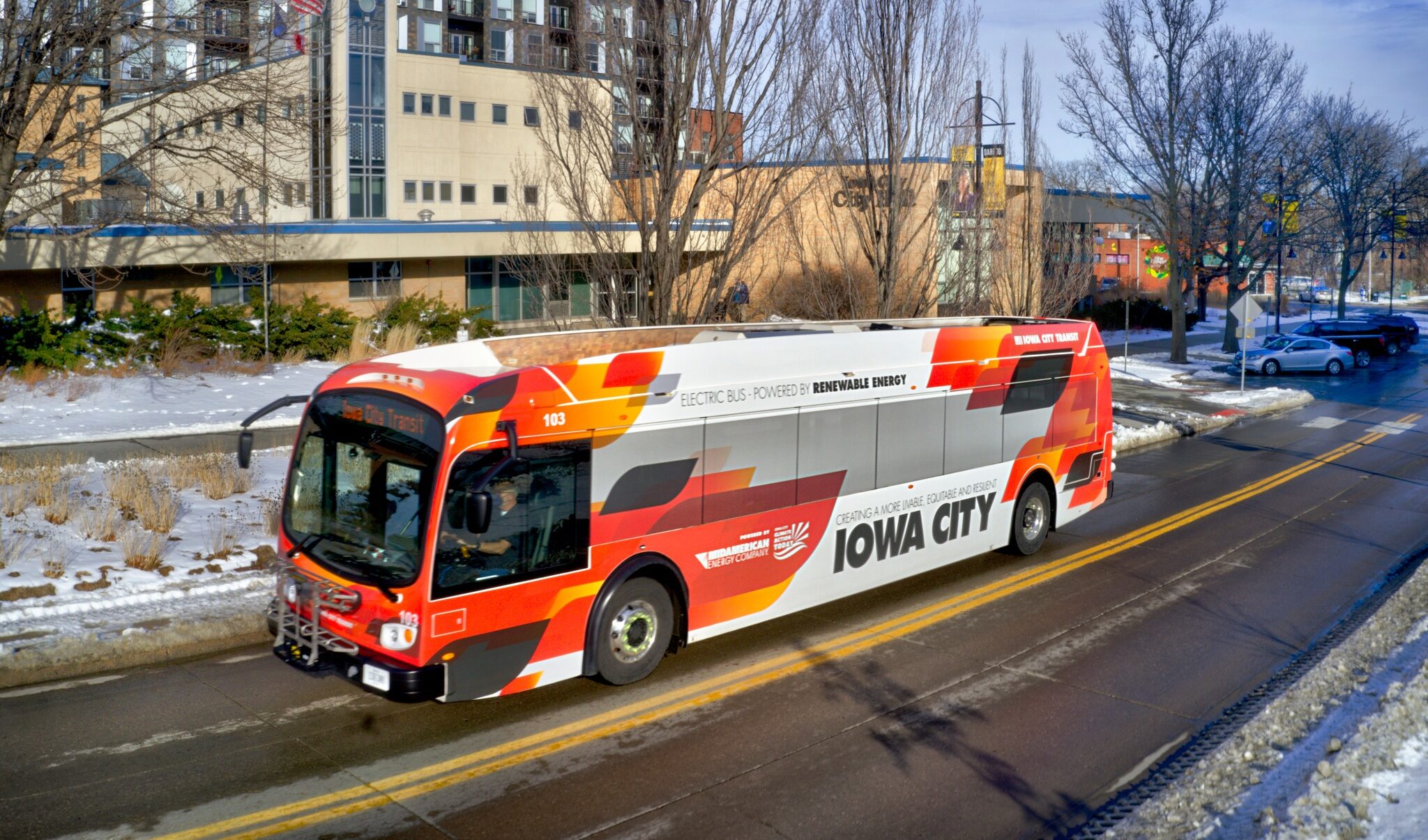
Iowa City Transit launched its electric bus fleet at the beginning of 2022, starting with four buses. With a price tag of around $4.6 million, the city bought the Proterra ZX5 buses with help from $3.3 million in grants from the Federal Transit Administration and the Iowa Department of Transportation, while paying $1.2 million out of pocket. The cost savings for the city are an essential component, as Iowa City Climate Action Coordinator Sarah Gardner told The Gazette, “We’ve now got about seven years of data showing that we’ve had real cost savings with the reduced maintenance. There’s just a lot of benefits to the city to electrifying its fleet.” Other well-known organizations had already turned to Proterra for their buses, including the National Park Service, the New York City Mass Transit Authority, and the City of Juneau, Alaska. Bright orange signs at the front and in the side windows read, “I’m electric.” Transportation Director Darian Nagle-Gamm expressed to the Iowa City Press-Citizen, “They stand out, and they’re definitely turning heads.”
Nagle-Gamm reflected, “This addition provides the improvements needed to make transit more attractive for the community, while also helping to reduce greenhouse gas emissions. We’re really excited to move Iowa City Transit forward to the future.” Capable of traveling more than 300 miles on a single charge, with the most battery storage on any 40-foot bus available at the time, the city adopted the buses not only for their reliability but also for the resulting reduction in noise pollution and emissions. Public transportation, including 27 diesel-powered buses, accounted for 22% of carbon emissions at the time. When plugging the buses in at night, they are largely charged with clean energy generated by wind power from the local utility, MidAmerican Energy, which is known for using 88% renewables to power local cities. Notably, by 2023, the four buses were responsible for a 10% drop in emissions from 2015 levels.
Gardner told The Daily Iowan that the hope is for the electric buses to encourage residents not only to use public transportation, but to consider going electric themselves. “People have historically been a little hesitant to adopt an electric vehicle for themselves. I think the buses are really powerful in changing people’s minds because, suddenly, when you see a giant bus going down the street that’s entirely powered by electricity, it gets a lot easier to imagine that your own vehicle could do all the things you need to do, too, powered by electricity.”
In 2023, the Federal Transit Administration awarded the city $23.2 million, of which $4.2 million was earmarked to add four more electric buses to its fleet, with the remaining $19 million earmarked to cover three-quarters of the cost of a new transit facility. The old facility was not only at the end of its life, having been built in 1984, but could accommodate only up to eight electric buses, limiting future growth. “In order to be able to expand our electric fleet and transition to a full lower (or) no emission vehicle fleet, most likely electric in our case, we need to build a facility that’s purpose-built for that transition,” Nagle-Gamm said. Last year, the city approved the purchase of the new buses, and it is aiming to break ground on the new facility next year.
In 2024, Iowa City laid the groundwork for future expansion by completing a Fleet Transition Study, which highlighted available electric equivalents for vehicles in its fleet, pinpointed infrastructure needs to support such a transition, and laid out a timeline for full fleet electrification. Nagle-Gamm acknowledged to The Gazette that while it will not happen all at once, as buses typically have a 15 to 20-year lifetime, “We are still moving in the direction of electric vehicles. It is clearly the future when it comes to transit.” They may even be able to replace the vehicles earlier, once they have enough mileage and natural wear and tear that they become available for grant funding around the 12 to 14-year mark.
Although Proterra went out of business and was bought by Phoenix EV, Iowa City plans to buy the new buses from Gilling, which already supplies its diesel buses. “From everyone that we’ve reached out to that have Gilling electric buses, the reliability is there. We’re excited to pivot manufacturers to a manufacturer that’s got more decades of experience, and then they also are our current partner for our traditional diesel fleet,” Nagle-Gamm explained.
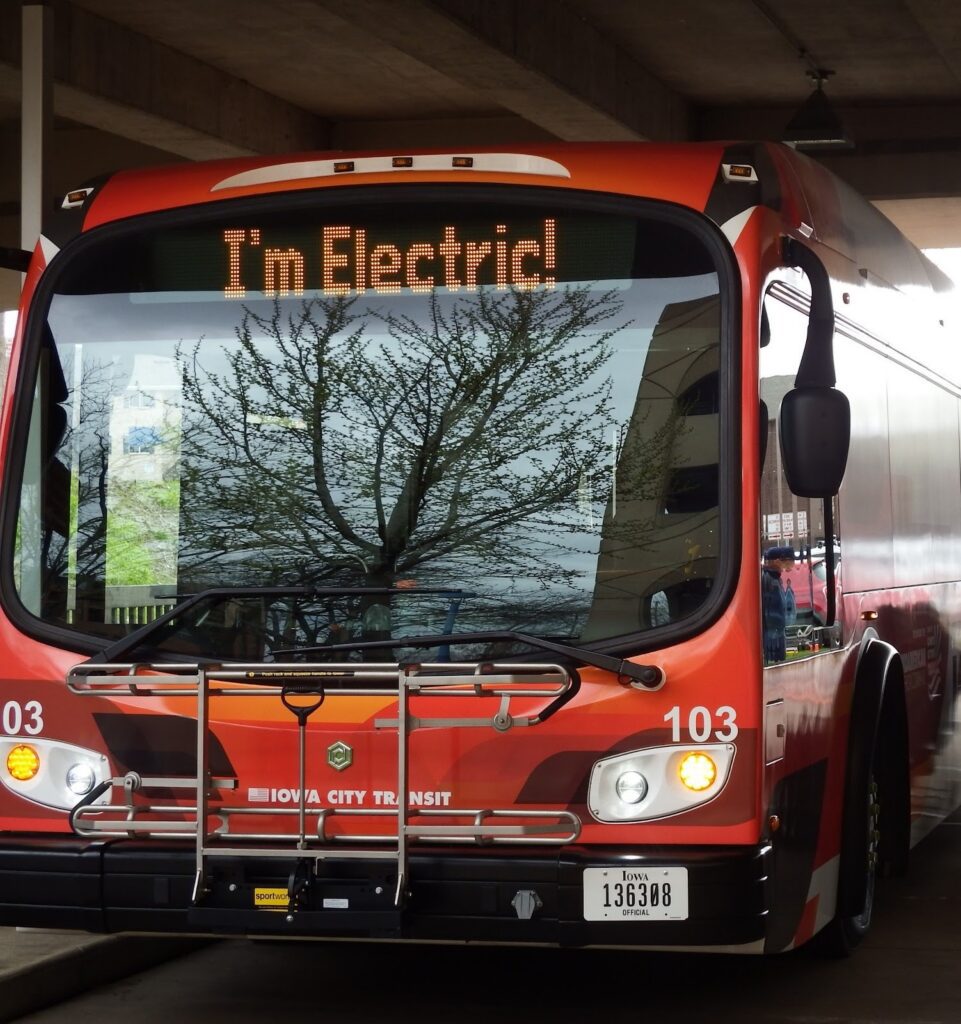
Photo Courtesy The City of Iowa City Government
Electric buses are not the only municipal vehicles receiving the electric treatment. In October, the Iowa City Police debuted an electric Chevy Blazer, marking the first fully electric law-enforcement patrol vehicle in the state, after showing them off at the University of Iowa Homecoming Parade. The new vehicle purchase follows the successful deployment of two RECON electric bikes for patrol. The police department uses the new EV for two out of three daily patrol shifts. Its full 290-mile range is more than twice the 100-mile maximum typically driven by an officer during a full-duty shift.
While it cost $55,000, $6,000 more than the department previously spent on hybrid vehicles, it was eligible for the now-defunct federal $7,500 tax credit. As Iowa City Police Chief Dustin Liston noted, “Again, I do think it’s going to be a cost savings in the long run. So we’re trying to be good stewards of the taxpayer dollars, and I think the officers are going to like it.” The city estimates it will cost only two to three cents per mile, compared to 15 cents for hybrid vehicles and 30 cents for diesel vehicles. Liston added that it also helps the city meet its environmental goals, “We have a climate action department, so this is one step in that process.” Once the car has been out on the road for a full year, Liston commented that the department will consider adding additional electric vehicles to its patrol fleet.
Including the buses, e-bikes, and the new police vehicle, Iowa City now has 16 fully electric vehicles for its operations, featuring two Chevy Bolts, five Nissan LEAFs, and two Ford Lightnings. Public charging infrastructure is obviously a piece of the puzzle. The city has one or more charging stations in every parking ramp that it owns, courtesy of its IC EVs Everywhere program. As of 2023, the city estimated its public charging stations had avoided 172,619 pounds of emissions, equivalent to planting 2,000 trees and letting them grow for 10 years. Through its Electric Vehicle Charging Rebate Program, it also offers a 50/50 match for the costs of equipment, materials, and labor needed to install Level one or Level two charging at multifamily residences. Indeed, Iowa City is leading a trend seen across the state. As Gardner told The Gazette, the EV car Show at the city’s annual Climate Fest has been the most attended segment for five years straight, and “From our outreach and engagement events, we have had more people who are interested in an EV being their next vehicle.”
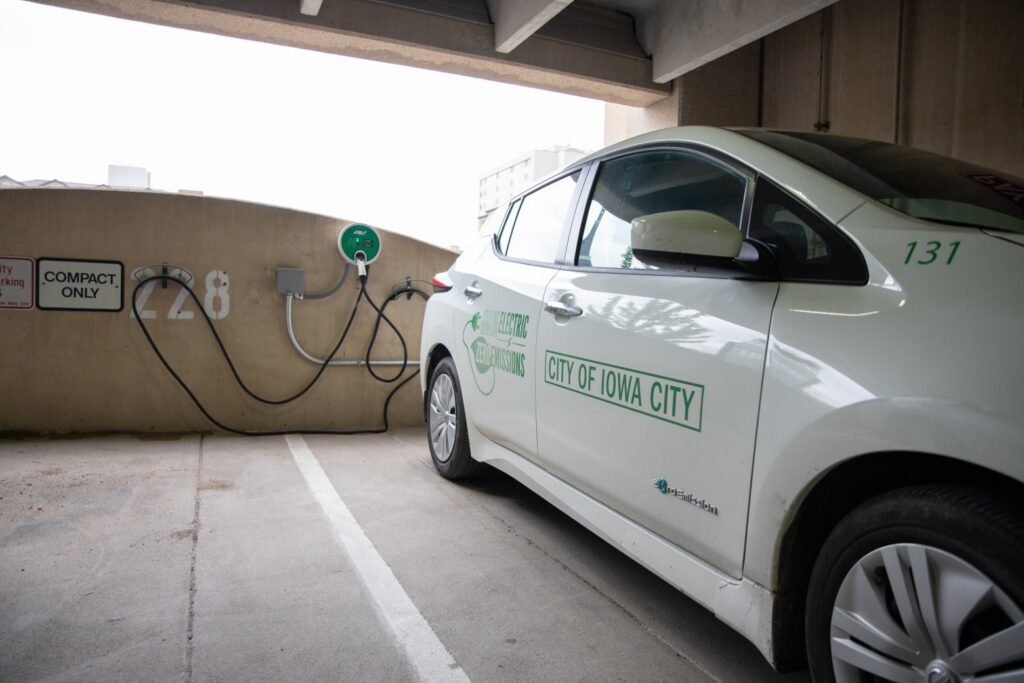
Photo Courtesy The City of Iowa City Government