
Graphite is a form of crystalline carbon that the U.S. Geological Survey has called “the most electrically and thermally conductive of the nonmetals,” thereby making it especially attractive for a variety of technologies. For example, it is used in next-gen fuel cells, steel, semiconductor substrates, and, perhaps most famously, high-purity Coated Spherical Graphite (CSG), the most popular anode material for lithium-ion batteries in electric vehicles and energy storage systems.
Demand for graphite, therefore, is only increasing. More than 225 lithium-ion megafactories are now operating worldwide, up from only 17 in 2019. In 2020, the World Bank Group estimated that graphite demand would grow 494% by 2050, from 2018 levels.
However, the U.S. does not produce any graphite, leaving it entirely dependent on foreign sources. In 2020 alone, the country imported 41,000 tonnes of the material. Notably, China currently accounts for more than 60% of the global supply. The national security risks are clear, according to Simon Moores, managing director for Benchmark Mineral Intelligence, who said in 2019 that “we are in the midst of a global battery arms race.” China’s export restrictions on graphite, imposed in December 2024, illuminate the threat. Graphite One explained on its website that Chinese production also poses ethical risks: “Production and processing includes material processed from North Korea and utilizes slave/forced labor with inadequate environmental controls in Xinjiang Province.”
However, the U.S. is ready to change the status quo. In 2018, the U.S. Department of the Interior added graphite to a list of 35 mineral commodities because it was considered “essential to the economic and national security of the United States,” “has a supply chain vulnerable to disruption,” and “serves an essential function in the manufacturing of a product, the absence of which would have significant consequences for the economy or national security.” In fact, it is one of only four critical minerals on the list deemed essential to all six industrial sectors screened by the U.S. Geological Survey for vulnerabilities. In 2021, graphite was also added to the U.S. National Defense Stockpile (NDS) Acquisitions List, a stockpile of raw materials used to reduce or prevent dependency on other countries. The mineral’s importance has been further elevated across administrations, visible in a 2021 executive order aimed at strengthening America’s supply chain resilience and a 2025 executive order aimed at increasing America’s mineral production.
As Senator Lisa Murkowski stated in an address recorded for Benchmark Week 2024, “If we want the United States to lead on advanced technologies and the industries of the future, if we truly want to ensure our national security and international competitiveness, we have to start at the start, with minerals, and build complete supply chains.”
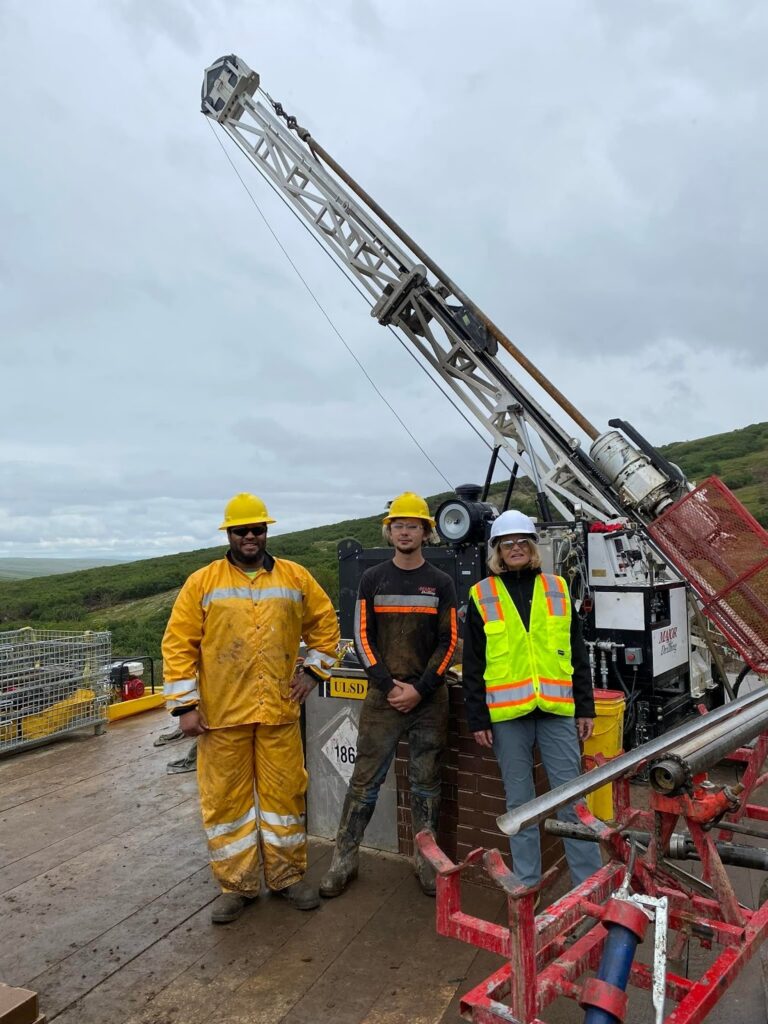
Photo Courtesy Lisa Murkowski
Graphite One is leading this charge. The company is focused on creating a vertically-integrated domestic graphite supply chain, starting with mining at Graphite Creek, a deposit in the Seward Peninsula in Alaska, which a 2023 report said is the “largest known flake graphite resource in the U.S.A. and is among the largest in the world.” Although the U.S. Mineral Deposit Database identified nine other sites in the U.S. with graphite resources, Graphite Creek was the only one estimated to have more than 8 million metric tonnes of the material. Last February, a feasibility study tripled previous quantity estimates.
At full production, the company plans to mine 4 million tonnes of graphite annually at the deposit north of Nome, Alaska. At an adjacent mineral processing plant, the company expects to churn out about 60,000 tonnes of graphite concentrate annually. That material will be sent through the Port of Nome to an advanced graphite manufacturing facility in Warren, Ohio, resulting in about 41,850 tonnes of battery-grade, coated spherical graphite for electric vehicles and energy storage and about 13,500 tonnes of other advanced graphite material for industrial and technology supply chains. An additional facility is also being planned at the Ohio site to reclaim battery materials through a circular strategy.
In July 2023, the U.S. Department of Defense (DOD) announced that its Office of the Assistant Secretary of Defense for Industrial Base Policy had entered into a $37.5 million agreement with Graphite One under Title III of the Defense Production Act (DPA). The Technology Investment Agreement grant helped the company fast-track its feasibility study by a year, thereby advancing the planned development of its domestic supply chain. Anthony Huston, President of Graphite One, reacted, “This Department of Defense grant underscores our confidence in our strategy to build a 100% U.S.-based advanced graphite supply chain — from mining to refining to recycling. The U.S simply cannot maintain a 21st-century tech-driven economy without Critical Minerals like graphite.”
Additionally, in November, Activation Laboratories confirmed the presence of rare-earth elements at the site, which can be used in wind turbines, electric vehicles, and advanced defense systems such as radar. Huston reflected, “Given the robust economics of our planned complete graphite materials supply chain, the presence of Rare Earths at Graphite Creek suggests that recovery as a by-product to our graphite production will maximize the value.” Recovering these elements could go hand in hand with graphite mining at the site, and the company plans to work with one of the National Laboratories to develop a plan to extract them.
In 2019, Alaska Governor Mike Dunleavy nominated the Graphite Creek Project as a High-Priority Infrastructure Project (HPIP) to expedite its approval, and it was designated as such in 2021. Last summer, it became the first Alaskan mining project to be posted on the FAST-41 Federal Dashboard, which streamlines the permitting process and ensures transparency with state governments and public stakeholders.
“As China continues to restrict the United States’ supply of critical minerals, it is crucial for Graphite One to advance without delay,” noted Sen. Murkowski, adding, “We now have a concrete timeline of 13.5 months for federal agencies to bring it through the permitting process.” “For our nation, the message is clear,” added Gov. Dunleavy, “There is no path forward to American Energy Dominance without the minerals, metals, and natural gas resources Alaska has in abundance.”
Photo Courtesy Graphite One
Environmental stewardship is essential to Graphite One’s future. The company has conducted environmental baseline studies since 2014, aware that the project is located near the Iñupiaq communities of Teller, Mary’s Igloo, and Brevig Mission. “Only when the communities surrounding our efforts feel engaged, heard, respected, informed and understood, can we develop win-win solutions for everyone involved,” Huston commented. Indeed, even the Bering Straits Native Corporation, with over 8,000 Native Alaskan shareholders, is an investor in the project.
The technologies that graphite will support are also vital to a cleaner world. In 2024, Graphite One entered a non-binding supply agreement with Lucid Group, which manufactures electric vehicles at its vertically integrated facility in Arizona, marking the first synthetic graphite agreement between an American graphite developer and an American EV company. It was followed by a second such agreement the following year, expanding the arrangement from solely synthetic graphite anode active material (AAM) to include natural graphite AAM. Marc Winterhoff, Interim CEO at Lucid, said, “A supply chain of critical materials within the United States drives our nation’s economy, increases our independence against outside factors or market dynamics, and supports our efforts to reduce the carbon footprint of our vehicles.”

Photo Courtesy Lucid Motors
The local area will also clearly benefit from economic development. During every field season since 2014, Graphite One has hired local people from Teller and Brevig Mission, “providing much-needed year-round high-paying jobs to offset the high cost of living in rural Alaska.” It is also committed to workforce development and donates funds to the Northwestern Alaska Career and Technical Center (NACTEC)’s training center in Nome. Plus, the company regularly works with Alaskan businesses for their support, expertise, and local knowledge. Dan Graham, CEO of Bering Straits Native Corporation, noted, “This project will strengthen national security and create not only a new domestic supply of graphite, but the opportunity for new jobs and economic growth across the US. BSNC is proud to be a part of it.”