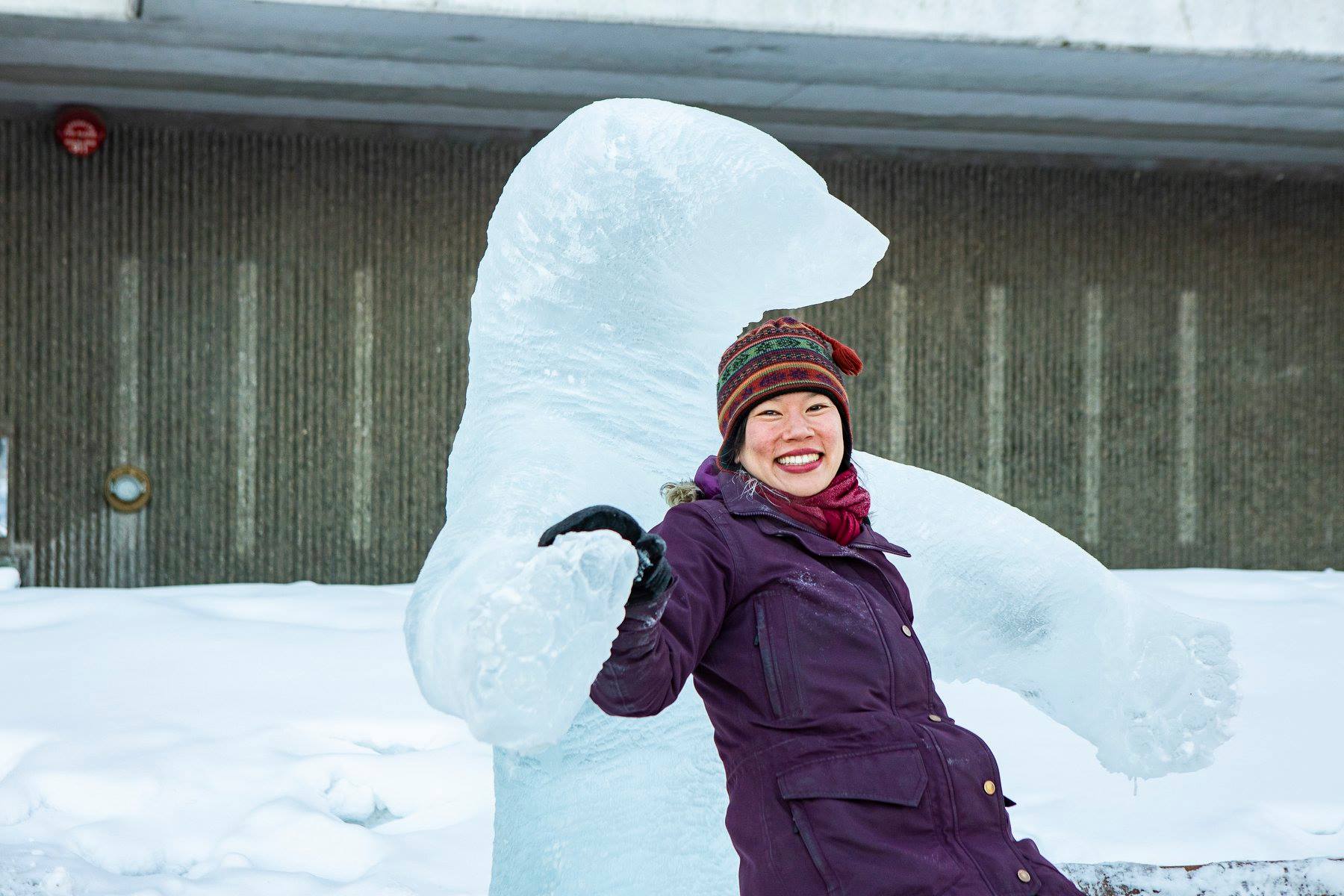
Dr. Daisy Huang is a tenured associate professor at the University of Alaska Fairbanks, where she also got her PhD in mechanical engineering and applied physics. Previously, the San Francisco native studied mechanical engineering at the University of California, Berkeley, where she earned her bachelor’s degree, and at Santa Clara University, where she earned her master’s. After working at a variety of semiconductor and power control companies in California, designing mechanical components, she decided to move to Alaska amid a whirlwind of global and personal events, including the dot-com bubble burst and bad relationships.
After driving to Alaska in her old Subaru with her two rabbits in tow, Dr. Huang bought a dry cabin, but she immediately discovered the challenges of living in such a northern state. “I very quickly learned that shoveling the driveway is a lot of work, and staying warm is a lot of work,” she said while giving a presentation ten years ago. In Silicon Valley, she did not have to think about where her power came from, and any outages were resolved in under an hour. In Alaska, she faced high energy bills amid skyrocketing oil prices and the need to keep herself and her two newly adopted retired sled dogs warm. Others in the state suffered from hunger and even died from extreme temperatures.

Photo Courtesy Dr. Daisy Huang, ACEP/UAF
Dr. Huang switched to burning wood to save money. When she began working as a research engineer at the university’s Alaska Center for Energy and Power (ACEP), she found that “wood heat, as it benefitted me, also benefitted communities.” One of her first jobs there was to conduct a community survey of Alaska Energy Authority grantees that used funding to deploy biomass systems. She reflected that discovering that they had built local economies around the energy source “made me think that maybe not all solutions are what you think they’ll be… It turns out the solutions are not always the flashy, high-tech ones.” Beyond saving money, these communities used the savings to relaunch preschool programs that had previously shuttered due to lack of funding, used excess biomass energy to heat greenhouses and grow fresh vegetables, and learned to insulate future buildings more effectively.
These learnings fueled Dr. Huang’s passion for promoting energy efficiency and clean energy sources. At ACEP, she continues to research methods for reducing energy costs for isolated Alaskan power grids. One project found that adding an ElectraTherm organic Rankine cycle (ORC) product called the Green Machine to village generators in Alaska could help them reclaim heat that would otherwise be lost by operating at less than full capacity during off-peak hours. A follow-up 2015 technical paper summarized guidelines for effectively deploying such a system. In 2019, Dr. Huang worked on a journal article that introduced the MicroFEWs approach to help Alaskan communities evaluate renewable energy decisions that promote food, energy, and water (FEW) security, asserting that energy is inherently connected to adequate food and water supplies in the Arctic and Subarctic. For example, the study claims that the addition of a third hydroelectric turbine at the Power Creek generation facility in the fishing community of Cordova would “cover most of the energy demand from the seafood processing plants.”

Photo Courtesy Alaska Center for Energy and Power
Much of Dr. Huang’s work has focused on how the adoption of renewables in Alaskan communities can save money and benefit local communities. “Rural communities in Alaska face the highest energy costs in the nation,” Dr. Huang and her fellow authors wrote in a 2022 journal article, noting that diesel and heating fuel have to be delivered via plane or boat. In 2016, she worked on a report that specified the best renewable energy sources for Peter Ballantyne Cree Nation communities, which lack natural gas and therefore face even higher business and household costs. The authors recommended biomass heating, solar PV, and water-source heat pumps. “Through investing in and incorporating more locally sourced renewable energy,” the report explains, “PBCN is ultimately aiming to increase energy self-reliance, provide new opportunities for local jobs and economic development, and combat climate change.”
Over the past several years, some of Dr. Huang’s projects have received government funding. In 2023, the National Science Foundation awarded ACEP $6 million for a five-year project, called “STORM: Data-Driven Approaches for Secure Electric Grids in Communities Disproportionately Impacted by Climate Change,” to advance the country’s smart grid. As principal investigator, Dr. Huang is working with communities such as Cordova, Galena, and Kotzebue to design microgrid and clean energy projects, which will involve “sustained community engagement toward productive research and workforce development,” she said.
It is not the first time that Dr. Huang has emphasized the importance of workforce development, as she previously told the Daily Yonder that she is interested in building STEM programs, “The idea is looking from a community perspective – what their energy needs are, and how we can translate that – in parallel – developing educational programs around kids learning about energy systems, [like] engineering or STEM in general, math, physics.” In past years, she has attended STEM Night at Pearl Creek Elementary in Fairbanks and given lectures and facility tours for ACEP interns, demonstrating her commitment to the area’s youth and her community’s energy future. Her dedication to ever-expanding knowledge has been evident since her California days, when she spent time after learning astronomy at Foothill College for fun, taught by a physicist at the Stanford Solar Center. “Kickass!” she exclaimed on LinkedIn.

Photo Courtesy Alaska Center for Energy and Power