
After growing up on Salt Lake City’s west side, Isaac Atencio determined it was the place for his business. After opening their barbershop, Salt Lake Barber Co., downtown in 2016, Atencio and business partner Eric Stone opened a west-side location in 2023 in a building that had been vacant for the past decade. Its owner, the nonprofit NeighborWorks Salt Lake, had spent years turning away payday lenders and pawn shops that offered it more money, holding out for a better fit. The two barbers turned out to be perfect.
Next door, Atencio and Stone added to their business portfolio and opened Culture Coffee. An instant success, on opening day in March of 2024, the shop saw a line wrapped around the block. General manager Mike Tuiasoa told KSL that the west side was a coffee “desert” at the time. Atencio put his reasoning plainly: “We got tired of seeing the same old things open up. If nobody was going to do it, we were going to be the people.”
“I feel like it’s really important that we are BIPOC-owned and operated business,” Tuiasoa told Fox 13 News Utah, “because it does reflect the diversity of the west side. We are Latino- and Black-owned, and managed by Pacific Islander, and all three of us have put in our cultures and our backgrounds into making this place special.” Stone described the cafe to Yale Climate Connections as a safe space for people from all walks of life. Adding to the charm and personal touches, the owners handcrafted the tables, and the bar is made of recycled bowling lane wood. On top of that, City Cast Salt Lake reported that the business partners with local organizations and supports programs that support food justice and address food insecurity.
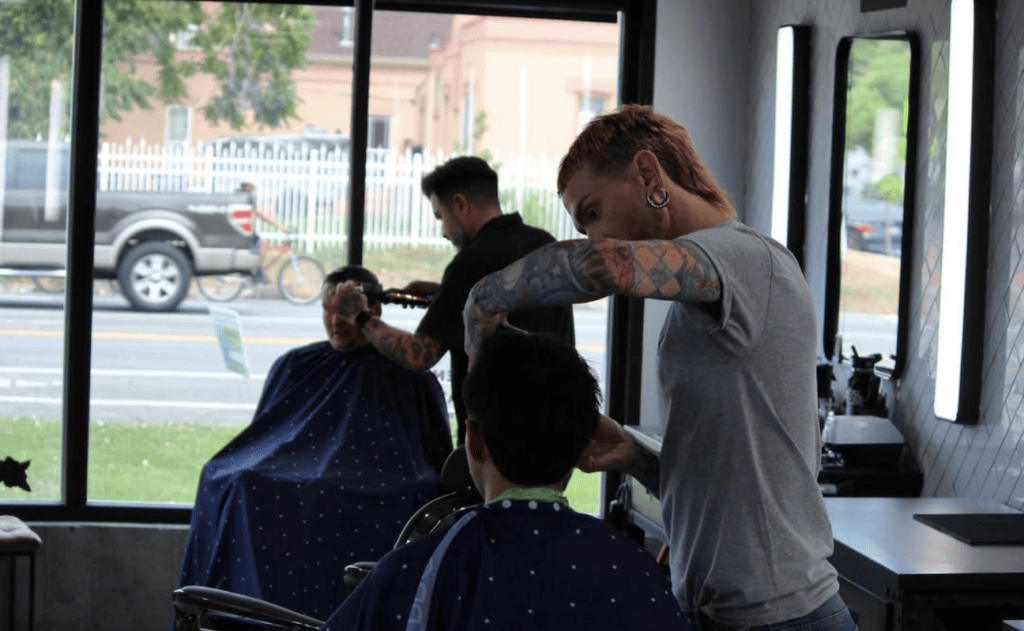
Photo Courtesy Salt Lake Barber Co.
On the logistics front, running two storefronts means paying for power every month. Outages carry their own cost. When a windstorm with gusts reaching 112 miles per hour struck northern Utah in September 2020, 203,930 Rocky Mountain Power customers were without service at the peak, and some outages lasted days.
To reduce that risk, Atencio and Stone decided to generate some of their own power. Through the Salt Lake City Solar Powered Communities Project, a partnership between the city’s Sustainability Department and the nonprofit Utah Clean Energy, the owners added 28.8 kilowatts of solar panels and 27 kilowatt-hours of battery storage to their building. Federal tax credits and a grant from the Urban Sustainability Directors Network covered the costs.
The payoff has shown up in the shops’ finances. Atencio told Yale Climate Connections that the system has been “a real great boon to us” from a bottom-line perspective and as a community resiliency hub. During a neighborhood outage, Atencio said the shops could hand out ice, keep the air conditioning running, or offer “a place for people to charge their phones,” thanks to their batteries. In addition, Atencio explained to Utah Clean Energy that it “really gives us the opportunity to live our motto, to be as sustainably-oriented as possible.”
Video Courtesy Utah Clean Energy
Atencio has described the two shops as proof of a simple idea, telling the Deseret News, “In our case, we’re trying to amplify that message by showing that all you need is a catalyst for a few businesses to open in an area. Once you do and have that local representation, it makes the difference.” He and Stone want solar to spread the same way. They told Utah Clean Energy they “want to help other businesses on the west side take advantage of this opportunity to go solar.”