
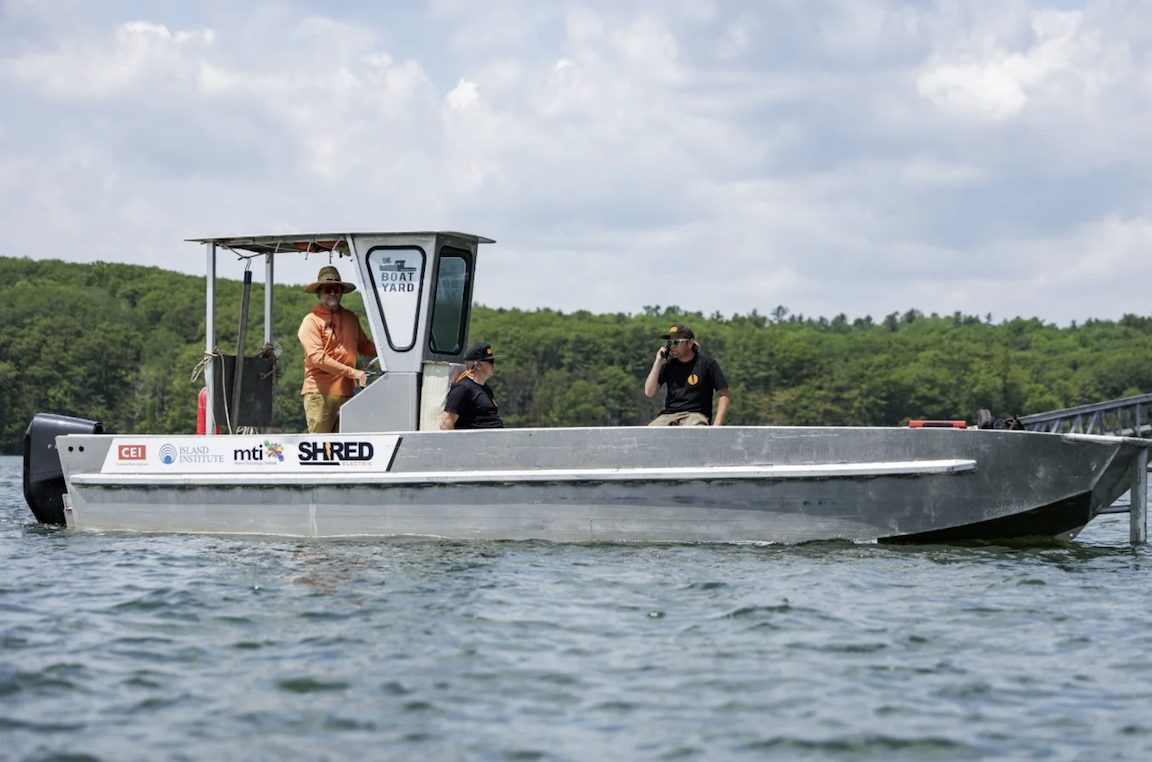
New Gloucester, Maine-based Shred Electric is hard at work electrifying marine operations or ‘sea farms.’ After growing up in Maine, founder Nick Planson attended Columbia University, earning his bachelor’s degree in engineering and management systems. He went on to work at a responsive energy solutions startup called CPower before entering the renewables space with Con Edison Development, helping advance clean energy projects around the U.S. In 2017, Planson decided to return to New Gloucester and join the family business, Planson International Corporation, which sells IT solutions to international humanitarian organizations such as the United Nations. Come 2021, though, he once again returned to his clean energy roots, teaming up with his brother-in-law, Chad Strater, who had long been working in marine construction.
The Sea Meadow Marine Foundation, a nonprofit dedicated to Maine’s working waterfront of which Strater is board president, purchased twelve acres on the Cousins River in Yarmouth, after Strater saw that it was for sale while leasing some space there. Assistance came from a U.S. Department of Agriculture (USDA) loan via Coastal Enterprises Inc. (CEI) and a grant from the Elmina B. Sewall Foundation, and Planson and Strater became co-owners of The Boat Yard, LLC. CEI, the USDA’s National Institute of Food and Agriculture, the Maine Technology Institute, and the Island Institute also provided financing for the business partners to acquire a 26-foot electric workboat to build the likes of docks, piers, and seawalls. They charge the boat with the same Level 2 charger that they use to charge a Ford Lightning electric vehicle.
The electric model was an easy solution to the problem of wasted fuel when idling at work sites, and just as it made their business more efficient at a relatively low cost, they knew it could help others. As Strater told the Maine Morning Star, “You need the right tools to do the job. You can’t be out there farming potatoes in a tractor from 1982 and expect to be efficient. So developing tools that make sense for efficiency, for Maine sea farmers, is what we’re doing.” Their workboat served as a prototype as the duo began testing electric motors and battery systems on other small, U.S.-built, aluminum workboats.
Photo Courtesy The Boat Yard
Since then, The Boat Yard has collaborated with boat owners and operators to install electric outboard motor systems. Many of these motors are sourced from Shred Electric, which shares space with The Boat Yard. Through the business, Planson offers waterproof marine batteries with 11-year warranties and internal heating that enables charging in sub-zero temperatures. Shred Electric also develops power kits comprising batteries powered by on-board renewables and housed in weatherproof enclosures.
These systems replace gas generators and pumps that often need repair or replacement, produce noise that disturbs neighbors and poses safety issues, and can result in leaks and spills that pollute waterways. As Planson described the work to Maine Public in real time, “A seal keeps surfacing, because there’s definitely some fish jumping this morning. And even if I accelerate a bit, you’re not hearing much noise. Such a great change over what would be even for a small gas motor, it would be noisy and smelly and there would be oil dripping into the water.” The company added to Columbia Business School’s Tamer Institute for Social Enterprise and Climate Change, in whose venture portfolio it sits, “We reduce human and environmental impacts of sea farms, small and large, improve accessibility, and help farmers focus on farming.”
Often, clean energy powers aquaculture operations on board. For example, with the help of additional grants, Shred Electric developed a solar oyster barge for the Nauti Sisters Sea Farm. It includes a 2.4-kilowatt solar array with six panels that feed electricity to batteries on deck and ultimately power winches used to pull floating bags or cages out of the water and tumblers used to sort oysters for market quality. While an electric winch reduces the need for manual labor, an electric tumbler offers a variety of benefits. “Not only does this make the work more pleasant, but it also helps prevent hearing damage from long days tumbling out on the water,” the company wrote on its website. Even beyond its electric advantages, the vessel is putting the ocean first by using a black finsulate coating rather than a traditional bottom paint, which not only lasts longer but also does not release toxic substances into the water. This barge is just the beginning for Shred, enabling the company to gauge what is working and what needs improvement for broader adoption.
Shred has also developed the ShredCube™, a cold-storage solution with built-in batteries that preserves the vessel’s extended range while advancing the decarbonization of transportation for the aquaculture and agriculture industries. It promises the solution “keeps harvests fresh from farm to table, ensuring top-quality taste and food safety no matter where you are.” Like the rest of the boat, it is cloud-connected via the ShredConnect™ technology, which enables remote monitoring, energy-need prediction and optimization, and alerts for any problems.
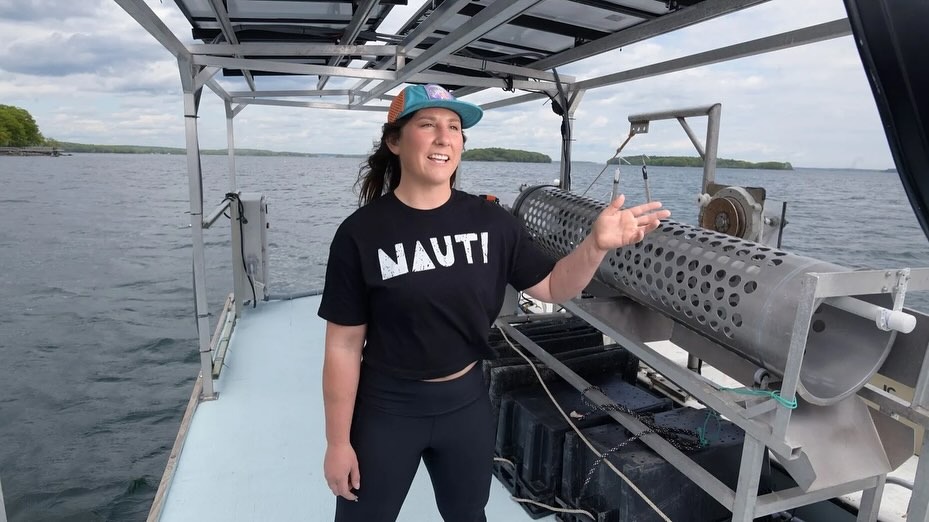
Photo Courtesy Nauti Sisters Sea Farm
Shred Electric has also branched out into snowbikes, in partnership with Ruffian Snowbikes. Planson told CEI about his inspiration: “I was fortunate enough to do a day of backcountry snowmobiling in British Columbia. And of course, it was an absolute blast, but it was so loud and so many clouds of smoke coming out of those machines that I had that cognitive dissonance of really loving being out there in the fresh powder, in the mountains knowing that that very pollution that is being caused by those machines is reducing how much snow there will be in the future.” The company wants the same batteries to run its boat motors, these snowbikes, and even racing e-karts, “so that customers can own one battery that they move from our snowmobile to our boat motor to our UTV.” The eventual goal, Shred Electric describes, is that each year, “we’ll come out with 1 new vehicle or other motor that the same battery will power.”
Most recently, after their own electric workboat spent more than 150 hours moving freight and towing other boats over the 2025 season, Planson and Strater decided that their testing on electric workboats was ready for commercial deployment. “We were out in every kind of weather. The boat performed flawlessly. With nearly 4,000 pounds of payload capacity and 18 feet of open deck space, it’s become a reliable workhorse in our daily operations,” Strater recalled to Bangor Daily News. Shred Electric now offers fully electric skiffs, built to order in less than four weeks and available in three styles.
These vehicles are all clearly environmentally friendly, and the duo have also demonstrated their dedication to Maine’s waterfront economy time and time again. When the Sea Meadow Marine Foundation bought the boat yard in 2021, preserving around 30 jobs in the process, Strater reflected, “The working waterfront is a critical aspect of Maine’s economy and environmental health. If the working waterfront goes away, it’s not coming back.” Current tenants at the boat yard include small kelp, oyster, quahog and scallop farms, and the electric retrofits offer promising cost-savings and operations advancements for aquaculture businesses.
However, the fun factor should not be overlooked, as Planson explained to CEI, “We’re selling them because they rip, they shred, and they require almost no maintenance. You don’t have to worry about gas or oil with the snow bike or with the boat, you go out and use it. Come home, plug it in, and it’s ready to go the next time. So it is about having fun out there or doing our work out there and not feeling guilty about the machines that we’re using to help us do that.”
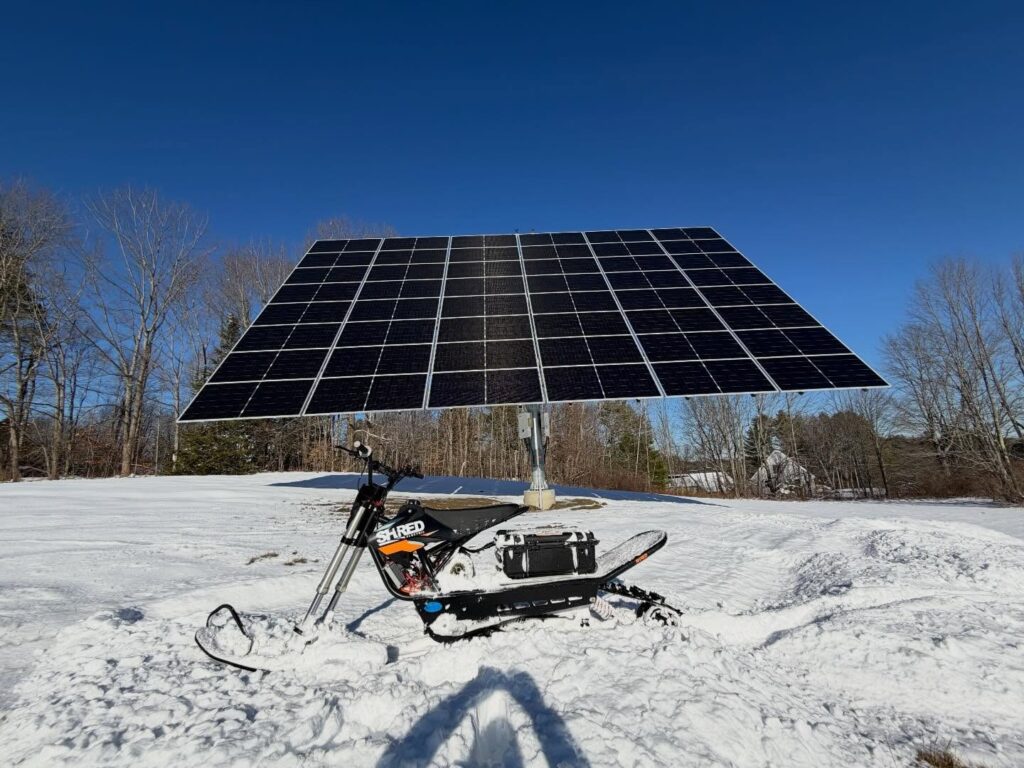
Photo Courtesy Shred Electric
It all aligns with the company’s mission statement. “Be Radically Empathetic,” it says, “towards ourselves, others, and the planet. Feel good about motors – use one battery, year-round.”